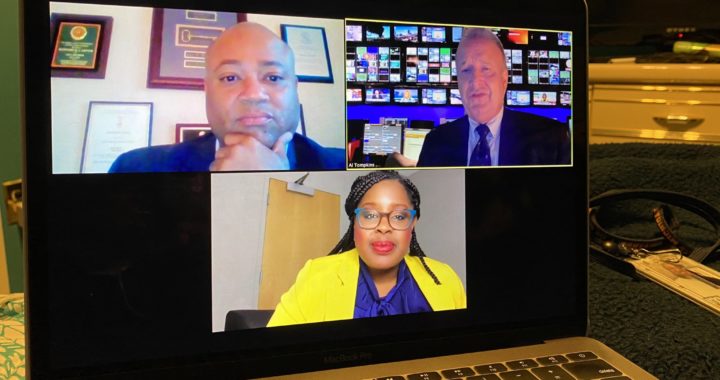
Join us at the NABJ Convention & Career Fair! Hosted in Chicago, IL this year, the convention brings incredible Black journalists from all over to network, inspire and educate us all on the ever-changing world of journalism, media, business and everything in between. From check-ins from the NABJ President, Ken Lemon, to convention preparation meetings, the excitement is pumping as we’ve shared many tips about what to do before, during and after the convention, and we look forward to seeing you there and having a great time!
Stay up to date with the convention & career fair’s itinerary here. Download the EventPilot app to register for and organize the events you’d like to attend. Remember to stay safe and have fun!
Congrats to AABJ’s 2024 NABJ Convention Grant Recipients!
In support of continued professional development opportunities for students, AABJ has provided financial assistance for these students to attend the convention. The recipients are:
Janiya Ansah – Clark Atlanta University
Nilea Cosley – Clark Atlanta University
India Rice – Clark Atlanta University
Aveon Sims – Clark Atlanta University
Marquette “Hollywood” Walker – Georgia State University
Fun Things To Do In Chicago That’ll Have You Saying “Yes, Chef!”
By: Aaleah McConnell
Are you heading to Chicago for the NABJ convention? Here are a few great travel spots in the Windy City inspired by the hit TV-series, “The Bear,” and some other attractions that you don’t want to miss! The National Association of Black Journalists’ Convention and Career Fair is less than a couple of weeks away, and while many of us have been anxiously preparing to rub shoulders with industry leaders and influencers in media, I’ve been watching FX’s “The Bear” a lot.
In case you haven’t heard of this hit dark-comedy drama series, it follows the story of a young chef and his small kitchen staff as they transform a modest, family-owned sandwich shop into a Michelin star-worthy destination. So, if you’re wondering what this particular story about chefs has to do with the upcoming conference, other than both taking place in the Windy City, then let’s take a deeper look!
I think it’s safe to say this show draws viewers each week for its awe-inspiring look into the culinary world, which appeals to the pathos of chefs and foodies equally. But, what attracts many people to the program is its portrayal of the everyday person fighting tirelessly for the actualization of their ambitious dreams. Which many people, especially young professionals, can identify with.
The job hunt can be a mammoth undertaking for even the most seasoned professional. One thing I learned from my hours-long binge of “The Bear” is the importance of taking a deep breath and appreciating the beauty of the world around you. Even in the process of finding your next big break.
So here’s my guide to local landmarks and restaurants featured in the show (and some that are not) that will help you make every second count at this year’s gathering. And don’t worry, this guide isn’t riddled with fine dining spots that’ll leave a dent in your pockets and a hunger in your belly, but if that’s your thing, check these out!
If you’re also a fan of “The Bear,” then you know Chicago is bursting with great food spots. Some are Chi-town staples and have even made cameos on the show like Pequod’s Pizza, well-known for its deep-dish style pie laced with a caramelized crust.
Mr. Beef’s Deli and Margie’s Candies are amongst the historic foodie destinations featured in the show but there are new institutions making waves in the city, like Virtue Restaurant and Bar, a Black-owned eatery serving up fresh culinary ideas.
One of the city’s most attractive features is Lake Michigan, which offers 26 miles of shoreline to explore. You can take in these stunning views via the Chicago Lakefront Trail, which is an 18-mile-long pedestrian walkway connecting nearby beaches, parks and waterfront restaurants along a convenient path where you can walk, bike or rollerskate.
The Bronzeville Arts District is a mecca of Black culture and artists and is home to Gallery Guichard, which boasts a large collection of art representing the African Diaspora. Art lovers visit the Pilsen Neighborhood murals each year to view the work of many Latinx artists. Plus, this stop will earn you a check off of your “The Bear” sight-seeing list.
There’s so much to explore and learn about the Windy City, and this is such an exciting opportunity to experience the culture while networking with other journalists and professionals. See you in Chicago!
Enjoy this fun word search during your travels! You can also download it here.
This issue of The Byline was edited by Mya Grant, Vice President of Print for the Atlanta Association of Black Journalists (AABJ), and Mandisa Johnson, Chair of The Byline.
Congrats Class of 2024! We wish all of our recent graduates the best in their future endeavors as they embark on new adventures. In this issue of The Byline, we featured three incredible student journalists who are making great strides early on in their careers. Education doesn’t necessarily end at the graduation ceremony, it just grows with you. So, remember to always be hungry for more, be teachable and keep striving for the best version of you that you can possibly be.
May Membership Meeting Recap
Special thanks to NABJ President, Ken Lemon, and First Lady, Kortni Lemon, for coming by and sitting in our monthly meeting. President Lemon shared some great information about the upcoming NABJ Convention, new things to come from the national organization and his positive remarks towards the chapter. We truly enjoyed having you Mr. President!
Vice President of Digital, Tyrik Wynn, hosted a very informational social media workshop for our members. From professional tips to content ideas, Wynn dropped tons of gems on how to be more social media savvy – and make some money from it, too!
Announcements:
The Byline continues its search for more writers. Please contact our VP of Print, Mya Grant, at myagrant3716@gmail.com for more information.
The 1st episode of “iN Contact” for 2024 is live! Watch it here.
July 31st – Aug 4th: NABJ National Convention, Chicago, IL
For more up-to-date information and access to future events, join AABJ today!
21-year-old Marquette “Hollywood” Walker Creates New Opportunities in Atlanta
Pictured: Marquette “Hollywood” Walker
By: Craig Allen Brown and Dijon Milow-Russell
Marquette “Hollywood” Walker has a tenacity for sports journalism that is exceptionally rare for someone his age. At just 21 years old, he has already garnered millions of views of his content with big name players in the sports industry. Currently serving as a sideline reporter for ESPN, Walker has demonstrated a relentless attitude that is sure to catapult him to the top of the sports broadcasting arena.
Originally from South Memphis, Tennessee, Walker credits his hometown with helping instill drive and a strong work ethic within him but increasing crime and violence caused him to consider a new place for his mother and him to reside. They collectively chose to move to Atlanta, as the Walker’s perception of the city was the new, Black media hub of the South. He didn’t know anyone in Atlanta but was confident that he could create a meaningful existence here.
Enrolling at Georgia State University was the first step. His initial interest in journalism was sparked by one of his high school teachers who also happened to be Memphis’ most renowned radio DJ’s, Stan “The Man” Bell. Bell would take Walker and other students to the local radio station every day during the school week to give students the opportunity to develop professionally. He even shared professional contacts with the students to promote future success in the areas that they chose to explore.
Walker believes his most impactful opportunity occurred at the 50th anniversary of Rev. Dr. Martin Luther King, Jr.’s assassination at Memphis’ National Civil Rights Museum. He commemorated Dr. King in front of thousands and left the stage feeling supremely confident in his ability to communicate effectively.
Once it became clear to Walker that a career in journalism was the answer for him, he didn’t waste any time. Instead of trying to align with a professional news organization, he used Linkedin and Instagram to directly connect with established sports stars. As a result, Walker has had the opportunity to interview NFL receiver and current podcaster, Brandon Marshall, NBA championship winner, Stephon Jackson, former NBA player, Darius Miles, and NFL Hall of Famer and current head football coach of the University of Colorado, Deion Sanders. His interview with Sanders went viral, accumulating over three million views.
As Walker began looking for more opportunities, he joined AABJ, was awarded the Olisteen Miles Scholarship, and contributes to the “iN Contact” broadcast team. He’s frequented several professional development opportunities, including the NABJ annual convention and the Black Sports Business Symposium. He’s also surrounded himself with others who push him to not only become a better journalist but a better person.
Walker credits his success to his devout faith. While many people his age are consumed with girls and “likes” on social media, Walker has achieved many successes that are much more meaningful. His ultimate goal is to become the “male Oprah Winfrey” as he continues to conduct viral interviews and tell impactful stories.
Perfecting Her Craft with Grace
Pictured: Grace Barlow
By: Radhiya Alston
As she finishes her first year at Spelman College, Grace Barlow reflects on her incredible accomplishments and role in journalism. Pursuing broadcast journalism, Barlow knows what it takes to continue her growth and knowledge in her college and professional career.
Native to Philadelphia, Pennsylvania, Barlow has been recognized for her extensive resume. During the summer of 2022, she produced a video with Philadelphia-based radio station, WHYY.
“I produced a video on gentrification and displacement from the University City Townhomes which impacted low-income families,” said Barlow. “They were only offering five hundred dollars for a single home occupancy to several Black families with five children.”
After producing this project with her team in 2023, Barlow earned her first Emmy award as a student journalist; the following fall, she chose to attend Spelman.
“I picked Spelman because I wanted to be surrounded by other Black women doing their thing,” said Barlow.
Barlow keeps her skills sharpened by writing for her school’s newspaper, The Spelman Blueprint, and anchoring for Morehouse College’s The Maroon Tiger. She enjoys being apart of the editorial staff and around other Black women who are also pursuing journalism, describing her first year as nothing short of a great experience.
One of the biggest highlights of her college career this year was interviewing Spelman College’s president, Dr. Helene Gayle. During their interview, Dr.Gayle shared with Barlow that being her authentic self is the way to being a true Spelman woman and Barlow lives by those words.
Another accomplishment of hers is being the only first-year student serving as an anchor for The Maroon Tiger. One of the most recent stories Barlow has worked on for The Maroon Tiger is the Spelman housing crisis, where she interviewed students who protested the lack of available housing on campus. Although these were exciting accomplishments, it did come with a few lessons which she is grateful for because it has helped her become a better journalist.
“I learned to slow down and trust my gut,” said Barlow.
She shared this knowledge and more during her appearance at the Taco Bell Foundation Pathways & Perspectives panel discussion earlier this year. Having faith in herself has been a driving force in the way she approaches her career and future and Barlow believes that others should think the same way.
Progressing towards her sophomore year, Barlow looks forward to perfecting her craft and becoming a better multimedia journalist. A huge congratulations to Barlow, as she’s been promoted to a managing editor position at The Spelman Blueprint. There are also a few summer programs she’s applied to and patiently waiting to hear back from.
As a fellow writer for The Byline, we wish Barlow nothing but the best as she continues to thrive as a student journalist. To follow Barlow’s journey, stay up to date with her LinkedIn page.
Freddrell R. Green, III’s Beginning of a Long-Lasting Legacy
Pictured: Freddrell R. Green, III
By: Mya Grant
College is the foundation of every aspect of our adult lives. We grow not only as students of our crafts but as individuals walking towards our greater purpose. Student journalist Freddrell R. Green, III is taking advantage of the opportunities available to him and molding them to help him leave a long-lasting legacy doing what he loves.
Green’s first interaction with journalism was when he was invited to a journalism camp through the Athens-Clark County High School Completion Initiative during the summer of sophomore year at Cedar Shoals High School. There he learned introductory information about journalism and met Richard Dunn, who’d become his mentor after the program ended. Through the program and under the guidance of Dunn, Green knew that journalism was for him.
“It was just such a very exhilarating experience,” said Green. “Because here’s this man showing me something that I could do with my basic writing skills that I never thought I could transition into.”
Once the program ended, Green took what he learned at the journalism camp and applied it to his student media career. He had the opportunity of hosting interviews with popular locals in his community and work as a broadcast editor at his student publication, Cedar Blueprints. Green believed that this was a great start into his journalism career that would elevate his college experience.
As a first-year student at Morehouse College, Green admits that this was not his first choice. Green initially had intentions to attend the University of Missouri for their reputable journalism program and the full-ride scholarship they were offering him but after doing more extensive research and understanding what he needed to thrive, he decided that Morehouse was the best choice for him.
“Even now, I’ve realized that there are so many other opportunities,” said Green. “There’s so much more opportunity here, journalistically, but it’s also a place where I can get just a genuine solid education.”
Green also says that the history and mission of Morehouse is what drew him to the university. He really wanted to be somewhere where he was nurtured in education and as Black man.
“It builds that solid groundwork of a true education,” said Green. “Not just going out to get a job.”
As one of the founding members of the Morehouse College Association of Black Journalists (MCABJ), Green believes that journalism is truly the study of everything. From gaining knowledge about your topic to understanding how to relay the information to an audience, there is so much to be learned and implemented in the way journalists operate. A well-rounded experience and continuous growth is what student journalists should aim for as they enter their career.
Through his involvement with MCABJ, Green notices that other student journalists aren’t as ambitious or committed to their craft. They see and go after the end-product but don’t take into consideration the work that goes behind it. Add the current state of journalism in the mix and it’s obvious that there’s some sort of disconnect. Green looks forward to opening those conversations and meeting other students to bridge the gap and elevate each other as the next generation of journalists.
As the owner of his media company, Greenlit Media, he wants to share more stories, show people what he can do with the skills he’s gained and contribute to the positive changes we’re seeing in the journalism industry today. Green wants to leave a legacy of leadership, service and action, and is well on his way. Visit his website and LinkedIn page to stay up to date with his work.
This issue of The Byline was edited by Mya Grant, Vice President of Print for the Atlanta Association of Black Journalists (AABJ), and Mandisa Johnson, Chair of The Byline.
STUDENTS WORKING TOWARDS CAREER SUCCESS IN JOURNALISM
From the Classroom to the Workroom: Alexis Grace Defies the Odds
By
Mya Grant
Opportunities can be limited for millions of journalism students when they first graduate from college. Figuring out which markets are the best to work, inexperience, and heavy competition can all deter students entering the workforce, but Alexis Grace defied those odds.
For Alexis Grace, her journey to becoming a digital media analyst for Cox Media is more than extraordinary. Receiving her undergraduate degree in journalism from Clark Atlanta University and her master’s degree in mass communications from Agnes Scott College, Grace used her time in school to prepare for her career through internships and mentorships. She credits former editor-in-chief of The Atlanta Voice, the late Marshall Latimore, as being a mentor to her.
“He really helped shape me into the journalist I was meant to be before he passed,” said Grace.
Through her first internship with CNN, she gained a sense of her purpose and what she wanted to do with a journalism degree.
“I believe my passion for media stems from service,” said Grace. “And making sure that those who don’t have access to the right news or the right materials to watch the news have the options to get access in the best ways possible.”
A huge part of her roles throughout her career have centered around accessibility — a focus point in most companies and products today. This was one of the first lessons she learned during her graduate program at Agnes Scott College, user experience and accessibility through website creation exercises. Also, carrying over what she was learning in her graduate program and combining it with the digital media work she was doing at The Atlanta Voice helped shape her skills which became transferable and attractive.
While most students are seeking jobs after graduation, Grace’s opportunity came directly to her. A Cox Media Group recruiter reached out to her through LinkedIn, reviewed her page and offered Grace a position right before she graduated.
“If anyone who is reading this does not have a LinkedIn account and it’s not up to date, I highly recommend updating your LinkedIn profile and check your messages often,” said Grace.
Like many Atlanta natives, Grace didn’t want to move away from the city to start her career. The connections she’s made, (as a student and after graduating from college) and experience she’s gained in Atlanta made her career progression easier. Grace says transitioning from a smaller team at The Atlanta Voice to a larger team at Cox Media Group is taking some getting used to but she’s confident in her role.
“It is a huge adjustment, something I’m still trying to get used to,” said Grace. “But I do know that all of the things that I did at The Atlanta Voice —having my hands in so many different things and programs— was all transferable for me to work in a corporate environment. So, I understand everyone’s position at Cox Media much more because I at one point had to do that position.”
Mya Grant is a senior journalism student at Georgia State University.
THE 2022 NATIONAL ASSOCIATION OF BLACK JOURNALISTS (NABJ) CONVENTION RECAP:
THREE JOURNALISM STUDENTS TALK ABOUT THEIR NABJ EXPERIENCE
A Renewed Hope and Confidence to Pursue My Passions
By
Alexia Clark
Alexia Clark, a rising senior at Georgia State University studying Media Entrepreneurship with a concentration in Journalism, was able to go to the 2022 National Association of Black Journalists (NABJ) national convention. This year’s NABJ convention and career fair was hosted in Las Vegas, Nevada from August 3rd through August 7th. A real opportunity of a lifetime, Clark received the chance to network with journalists from different broadcasts, newspapers, and magazines. It also featured options for graduating students, upcoming internships, and job opportunities.
Following her arrival, Clark and other students were advised to check in, and although the time difference was a lot, they were able to change and catch a late afternoon workshop on the first day of the conference. Every workshop she visited felt powerful and impactful. Overall, she was extremely grateful to be in the room with such influential powerhouses in the media. For example, the opening ceremony was championed by Kimberly Godwin, Florida A&M University Alumna, and president of ABC News. She gave a speech that highlighted her work of being a voice and paving the way for Black journalists and media personnel.
“Through social investments and collaborations, Disney is empowering youth to pursue their dreams and build their skills to become who they imagined they could be,” said Godwin during her speech.
August 4th, the conference was in full swing. Clark started her day by attending the NBC Universal Student Networking Breakfast. After breakfast was finished, she headed to participate in workshops throughout the day. One of her favorite workshops for that day was the Community Engagement Journalism workshop. The student is inspired by highlighting issues within her respective communities and solutions. The workshop engaged her passions and gave her tools to further connect with the local community that she serves.
Beforehand, she made sure to bring copies of her resume so that she could effectively network with possible recruiters and other professionals. As this was her first NABJ experience, the career fair was a bit overwhelming. She never thought she would be in the rooms she stood in during that week.
Clark is a low-income student born in Fort Myers, Florida and raised in a small town, Arcadia, Florida. She is one of the first in her family to attend a university and has faced a multitude of obstacles along her way. Clark originally started at Florida A&M University and attended for two years until financial hardships caused her to withdraw to save up funds to cover her remaining tuition. With the help of a guided mentor, tenacity, and dedication, she landed a job at AT&T and was quickly promoted, which allowed her to relocate to Atlanta, GA. One year after her relocation, she suffered in a car accident which made her unable to work. She then decided to transfer and continue her education at Georgia State University under the guidance of her longtime mentor, Ashley Coone. Coone guided Clark on the next steps she would need to take to transfer as well as provided her with a scholarship to cover her books for her first semester back.
Nonetheless, her dedication landed her this opportunity to travel to a new city and connect with like-minded professionals. In continuation, at her first round of going through the career fair, she noticed the chatter and bustling conversation of students and young professionals aspiring to land their next role. The first booth that caught her attention was the E.W. Scripps Company. After a brief conversation with a recruiter, she was invited to attend their evening reception which featured Omarion. Connections were also made with notable publications such as the Dallas Morning News, Hearst Corporation and CNN. Although she felt overwhelmed the duration of the time she was there, everyone she spoke to greeted her with warmth and a commitment to aid her in the next steps of her career.
“I went to the career fair out of curiosity and was extremely nervous. The more people I talked to, the more they let me know how impressed they were with my resume and work. I now have a clear goal for my future and career,” said Clark.
The week was packed with workshops, galas, and receptions back-to-back. Clark learned valuable techniques to add to her toolkit as a young media professional, made valuable connections and had a lot of fun. With unrelenting determination, passion and focus, Clark has taken one little step at a time to meet her goals. She looks forward to attending the NABJ national convention in Birmingham, Alabama in 2023, where the gears in her head will continue turning to further develop professionally and personally.
She thanks the Atlanta Association of Black Journalists (AABJ) and AABJ President Craig Allen Brown for the platform which allowed her to embark on this journey. With lots of determination, Clark hopes to make a name for herself in this industry by working hard and becoming well-rounded.
“Seeing people like me achieve in their field makes my dream seem closer and closer. I have renewed hope and confidence for continuing to pursue my passions,” said Clark.
Alexia Clark is a senior journalism student at Georgia State University.
The National Association of Black Journalists (NABJ) and National Association of Hispanic Journalists (NAHJ) 2022 Convention in Las Vegas was my first convention and definitely an experience of a lifetime! The convention not only made me realize the type of journalist I want to be, but also showed me the immense pride in being a Black journalist.
Prior to my arrival, I had no idea that I would be attending. Two weeks before the convention, the Atlanta Association of Black Journalists (AABJ) President Craig Allen Brown notified Clark Atlanta University’s NABJ Chapter GroupMe of the AABJ grant. This was my chance to try really hard to attend the conference that so many people had vouched for. I always knew that my attendance would be beneficial; however, I did not have the means to fund my trip. After applying for the grant, Mr. Brown notified me that I was one of four student grantees to attend. This was the beginning of a journey that I will forever hold dear to my heart.
Upon arrival at the convention, I could already sense that something amazing was in the air. The mere thought of being amongst other like-minded journalists and peers brought me immense joy. I had always heard glorious stories of what the convention did for my mentors like Jacque Reid, and my professors Jolene Butt’s Freeman, Summer Jackson Cole, and Christopher Daniel. Witnessing this conference in real time allowed me to really see what the world of journalism could offer.
On the very first day I had a great welcome at the open ceremony. This set the tone for what the rest of the convention would look like and the opportunities I would be presented with. This was the celebration of being in person for the first time, and for celebrating all that NABJ and NAHJ meant to the communities they serve. Here, I was home.
Aside from the joy the conference provided me, the number of opportunities were just as abundant. I met thriving journalist Tiffany Cross, and even previous mentors like Mike Hill. I was even able to interview with companies such as Entertainment Tonight and ABC, which led me to connect with future employers and gain career advice. I was also able to interview Olympian Sanya Richards-Ross, and gain content for my reel. The convention taught me that my Blackness was welcomed in journalistic spaces, and that I can be a representative of the narratives of Black and Brown people everywhere.
This year’s convention is something that I am forever grateful for. I learned so much about how I can improve, set myself up for success, and how voices like mine are needed in this world. I am grateful to AABJ and Craig Allen Brown for sponsoring my trip, allowing me to see a world outside of my own.
India Rice is a junior journalism student at Clark Atlanta University.
My experience at the 2022 National Association of Black Journalists (NABJ) Convention is surely an unforgettable experience that I will cherish for years to come. Notably, the summer of 2022 began as an ordinary one, in which I spent most of my days working and trying to save money to go back to school in the fall.
This was the summer of my junior year, so I prioritized searching for internships in the Atlanta area, and by the grace of God, I was granted the opportunity to become a freelance writer for the Atlanta Voice, in which Craig Allen Brown, President of the Atlanta Association of Black Journalists (AABJ), formerly served as the managing editor.
In a divine series of events, I filled out an application for the AABJ Grant that was awarding students the lifetime opportunity to take a trip to the NABJ Convention which was being held in Las Vegas Nevada.
Admittedly, my anxiety almost got the best of me as I convinced myself that I wasn’t ready to take this step in my career and told myself that I was just a student, and I would apply next year.
As the pieces began to fall into place, I finally gained the courage to take the leap and before I knew it, I was on a flight to Vegas with three other journalism students who eased my anxiety with reassuring words and support.
Saying that the convention was overwhelming is quite an understatement. Everyday there were panels to attend, people to network with, attractions to see, long walks to take, amazing food and so much more.
One of my most memorable experiences at the convention is when I sat in on a journalistic panel discussing the coverage of a mass shooting in which Lester Holt was a surprise guest. It was incredible.
It was definitely exciting to network and take advantage of the opportunity to speak with so many of my inspirations within the field. I was able to speak with women like Tiffany Cross and Claudia Cruz. It was also exciting to visit the NBC Universal brunch with other student journalists and gain internships.
A very popular part of the convention was the career fair, where I was able to get interviews with the E.D. Scripps Company, Yahoo and Disney. Although I am still a student, they were practical interviewing experiences and many of the companies offered great advice and contact information.
In my personal time I visited the Forum Shops in Caesars Palace, ate at Nobu and the strip, and got 10-dollar tattoos in downtown Vegas with two of the journalists that I came with. Downtown Vegas was so beautiful. It looked a lot like California, and my favorite store there would be Buffalo Exchange.
Overall, my experience at NABJ was informative, inspirational, and unforgettable. I am very thankful to AABJ for the opportunity to grow professionally and allow students, like myself, the opportunity to gain practical experience in the field. I cannot wait for next year’s convention.
Tammia Jacobs is a junior journalism student at Alabama State University.
This issue of the Byline was edited by AABJ VP of Print Tianna Faulkner and The Byline Chair Natalie Mendenhall.
As an organization, we are mourning the loss of Jovita. She played an integral part in not only AABJ, but also as a presence in Atlanta. We understand many of our members were close with Jovita, and even if you did not know her personally, you may have felt connected to her through her work in the community. You can read more information about Jovita, her life and watch a very touching tribute video on WSB-TV’s website. AABJ has shared many memories with Jovita Moore through the story feature on our Instagram account.
AJC Higher Education Reporter Speaks on Challenges in Higher Education Learning
By Elisheva Wimberly
Eric Stirgus, AJC reporter
Eric Stirgus is the Higher Education Reporter at The Atlanta Journal-Constitution. He focuses on schools and universities throughout Georgia, primarily focusing on metro-Atlanta colleges and universities.
Two years ago, Stirgus focused on a variety of topics in higher education, including student loan debt, sexual misconduct and administration in higher learning. Today, Stirgus still covers those issues, but on a very small level. Stirgus looks at higher education from a completely different lens. About 90 percent of the issues he covers today are COVID-19 related, ranging from how colleges are managing the pandemic to the type of services they provide students. The Byline asked Stirgus if concerns of faculty are being heard regarding Atlanta colleges and universities not providing enough safety measures.
“Faculty will say no. They just finished weeks worth of rallies and demonstrations,” Stirgus said. “They want mask mandates and they’d like to have vaccine mandates but the University System of Georgia says no.”
The University System of Georgia (USG) strongly encourages faculty, students and staff to wear masks and get vaccinated, but Gov. Brian Kemp has been adamant that they don’t want to see mandates.
“The faculty are frustrated”, Stirgus said. “They feel the need to speak up and it keeps me quite busy trying to keep up with it.”
Stirgus said even through these rallies and demonstrations of protest from faculty he hasn’t heard much from students on the issue.
“In general, I feel like they’re supportive of these issues that faculty want but I don’t see them protesting,” Stirgus said. “I think that most of them want to be back on campus after over a year of not being on campus and experiencing online learning.”
The majority of students Stirgus sees on college campuses are wearing masks. However, the University of Georgia has had more positive cases than any other institution in Georgia.
When Stirgus visited UGA last week and went into the student center, he noticed half of the students present were not wearing masks. Last week, UGA had a big drop in their COVID-19 cases. Stirgus will be monitoring reports to see if the University of Georgia’s numbers show up low.
The Byline asked Stirgus if there’s a possibility of vaccine mandates becoming a requirement for all faculty, students and staff across the University System of Georgia.
“Biden has taken that step for federal workers and businesses with more than 100 employees but if he wanted to he would have done it by now,” Stirgus said. “If there is another spike, he might mandate it but we’ll see.”
Despite the feud over mask mandates, there are some positives to higher education according to Stirgus. He hears from many administrators and faculty. They share with him that remote learning has helped them become a lot more nimble in trying to find new ways to reach out to students. Stirgus says COVID-19 has given people in the education and outside world a better perspective of the challenges that it takes to be an educator.
“Before COVID I was writing on mental health,” Stirgus says, “That has become a greater challenge with COVID and they need to provide students with services that support their needs. Faculty realize those things are still very important.”
Compared to the University of Georgia, the Atlanta University Center’s (AUC’s) COVID-19 numbers have been very low, as they have been following mask mandates. Stirgus says they are different from the University System of Georgia because they require students to be vaccinated on campus. The AUC does not keep track of self-reported cases. And recently, they took the step last week to do weekly COVID testing. Along with the Atlanta UniversityCenter, Emory’s cases have also gone down.
Strigus believes the AUC is using more aggressive measures than the USG. Morehouse College and Spelman College have cancelled their Homecoming 2021 due to the lingering effects of COVID-19. Whereas universities such as UGA recently had 93,000 fans in their football stadium.
“A lot of schools are going full speed ahead,” Stirgus said. “I don’t see them adjusting.”
As for commencement ceremonies, Stirgus says the deciding factor on that decision will be the COVID-19 numbers.
“Hopefully the numbers will decline by commencement,” Stirgus says, “As long as we do what we have to do to keep the delta variant in check, I think we will see commencement ceremonies.”
Elisheva Wimberly is a student at Georgia State University.
Sandy Springs Mayoral Candidate, Dontaye Carter Discusses Career, Equality and Politics
By Da’Zhane Johnson
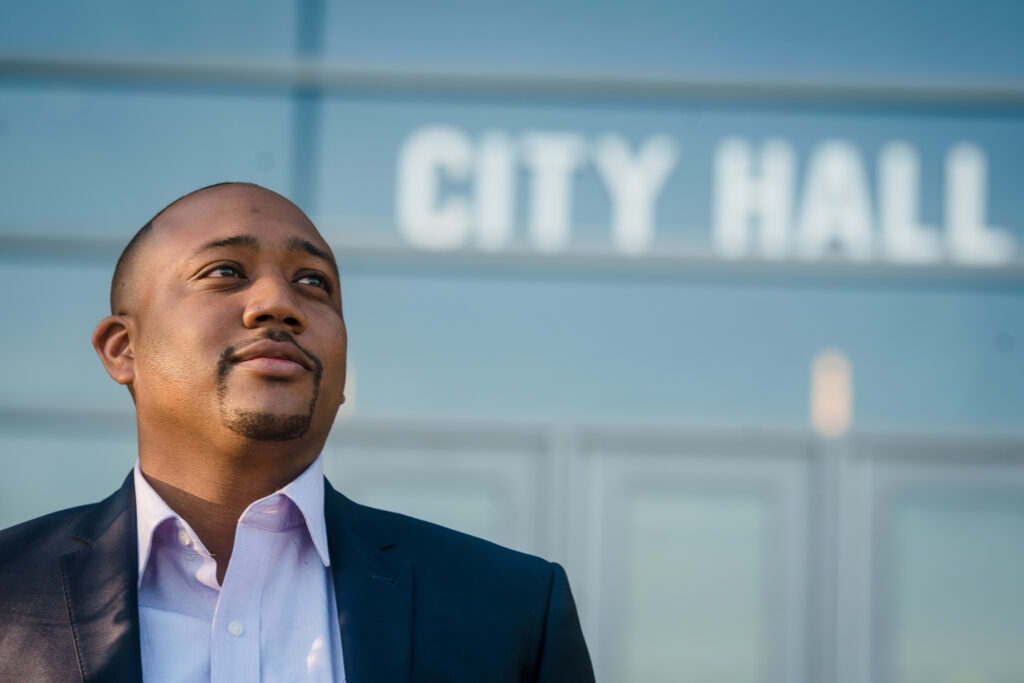
Dontaye Carter at City Hall in Sandy Springs, Georgia (Photo by Kevin Lowery)
Dontaye Carter is a Black man juggling a family, career, and now a campaign, proving once again that hard work and perseverance prevails. He is running for Mayor in the city of Sandy Springs against incumbent Mayor Rusty Paul, who has been in office since 2014, in hopes of providing a better future and world in which his young daughter can live.
While a sophomore in college at Florida A&M University, Carter already received his first journalism job at WCTV in Tallahassee, Florida. Inspired by his mother’s hard work ethic, Carter would wake up for work at 4 a.m. and then head to class at 9 a.m. He kept this routine for six months until the station promoted him to a producer. His success post-graduation matched his previous years too. Carter was a reporter in Tulsa, Oklahoma, then brought his talents to Atlanta.
The next couple of years, Carter continued reporting in the Georgia capital. Unfortunately, the work took a toll on his personal life, which caused him to switch careers.
“Personally, not only did I want to be a husband that was there, but a father that was there,” Carter said. “I wanted to be invested in my relationship, in my family, and I wanted to find something I was passionate about.”
The Fulton County’s District Attorney Office is where Carter found the passion he was searching for. While serving as a public affairs officer, Carter worked on cases that he felt had unjust verdicts. The case of four teens who were accused of murder specifically stuck with the mayoral candidate throughout the years. Often the cases showed signs of injustice and imbalance within the community.
Carter then decided to enhance the voices of unjust victims through his own business, Carter Media Group. The company served as a companion with attorneys to display the stories and challenges victims faced in their cases. In fact, Carter Media Group has been the public relations firm for several high-profile cases, like the case of R&B singer R. Kelly .
“I worked with Attorney Gerald Griggs, many of the survivors of that case and their families. We worked diligently because what we saw happening was everybody trying to turn that into a he-said-she-said case, but it was really a case about human sex-trafficking” Carter stated. “These plane tickets have to have these girls’ ages on them, so we put them out.”
Carter went on to speak about his work with the Jimmy Atchison case too. He recalled looking through files. Additionally, he highlighted the importance of keeping the public informed. Several agencies were even called to examine the case facts thoroughly.
Despite the backlash he’s recently received from some residents, Carter still believes politics is his best outlet for promoting change in Sandy Springs. He spoke of the significance of community, representation and trust. The three elements are key components to what has inspired him running in elections this year. The husband and father wants a city that, most importantly, gives his family a voice and protection, and obtaining the title of mayor will grant him access to create that city.
Sandy Springs is known to have a large white population and Carter has not ignored this fact. He understands that most residents of the city agree with the injustice displayed by policymakers in the past. Carter spoke in detail about his standards for people who are elected into office.
“There is nobody in office right now that I trust to take care of my daughter or anybody that looks like her. We have to put people in office that put their constituents first,” Carter stated. There was a lot of talk last year about change, but the way of those words haven’t met actions a year later. Until we get people in office whose words match their actions, we’re never going to be in an equitable society.”
While in office, Carter has explained before that he wants to focus on several issues, which include affordable housing, sustainable developments, schooling and diversity and inclusion. However, his passion for these issues does not negate from his immediate focus — managing the COVID-19 pandemic. Carter explained how he wanted to open the discussion of mandated vaccines to further the safety for all residents. The former reporter believes the conversation surrounding COVID-19 has been converted from survival to political.
“I know the mandating has been so politicized, but the reality of it is, in Fulton County, your child has to get 14 vaccinations before they start school,” Carter said. “We’re already getting vaccines, one more vaccine to ensure that people are going to survive is vitally important to me.”
The details of Carter’s campaign can be found on www.dontayeformayor.com. Election day is November 2.
Da’Zhane Johnson is a student at Clark Atlanta University.
Atlanta City Hall Reporter Speaks Politics
By Ariyana Griffin
Wilborn P. Nobles III covers City Hall for the AJC.
Wilborn P. Nobles III is a journalist with The Atlanta Journal-Constitution (AJC), where he covers Atlanta City Hall. He originally joined the AJC staff to cover DeKalb County Public Schools in November 2020. Earlier this year, he started to cover Atlanta City Hall. He previously worked for The Baltimore Sun covering the government. There he covered police shootings, housing discrimination and other things revolving around issues within Baltimore County, Maryland. Nobles also interned at The Washington Post, where he covered local news. Additionally, the Louisiana native covered education for The Times-Picayune in New Orleans.
With politics being prominent in Atlanta right now due to the upcoming mayoral election, Atlanta residents also have to vote for a new council president and an entirely new city council, and the Atlanta Public School Board.
All 15 seats for the Atlanta city council are up for election. Among those 15 seats, six of those seats will not be filled by an incumbent due to leaders running for other positions or just not running for re-election. Nobles, however, is solely focused on covering the Atlanta Mayoral election. Early voting began on Oct. 12 and ended Oct. 29. The general election will take place on Nov. 2.
Each local election is crucial and dictates the future of a community, including where tax dollars go.
“Super voters are people who vote in every election. No matter if it has something to do with the president or raising taxes or legalizing some new aspect or service to the city,” Nobles said. There is also a large group of people who are “apathetic” because they feel like the elections do not care about them or their community, an issue Nobles found prominent in Atlanta. Some people also do not believe that the vote counts or is essential, making them sceptical to go out and vote. Nobles explained that it is crucial to learn and research people who are running for office or who are interested in running for office so people can be informed and then participate.
“Black voters are concerned about affordable housing, career opportunities, and public safety. The latter issue includes both crime and police reform,” Nobles explained.
Nobles said he always wanted to cover politics and government to help hold politicians and leaders accountable. His advice to reporters or anyone when covering politics is simple.
“As a new reporter on the beat, they want to give you their best impression, but it is important for you to do your homework, ” he said. “Talk to people and read what’s been written about them, any sort of homework you can do ahead of time.”
He said that as a journalist, your first obligation is accountability and transparency.
For more information, you can follow Wilborn Nobles or read his articles about the Atlanta mayoral race at www.ajc.com.
Ariyana Griffin is a student at Clark Atlanta University.
K-12 Reporter Gives Insight on how COVID-19 Affected Metro Atlanta Schools
By Ariyana Griffin
Kristal Dixon is the K-12 reporter for Axios Atlanta Local News
Kristal Dixon was an education reporter covering Cobb County for the Atlanta Journal-Constitution (AJC). She now serves as the K-12 reporter for Axios Atlanta local news, a publication that will be launching in October. She has also covered some public safety issues in Cobb County. Due to unprecedented times, there has been plenty to cover when it comes to the school systems, and here is what she has to say about that.
How did you get into education reporting and journalism?
I have always wanted to be a journalist since my teenage years, so I started focusing on that. I worked at the school newspaper at the University of West Georgia and I just continued my career that way. I started covering K-12 education in my first full time reporting job at the Cherokee Tribune in August 2007. I covered K-12 education for about three or four years. I took a bit of a break from it because I started covering the County Government Beat, and later started working for Patch.com. I kept following K-12 education for the last several years, but when I was hired at the AJC in February 2019, I kept that up. I narrowed my coverage down to Cobb County. In February of 2021, while I was at the AJC, I was promoted to the education team to cover Cobb and DeKalb County schools.
What are some key issues that you have noticed K-12 students face?
Right now, obviously the COVID-19 Pandemic is a brewing issue that schools have been contending with for the last 18 months. Also the COVID-19 pandemic actually brought to light a lot of inequities that school districts saw when it comes to K-12 education. A lot of districts realized that other students did not have the technology that they needed at home to do their virtual lessons. So a lot of districts began to fundraise and partner with community organizations to get laptops and hotspots donated for their students. Because of this, a lot of districts are contending with what they call a “learning loss.” They are actually checking in with students to see how much they’ve been able to retain, how much they may have gained, or how much they may have lost during the pandemic. Those are the two main issues that are happening right now.
Tell me a little more about the upcoming publication, Axios.
We haven’t launched yet, I am in training right now. We are going to launch a new Atlanta site. Axios has an initiative that they want to open websites that cover news featuring various topics in different communities around the country. Atlanta is one of several sites that they plan to open in 2021. My job will entitle writing stories that will go in a daily newsletter. We launch on October 4, 2021. We will be covering news around Atlanta. I would be interested in continuing to watch K-12 education at Axios.
Have you branched out and covered any stories on higher education?
Kennesaw State, located in Cobb County, was having a housing shortage for its students. They decided to break ground on some apartments that would house students who attend Kennesaw State.
What were some of your biggest stories you have covered regarding public safety?
One story I covered last year was police departments using license plate readers to help them solve crimes. They put them up in certain intersections or neighborhoods that they believe are “problem areas.” Anytime a vehicle has been flagged as being connected to a crime, whenever that vehicle passes through the license plate reader, the police department knows that this vehicle is connected to a crime possibly in that area. This is not really public safety related, but it is along the lines of law enforcement agencies.
I did cover some jail deaths at the Cobb County Adult Detention Center. Since December of 2018, there have been nine in custody jail deaths at Cobb County Adult Detention Center. It became a flashpoint in the 2020 elections of the Cobb County Sheriff, which the long time incumbent Neil Warren lost to incumbent Sheriff Creg Owens. This also led a lot of people who had family members that were detained at the jail and the ACLU of Georgia to reach out and bring attention to the conditions of the jail. There were also some issues with a lot of vacancies at the Sheriff’s Office, which some people say contributed to the lack of adequate staffing at the detention center.
For more information about Kristal Dixon, you can follow her at @KristalDixon.
Ariyana Griffin is a student at Clark Atlanta University.
This issue of The Byline was edited by Tianna Faulkner and Amir Vera.
Journalists provide post-Election Day analysis for Morehouse College event
By Elisheva Wimberly
A week after Election Day, Morehouse College’s Journalism and Sports Program hosted its annual post-election analysis discussion. The college has held the discussion since Barack Obama was elected president in 2008.
Led by program director and Morehouse College professor Ron Thomas, this year’s event, which included a panel discussion with diverse journalists, focused on the presidential race, Georgia Senate runoffs and the state’s transformation to a “blue state.”
NBC News White House correspondent Geoff Bennett said covering President Donald Trump changed his life and spoke on what made the past for years difficult for him as a reporter.
“You can’t trust people who are saying things which are close to the president,” Bennet said. “The biggest part is separating the noise.” Bennett said relaying words precisely as they appear from President Trump is crucial in not hiding the truth.
Morehouse College hosted it’s annual post-Election Day analysis event. (Credit: Morehouse Journalism & Sports Program).
“If the president is using racist language, call it racist and not racially charged. Be empowered in the newsroom and say it on air.”
Panelists also discussed the varied reactions to Kamala Harris becoming Vice President-elect. Christina Greer, a Fordham University at Lincoln Center political science professor, has reviewed women’s history in politics over time and said President Trump’s resistance to accept the election results is not about Joe Biden, but Harris.
Biden will be 78 years old on January 20. If inaugurated, he will be the most senior president ever to take office, and could lead to Biden not seeking a second term, Greer said.
“They cannot fathom a Black woman, an Indian woman, a child of immigrants, a graduate of an HBCU possibly as a leader of the free world,” Greer said. “It’s not about Joe. I think it’s about this idea that a black woman could be in charge of the United States of America.”
The divide between both the Democratic and Republican parties in this country has led Greer to believe we’re at a point of no return.
“We’ve shown time and time again in the past four years that white supremacy, anti-Black racism, and patriarchy are the foundation and bedrock of this nation, and we have not moved very far away from it,” Greer said.
Apart from the presidential race, Georgia will have two Senate runoff races between Democratic nominee Jon Ossoff and Republican incumbent David Perdue and between Democratic Nominee Rev. Raphael Warnock and Republican appointee Kelly Loeffler.
“It’s important to note over the past 20 years, Democrats have always lost the runoffs. But their showing in the 2018 runoffs was stronger than it has been,” Morehouse College political science professor Adrienne Jones said. “For this particular runoff election, all eyes are on Georgia. Hopefully, people will stay motivated and realize the high stakes.” Jones added Biden and Harris’ ability to run the government will be enhanced by Georgia democrats winning the Senate races.
“There’s a risk in both races, but this is a different kind of runoff Georgia has seen before,” Jones said. “We should expect different and improved results.”
Republicans invested in Latino voter registration all over the country. President Trump received Latino support in Florida and Texas. Mariela Romero, the producer of Univision news magazine Conexión Fin de Semana, said the support of a Hispanic person comes from either what country they’re from or where their family is from.
Romero said many Latinos voted for Trump due to false claims that Democrats are socialists. Ads compared Joe Biden and Kamala Harris to Venezuelan socialists and Cuba’s Castro family.
“It was shocking. It was completely false,” Romero said. “It executed rapidly, and people were fighting like the democrats were the worst thing that happened to this country.”
Many Latinos living in rural areas are also exposed to talk radio. Romero said Democrats have to do a better job in reaching those communities, adding the message that comes from propaganda, social media, and radio is compelling.
Romero also said religion plays a role: Many Latinos are Catholic or becoming Evangelica and some of those churches are very anti-LGBTQ and anti-abortion. While Trump lost the support of white Catholics, he gained approval from Latino Catholics, she said.
“The lesson for the Democratic party is: The Latino electorate is too diverse to pigeon hole,” Romero says. “Democrats have to send targeted Latinoes to the Hispanic community.”
Elisheva Wimberly is a student at Georgia State University.
Robin Roberts inspires women during United Way leadership breakfast
The intimate event was a virtual conversation with topics ranging from the progress of women to how COVID-19 and racial injustice have thrusted issues of inequity into the headlines.
“We’re not complaining — we’re explaining. Full justice is not served until those who are not affected are as outraged as those who are,” Roberts said.
Monica Kaufman Pearson, a retired anchor for WSB-TV, served as moderator for the program. Pearson, a staple in Atlanta, has a long friendship with Roberts. Back in 2012, Roberts served as emcee for Pearson’s retirement party held in the Fox Theatre while battling her newly diagnosed myelodysplastic syndrome, or MDS.
Robin Roberts spoke about her career and triumphs at the United Way of Greater Atlanta’s annual women’s breakfast. (Credit:United Way of Greater Atlanta)
As keynote speaker, Roberts detailed the highs and lows of her lifetime. She fondly shared her journey to becoming a successful anchor and the struggles of being a Black woman in journalism.
“I made it very clear: I am proud of who I am doing the work like everyone else,” Roberts said. She recalled working multiple jobs, even working as a school bus driver on her quest to make a name for herself in media.
The youngest of four children, Roberts grew up in Pass Christian, Mississippi.
“I grew up knowing 3 D’s in my family: discipline, determination and da-Lord.” The euphemisms instilled by her family led her to the path of success and stressed the importance of a familial unit.
Before landing a permanent role as co-anchor for Good Morning America in 2005, Roberts worked with ESPN for 15 years, hosting Sportscenter and covering the 1992 Olympic Games in Barcelona. Roberts also helped shape ESPN’s coverage of women’s college basketball. Her reporting repertoire earned her many accolades throughout her career, including the Walter Cronkite Award for Excellence in Journalism and an induction into the Broadcasting & Cable Hall of Fame.
But apart from her success, Roberts had her share of struggles. In 2012, Roberts was diagnosed with MDS, a rare blood disorder affecting the bone marrow. Rather than dealing with the diagnosis privately, Roberts became a public advocate using her platform to spread the message and encourage viewers to become more educated on the diagnosis. The coverage of her diagnosis earned her a Peabody Award. Roberts believed she was a messenger as a public figure to overcome adversity and inspire others worldwide.
“It’s not what you accomplish, it’s what you overcome to get there,” she said.
Greer Wilson is a recent Spelman College graduate.
Georgia State student recounts virtual NABJ student project experience
By Tyrik Winn
Georgia State University student Tyrik Wynn participated in his first NABJ/NAHJ virtual convention this past summer as part of the organization’s Student Projects.
The program provides students with reporting, writing and leadership experience during the convention held in August. Initially, Wynn wasn’t sure if he would be able to participate in the program, but program organizers learned of his journalism experience and brought him on board. Wynn shared his experience about NABJ Student Projects with AABJ:
When I first joined the project, NABJ hosted anchor auditions for the newscasts. The next day, I was able to meet everyone who was a part of the project, and try out for the anchor audition. The mentors said I did an amazing job with reading the script, but they said I was extremely loud and I needed to tone my voice down. I took their advice and began to work on volume control while on camera.
Shortly after the audition, Denise James, one of my broadcast mentors, gave me my next assignment which required me to produce three packages within one week. When the convention week came, I was ready and thought student projects were going to be a breeze, I was sadly mistaken. I had my work cut out for me.
Tyrik Wynn (Credit: Tyrik Wynn)
Since I had three packages, I had to schedule over 10 virtual interviews. I was also told I had to anchor two newscasts as well. I was learning how to work under pressure and tackle multiple projects at once.
One of my news packages focused on Dorothy Tucker’s first year as NABJ president. My other two packages were on NABJ elections and the NABJ/NAHJ’s first joint virtual convention.
Working on Tucker’s first year as NABJ president was my favorite assignment because I was able to interview her, which I considered a big honor. Tucker opened up to me about her first year and even talked about her experience having the coronavirus and how it affected her work.
The schedule for the NABJ Student Projects was very demanding. Each day, we began at 9:30 a.m. and my workday often ended with late nights. For one week, my life revolved around student projects; I couldn’t focus on anything else.
Tyrik Wynn is a junior at Georgia State University.
AABJ Members can donate money to AABJ using their Kroger Card
Did you know that AABJ is part Kroger’s Community Rewards program?
Yes, every time you use your Kroger Plus card when you checkout at any Atlanta division Kroger location (Georgia, east Alabama and South Carolina), AABJ can earn money — but you must sign up online for a Kroger.com account.
Signing up for a Kroger.com account also allows you to manage your card information, including address, phone number (in case you don’t have your Kroger Plus card, you can still get your savings by entering your phone number on file), track your fuel point, load digital coupons to your card and if you are a Kroger Pharmacy customer, even manage your prescriptions and refills.
This is edition of The Byline was edited by Raisa Habersham and Tianna Faulkner. The Byline will be taking a hiatus for Decemeber and will return in January. Have a happy holidays and new year!
AJC Washington Correspondent talks elections, Black voters and Georgia’s role in the election
By Elisheva Wimberly
With Election Day fast approaching, long lines are already wrapped around early voting locations in Georgia — a state considered battleground territory this presidential election and one that has come under fire for rampant voter suppression. The Atlanta Journal-Constitution’s Washington, D.C. reporter Tia Mitchell has a virtual front seat to all the action.
Mitchell came to the AJC in 2017 after covering crime, education, local government and state politics in Florida with various newspapers. As the AJC’s Washington correspondent, Mitchell covers Georgia’s delegation and national issues for a Georgia audience. The Byline spoke with her about the upcoming election season and the roll Georgia plays in it:
Q: What does this election mean for Black voters in Georgia?
TM: This is a very important election because people realize that it matters who represents you in all government levels. The President of the United States is one. The President of the United States has a tremendous amount of executive powers. We see it play out as far as the Supreme Court, and we see it play out as far as healthcare and abortion rights; we’re seeing it play
Tia Mitchell, AJC Washington Correspondent
out as far as immigration, policing, and racism. We should remember we have to pay attention up and down the ballot because yes, who is president matters, but the Congress members also matter. As voters, we have to decide which policy we like best and use that to inform us of who we want to represent us in Washington.
Q: How do you think we, as voters, should take time to learn about the candidates?
TM: It’s a personal responsibility and a civic duty. We talk about the “John Lewises” of the world and the Civil Rights leaders. We say we honor them. Well, John Lewis laid his life on the line many times for African Americans’ right to be able to vote. It wasn’t easy, we romanticize it, and now that Black folks have been voting for a generation, it’s easy to take it for granted. If we truly say we want to honor him and others, we’ve got to spend a little time doing our part. You have to take half an hour to google the candidates and see what they’re talking about. You have to take 15 minutes to tune into their debate or read articles about the race. You can go to the AJC or your local paper to see what’s being written about them. Take a minute and google them so you can see on their websites what they care about.
Q: How do you feel about Georgia being a purple state? What are some key races in Georgia? How does it feel that Georgia is a battleground state?
TM: It’s really interesting to see Georgia enter the conversation as a battleground state. I’m always skeptical because most of my career was in Florida, a battleground state. In the past 10 to 12 years, statewide elections have all been won by Republicans. For me, it’s harder to say Georgia is purple, but we cannot deny Georgia is purpling. We can’t deny how close Stacey Abrams got (to being elected Georgia’s first Black woman governor), but the question is: Is this the year a Democrat finally wins statewide in Georgia. Trends have to start with Democrats winning statewide to say that Georgia is a purple state.
Q: What are you covering election-wise right now?
TM: Because of coronavirus, it changed. I’m not doing as much traveling as I used to. However, we’re still covering the debates, covering the candidates, and covering the fact that Joe Biden is more competitive in Georgia than any Democrat has been in recent years. We’re also covering endorsements and advertisements, and I’m covering congressional races. I plan to travel to Atlanta ahead of the general election to cover the final days of the general election campaign.
Q: Are you expecting any surprises in this upcoming election?
TM: It’s hard to say because it’s so unpredictable. When I started in Washington, we were covering impeachment. We never thought we’d be writing about a pandemic. I don’t know if anyone predicted how competitive Joe Biden would be in Georgia. Things come up, scandals come up, and it’s just never what you would expect.
Q: Aside from being an AJC reporter, you’re also chair of the NABJ Political Task Force. How did you get started with the task force?
TM: In early 2019, one of the major news networks announced their political task force team, who will be covering the presidential race, and their team was all white. Everyone was coming for that network, saying their team had no diversity. NABJ, rightfully so, put out a press release saying the lack of diversity was a problem. And Marlon Walker, NABJ’s VP of Print at the time, told me to send him a proposal after I told him there was no action being done. And I said that’s what I get for opening my mouth. At the time, I was just a local government reporter, but I had a passion for politics.
It was always hard to get my foot in the door, even in NABJ, because there weren’t many political journalist opportunities. I saw there was a political task force, but they weren’t very active. I started reinvigorating the task force. We had elections, and that is when I was elected chair. I connect managers to our task force, who want a diverse staff.
Since then, we’ve had programs, webinars, and networking events in Atlanta. We share ideas, resources, best practices, and job openings. We’re currently increasing our board so more people can work on the task force.
Q: What tips can you give people who are engaging in political reporting
TM: For me, it’s two things. Some journalists have an ultimate goal, and everything they do is an incriminate step toward that goal. I am not one of those people. I’ve always been someone to look at the opportunities before me and either pursue it or don’t. I started as a night cops reporter right out of college. I tried it, enjoyed it, and got a local government job through my educational beat. I realized then that I liked political and government reporting. I wouldn’t have known that had I not tried it. One of my pieces of advice is to try it. Even if it appeals to you in a small way, try it. Take those opportunities that come before you because you never know what doors it’ll open. Take those opportunities but also make your opportunities.
Elisheva Wimberly is a senior at Georgia State University and a member of the school’s NABJ student chapter.
AABJ webinar explores the challenges in recruiting athletes in NASCAR, baseball
By Greer Wilson
If you were to count the number of Black athletes on your fingers and toes, you’d probably wouldn’t have enough to finish the count. Black athletes comprise 74% and 70% of the NBA and the NFL, respectively. But when you look at other major sports, such as NASCAR and Major League Baseball (MLB), Black people are highly underrepresented.
On opening day this year, Black players comprise 7.8% — 80 players — of 30-man rosters, injured and restricted lists, according to an analysis by USA Today Sports. In NASCAR’s 73-year history, only two Black drivers have competed in the sport’s full Cup series: William Darrell “Bubba” Wallace and Wendell Scott, according to a Washington Post article about the lack of diversity in the sport.
Pictured from top to bottom: NASCAR Senior Team Coordinator Jasmine Neely about and Fox Sports Associate Producer David Cason
The Atlanta Association of Black Journalists hosted “Minorities in Sports,” a webinar that focused on Black journalists covering sports that lack racial diversity. The webinar, which featured NASCAR Senior Team Coordinator Jasmine Neely and Fox Sports Associate Producer David Cason, also covered the limited reporting opportunities Black journalists have in sports reporting compared to their white counterparts.
Neely, a native of Charlotte, North Carolina, was introduced to the auto racing company after accepting the NASCAR Drive for Diversity Internship as an undergraduate student. Neely said she was not exposed to Nascar growing up, but was drawn to the sport while working as an intern.
After experiencing a positive work environment as an intern, Neely sought out full time employment with NASCAR. During her tenure, she was a part of discussions for NASCAR to remove the Confederate flag, which was steeply associated with the sport.
This past June, Wallace, the only black driver in NASCAR’s top racing series, publicly made a plea for the organization’s removal of the Confederate flag.
“I think even before that, when the George Floyd situation happened, we had come together as a company more so in a smaller setting on Zoom of course,” Neely said. “It was a NASCAR ally counsel, and I was excited to be a part of it.”
Cason was inspired to work within the sports field, after watching Atlanta Braves games with his mother growing up. The Atlanta native accepted a position with Fox Sports, which deepened his love of baseball.
“We did the Braves post-game shows, which led me to being in the locker rooms and eventually being able to travel with the team,” he said.
Both panelists work in sports industries typically not occupied by blacks. While both acknowledged the lack of diversity within their respective companies, they also emphasized the importance of representation needed within the spaces.
“I think the reason African Americans are not drawn to baseball, at least as of yet, is for one it’s slow, and it’s kind of boring to some people. There’s not alot of us that play baseball professionally, on (television),” Cason said. “If you don’t see someone that looks like you, you don’t have representation. You don’t relate to it. It’s also an expensive sport to play. Whereas with basketball and football you just need a ball and some friends. Baseball, you need a ball, bat, gloves, a big open field to play.”
Despite the challenges and accessibility of the sport, Cason said he hopes interest of baseball in the Black community will return.
“I know there’s a lot of programs to get young people more involved with baseball,” he said. “Baseball’s trying to promote the younger players. The Afro and Latino players are being promoted a lot. Hopefully more diversity, and people who look like us will start participating in baseball.”
Despite preconceived notions people have about the sport, Neely said NASCAR is working to attract more coverage that will lead to a more diverse audience, but she said there are challenges.
“African American media are not quick to cover NASCAR because of the stigma that is put on it. Things that people have heard about in the past, I do get those questions ‘Hey are there Confederate flags?’ ‘The people there, are they racist?’ I get those questions,” Neely said. “It’s really just a matter of seeing for yourself and coming with an open mind. That’s how we get new people to cover the sport.”
Greer Wilson is a recent Spelman College graduate.
ANNOUNCEMENTS
AABJ offers digital events for members
Througout October and November, AABJ is hosting series of digital workshops focused on repprting, podcasting and mental health. Be sure to check your email for the Zoom registration link for these upcoming events:
October 27 at 6 p.m.: Mental health workshop with MIMs Connect November 12 at 7 p.m.: Podcasting Workshop with Pope Productions November 19 at 6 p.m.: Writing for Digital Workshop with MIMs Connect
NABJ hosting its digital and joint regional conference
The National Association of Black Journalists is hosting its first-ever virtual, joint regional conference Nov. 21. Members can register for the daylong conference for $35. The registration deadline is November 18, 2020, at 11:59 p.m. ET.
This edition of The Byline was edited by Tianna Faulkner and Raisa Habersham.
How does it feel to be a graduate? It’s the question everyone has asked with pride and joy in their voice. That question has a different meaning for recent graduates such as myself and fellow colleagues, who received diplomas, but went without a ceremony due to the COVID-19 pandemic. At the beginning of March, we had no idea that our last moments walking throughout Clark Atlanta University’s campus would abruptly end.
There was a sense of confusion, continually asking myself “what’s next,” “how am I going to get a job due to the high unemployment rate and lack of hiring” and “Should I move in with my parents until everything blows over?”
Graduating from college is not just a milestone, it’s a transition into adulthood. The everyday struggles of the world can be daunting, with warnings to enjoy college while you can because time flies. This statement has been continuously said without knowing there was such a unique meaning for the class of 2020.
Alexis Grace, Clark Atlanta University graduate.
But my worries aside, I maintained hope and patience that I would find a job. The summer before my senior year, I participated in the NABJ Student Multimedia Projects. Throughout my time in the program, different universities and recruitment programs from media outlets would stop to speak with us and seeing the work.
There, I ran into James Washington and Janis Ware,general manager and publisher, respectively, of The Atlanta Voice, a Black-ownednewspaper based in Atlanta. They saw the work I did in the program and wanted to see my work at The Voice. While they knew I could write, they never knew of my other hats, from graphic design and layout to social media management.
I was an intern at The Voice for two years prior to student projects, writing articles about different events happening across the city. I loved to write, but I wanted to gain more experience on the digital side of things, so James, or Washington as he is often called, said he would contact me closer to my graduation date.
Between student projects and graduation, I became NABJ-CAU president and interned with CNN’s digital programming team. I worked on a few personal projects while gaining credentials and certifications for programs on LinkedIn and HootSuite.
My talents and hardwork opened doors for me to gain connections and meet valuable people in the media industry. My internships and other media work also taught me the importance of holding on to and building relationships. In my case, my meeting with Washington and Janis led to social media jobs for The Atlanta Voice and The Dallas Weekly, a Black-owned newspaper based in Texas. I went from having no job to two positions in less than a month.
If the pandemic never happened, I would not have looked into pursuing another degree. Several universities waived GRE requirements, which worked in my favor because I hated the test and the preparation that went into it. I am now in my first semester at Agnes Scott College, pursuing my master’s in writing and digital communication.
For anyone still looking for a job, my advice to you is this: Never burn bridges that you have not fully built yet. You never know what is on the other side. Also, do not limit yourself on what you can do. There are so many resources and opportunities waiting for you.
Alexis Grace is a 2020 graduate of Clark Atlanta University. She currently works as a social media editor for Black-owned publications, The Atlanta Voice and The Dallas Weekly.
Reflections from the NABJNAHJ Virtual Convention
The convention was ‘very beneficial’
By Kassidy Jack
With the recent changes to life as we know it as a result of the COVID-19 pandemic, nothing has been the same, and people are still adjusting to the new norm. The National Association of Black Journalists (NABJ) and the National Association of Hispanic Journalists (NAHJ), however, did not let the virus stop them from holding their annual convention.
I attended the organizations’ first joint virtual convention and career fair, a four-day event catered to aspiring and active journalists, media executives, journalism educators, public relations professionals and students.
Kassidy Jack, Clark Atlanta University
All sessions, workshops, plenaries, forums, networking activities, meal events and the highly anticipated career fair were held online. There were so many excellent speakers and panelists.
Some of my favorite sessions included “Bearing Witness While Black: African Americans, Smartphones and New Protest #Journalism,” led by MSNBC’s Trymaine Lee and author of Bearing Witness While Black, Allissa V. Richardson. During this session, Richardson discussed what inspired her to write her book, Bearing Witness While Black, as well as how to avoid being traumatized by microaggressions Black people experience daily. I learned about the difficulties’ reporters face covering Black Lives Matter protests while dealing with their mental and how Richardson has personally learned to cope while still executing her assignments.
Another notable session was “Entrepreneurship for the Next Normal,” in which Black women business owners, Tina Wells, founder of Buzz Marketing Group, and Yolanda Owens, owner of Iwi Fresh, discussed how COVID-19 affected their businesses. The women also shared creative tools and tactics they used to help their businesses survive such a crazy time. I loved the inspiration that filled the virtual room and the transparency from the panelists. I do not think there was one person who left this session without feeling motivated and valiant in continuing their respective endeavors despite COVID-19.
Besides the online sessions, I was thankful that convention attendees could playback any session after it ended. For someone like myself who wanted to be in about 30 sessions at once, this was very beneficial.
NABJ and NAHJ did a remarkable job with their very first virtual joint convention. This was my first convention, and I can only imagine how much better the live event is.
Kassidy Jack is a junior at Clark Atlanta University.
The convention ‘was a changing moment in my life and career’
By Ariyana Griffin
I have always loved journalism and media, but was nervous about officially taking it from a hobby to my undergraduate major and career path. After getting my feet wet by joining my school’s newspaper, The Panther, I switched my major to journalism from sociology. Through my school, Clark Atlanta University, learned about NABJ and joined immediately. Being new to the organization, I was not familiar with the convention. So, when a classmate sent me a tweet about a chance to attend the convention, I knew I had to take this opportunity to gain some exposure. It was the perfect way to get acquainted with the organization and some of the opportunities NABJ has to offer.
Thanks to Craig Brown, a Clark Atlanta University graduate, and AABJ’s
Ariyana Griffin, Clark Atlanta University
parliamentarian, I was granted access to the NABJ Virtual Convention on August 5-8, 2020. It was amazing to be in a space with people who look like me and who are passionate about journalism and everything it entails. I also appreciated that the convention incorporated current events and subjects such as social justice issues and the COVID-19 pandemic because it made the convention interesting, engaging, and modern.
Sessions such as the W.E.B. Du Bois Plenary, “Progress Before, Progress After: The Criminal Justice System and COVID-19” and “Where Do We Go From Here: What’s Our Collective Strategy to Overcome Social Injustice?” helped me better understand the correlation between the work that activists do and the work that journalists do to inform the public.
Hearing panelists with differing viewpoints gave me a wider horizon about many topics, including prison reform. Maria Hinojosa, anchor and executive producer of Latino USA, said Latinos are often unheard when it comes to reform discussions. While learning that upset me, I was even more motivated to do work that is inclusive.
Hearing speakers, journalists, and activists discuss their passion was a changing moment in my life and career because it motivated me to write about civil rights issues, police brutality, social justice issues, and the history of these topics that are often not taught. While my first convention was virtual, the sessions have me excited for next year’s convention in Houston, Texas.
Ariyana Griffin is a mass media and arts major with a concentration in journalism and a sociology minor student at Clark Atlanta University. She also runs a blog, Equal Justice for Some, focused on highlighting injustices. She is originally from Inglewood, California.
APS Superintendent discusses her goals for the school year
Atlanta Public Schools Superintendent Lisa Herring spoke with Condace Pressley, host of AABJ’s monthly program In Contact, about her new role and how she’s managing the district in the middle of the COVID-19 pandemic. Herring has more than 25 years of experience in education and is a graduate of Spelman College and Georgia Southern University. Prior to joining APS, Herring served as the superintendent of the Birmingham City Schools in Alabama. Here is a portion of the interview:
Talk to us about your vision and some of your goals for the Atlanta Public Schools.
Lisa Herring: My vision as an educational leader, specifically as a
Lisa Herring, APS Superintendent
superintendent, is to ensure that we first remember that our core business is teaching and learning. And secondly, in that core business of teaching and learning, there’s a model that focuses on three key areas: the student, the teacher, and the content of what we teach. I’ve been fortunate to serve in urban school settings. My vision for Atlanta Public Schools is perhaps threefold. Number one, it is one in which we see a high level of academic progress and success for all students that we serve. Number two, that as we define that progress, and measure it, and that we look at it through a lens of equity. And then third, I do believe that every child that enters into our systems should exit, not only having fully identified their gifts, but being able to have the necessary skills to then transition to the next level of their life’s journey.
What are those one or two things that are going well in APS, and how do you seek to build upon them?
LH: Let me let me take a moment to brag about our outstanding leaders and high performers within the school system over the last several years. I know this as a former superintendent, some of the most critical decisions we make are tied to principalship selection and district leaders who help support schools. I am so impressed with not just the caliber of staff, but the love and loyalty and investment in the work and the children that I have seen. I’ve observed in the last several months individuals that perhaps we would call them in any other field essential workers. Those who have been frontline and sharing that Atlanta Public Schools continues to run and operate in a fluid successful manner, even with restrictions during a pandemic, whether that’s the school bus driver whose role has changed now into food delivery services, or school nurses, or school psychologists and counselors who’ve not only taken additional approaches to how we make sure that people are well. And because of the pandemic, we’re all cognizant and conscious about the cleanliness of our surroundings. And I’m not saying that it wasn’t [before the pandemic]. But given what we had, we’ve taken it to another level. I am clear that we have a high level of dedication to excellence in Atlanta Public Schools.
It’s one thing to start a new position at the end of a school year or at any point during the year. But to do so in the middle of a global pandemic, for which there is no vaccine is quite the undertaking. How would you characterize your transition, and as we wrap up your thoughts, again, just looking ahead to this exciting new challenge that you’ve accepted.
LH: The challenge is indeed exciting and new in that, as familiar as the city is, being the superintendent in the city as a new role and opportunity, being a superintendent, whereas it may not be new, the superintendent of city of Atlanta, or Atlanta public schools is new for me. I’m very thoughtful every day I think about are we doing enough or doing too much in certain categories. I worked very hard as a leader to not make decisions that I have to second guess. And I also want to make certain that the team of leaders around me feel empowered to execute whatever expectations are put in front of them.
That being said, we have to be very thoughtful about our practices and our actions. We have to have a level of reflection when we need to reevaluate but we also have to do things with a sense of urgency. And yet in the midst of all of that, we also have to remember that we’re not on an assembly line building cars, but we’re virtually in homes and in front of individuals. Still trying to impact minds and the thinking process, it’s a heavy weight. I think about it every day.
And then I think about the fact that we’re also trying to do it and keep ourselves healthy, and keep the people that we serve healthy. And all of us are only individually responsible for that part. We couldn’t have guessed this season. Our goal in Atlanta Public Schools, is that a year from now or two years from now, when they’re trying to figure out how to make certain that when and if it should ever reoccur, maybe they’ll look at APS for some guidance there. We want to be a model for what is right. What is right, not just in terms of the work, but that we do right by people, and most importantly, children.
This interview was edited for length and clarity. The full interview may be viewed Sundays throughout September at 10:30 a.m. on AIB-TV.
This issue of The Byline was edited by Raisa Habersham.
AABJ President talks Black Twitter’s reaction to his Verzuz battle story
By Amir Vera
We’ve all seen what happens when you cross Black Twitter.
When someone who isn’t in tune with the culture gets relentlessly attacked for being anti-black, clueless or simply having a controversial opinion. Black Twitter can and will fry you without mercy.
I knew that and yet had no idea I would be the next victim between the night of April 18 and stretching all the way until the evening of April 20.
It all started with a simple story idea. Like many R&B fans, I had been anticipating the Verzuz Instagram Live battle between singer-producers Kenneth “Babyface” Edmonds and Teddy Riley. But things didn’t go according to plan because of technical issues, specifically on Teddy Riley’s end.
As a viewer, I thought it was funny, but as a journalist, this immediately looked like a story for CNN. So I wrote the story with the headline “Instagram Live battle between Babyface and Teddy Riley was a complete fail.” The headline wasn’t inaccurate. The two artists attempted to do something and it didn’t happen. Thus, it was a fail.
There were also no issues with the reporting; everything I had written was either based on social media feedback of the failed live or posts from the artists themselves.
Black Twitter’s main criticisms were the “harsh” headline and many thought it unfair I wrote about the failed Verzuz as opposed to writing about the other successful battles.
And so began the barrage of comments, including calling me an Uncle Tom and a token and chastising me for “telling the family business” on what many see as a mostly white platform.
I was unfazed by thecomments; as a journalist, I know my work will be critiqued. However, I was baffled by comments saying CNN had no right to cover the event, and instead preferred the event be covered by Black cultural websites Vibe, Complex, or BET.com.
Part of the reasoning is some view CNN as a platform that doesn’t cover cultural events like the Verzuz battles, but instead focuses on hard news and politics. The deeper issue wasn’t with me or the headline. It was the fact people felt CNN had invaded a black space and used a token (me) to invade that space.
I can tell you that’s simply not true.
While some would feel pigeon-holed by being the “black reporter” — which often happens in newsrooms — I believe it is my mission to report those stories that otherwise wouldn’t be reported at CNN.
I later wrote a follow-up to the Riley and Babyface battle, but not because of the lashing I took on Twitter. The world needed to see what happens when two legends (successfully) go head-to-head. I’ve also reported on the other Verzuz battles since then because if I didn’t write them, who would?
Amir Vera is president of the Atlanta Association of Black Journalists.
Outgoing NABJ VP-Print on his advocacy for Black print journalists
By Marlon A. Walker
NABJ doesn’t care about print journalists.
That could easily be rephrased to be put in a better light, but many members of the largest advocacy organization for journalists of color feel that way, often cast aside for their more visible broadcast counterparts.
That doesn’t mean the work stops.
The job of a print journalism advocate within the confines of the National Association of Black Journalists can be best reflected through the main conflict many black journalists face in mainstream newsrooms across the country as they seek to tell stories from black communities. That people outside the black community have to be convinced there is, indeed, relevance in issues those outside do not see or understand.
Marlon Walker, NABJ Vice President of Print.
Black journalists get it. Black print journalists also fall victim to the same ideologies, being forced to convince others outside print newsrooms of the relevance to their concerns.
“There’s something to the premise that you’ve got to be a part of something to understand it,” the late Roosevelt Wilson told me several years ago as I sought to better understand my role as NABJ’s vice president of print.
Wilson was a retired professor in Tallahassee, Fla., at Florida A&M University’s School of Journalism and Graphic Communication and a long-time journalist who spent 18 years as publisher of the Capital Outlook, the city’s black newspaper. He had been my teacher at the school, my boss at the paper.
“Diversity for diversity’s sake – I can’t make a case for that. It’s like having a plain cake but putting the layers in various colors. It’s the same cake. That doesn’t mean it tastes any differently. If you want a rainbow cake, you get a chocolate layer, a strawberry layer, and so on.
“That’s where I think there’s miscommunication.”
Again, that doesn’t mean the work stops.
Through conversations with mentors, former professors, newsroom leaders, and reporters across the country, I developed programming outside of the annual convention that would speak to the deficiencies seen in professional development offerings. NABJ’s current model for success includes an annual conference heavy on digital resources and a career fair many convention attendees see as the main reason for their attendance.
NABJ Presents: The Basics Bootcamp is a training ground to not only make sure members know what they need to know to get jobs but puts them in small classroom environments with hiring managers who accept the invitation knowing they could find their next police reporter or social media manager.
Through that program, about half the participants have taken jobs, internships, fellowships, and freelance opportunities as well as finding mentors and guides as they work their way through the industry.
I’ve spent countless hours with newsroom managers pitching them black journalists who they would not have found through their traditional networks – college friends, other recruiters, even job boards – because our members are more often matriculating through programs that don’t have journalism resources, or lack in-house professionals with the network to spread their name and work ethic.
We do it because in 1978 when the American Society of News Editors set a goal to push newsrooms to have the same diversity as the communities they covered, just 4 percent of newsroom employees were people of color. People of color make up less than 20 percent in newsrooms across the country today, while people of color are nearly 40 percent of the country’s population.
I do it because of people like Pearl Stewart, the first black woman to lead a major daily newsroom, who was a professor of mine. Her network helped in major ways.
I want my network to do the same for somebody else.
Marlon A. Walker is Vice President of Print for the National Association of Black Journalists.
Black male journalists discuss challenges breaking into the field
As the meeting began, Chapman and Jackson discussed how their journalism careers began and demonstrated why it is important that black voices be heard in the media.
Leroy Chapman. (Chris Hunt/AJC Special)
“Once I got in, I had the right kind of mentors who said you should think about being a leader,” Chapman said. “We need African-American men who lead in journalism because in these big corporate entities our voices are needed. We need to express issues in our community and open our door to be a connection to the community who do not know how to connect with the media.”
“I came to Atlanta to segway to the opinion side of the business,” Jackson said. “Journalists aren’t paid to have an opinion, we are paid to keep our opinion out of what we do. Newspaper opinion sections are the one place where you can have an opinion.”
As their journalism careers began and they started working, both men said they realized quickly how different of a world they were in, but also the importance of their position.
“I was a business reporter and I was covering banks,” Chapman said. “I go to a bank and they have all their regional vice presidents in there, I was the only black person there not serving food. Being a journalist is a passport to being in rooms that you never thought you would be in. When you are there as an observer, you’re able to have a real understanding of where power rests.”
Chapman also added how different he saw things during his time as a sports reporter. “I was a sports writer for a while. On the field, we are everywhere. In the administration and front office, we are not there.”
Jackson said his experience taught him much more about himself as he learned from other people.
Andre Jackson, AJC Opinions Editor
“I grew up in an all-black school and neighborhood. You move from that environment to a university that is more diverse,” Jackson said. “You gain experience with people who didn’t grow up in the same background and same ethnicity as you and you have to get comfortable with that
“You quickly have to get comfortable with yourself and who you are. You quickly learn that some of the things that are said about yourself as a representative of a group are not necessarily true. In my youth, in the newsrooms I worked in, I was labeled the office militant because I was quick to call things out about things that could have been better. Sometimes you want to be listened to more than heard.”
Black journalists have fought hard for years to help change the number of people of color covering issues and how the Black community is portrayed. For these journalists, they are fighting hard during these times to make sure African-Americans not only are depicted in positive light but that the full truth is told.
“The biggest thing I see is how the mainstream media covers us and how we are depicted in a manner that is not true,” Byron said. “I have covered several court cases and if I was not in the courtroom, your clients may have had a different story. It was important for me to be in those courtrooms.”
Dennis Byron, Editor-in-Chief of Hip Hop Enquirer Magazine
How black men are depicted in the media is of high importance now with several protests going on in multiple cities, including Atlanta. Chapman reiterated the importance of reporting during times like this.
“What we want to do is provide the fullest picture possible. The thing we want to do is tell the whole story,” he said. “We have been on the street, we have had African-American journalists there and we are asking, ‘Why are you here?’ (when referring to the protests). We are always doing our best to get behind the whys.
“The why is a lot of things, it is the routines of having black men who are victims of police violence and that is the heart of the why. We have to be able to understand the context; many of the people are not old enough to have been on the streets of Ferguson, some of these kids are 18 and 19. They’re under a lot of trauma and stress and it is up to us to explain a lot of that. The story is not looting, it is all the facts. It is about socioeconomic, education, having a seat at the table and having safety.”
Jackson added social media has changed the way African-Americans are represented and how hard it is for journalists to do their jobs.
“Social media has had a big influence because people can create their own realities,” he said. “Now anyone with a cell phone and a voice can do that. They can present things that are factual and it takes a lot of discernment from the audience to dissect the truth of what is being put out.”
Howard said she was excited about the way journalists are seen as the prime source of relative and factual information for the world.
“When it comes to journalism, one thing that has emerged in this pandemic is that we are becoming the ones that connect the dots for people,” Howard said. “I’m really proud of journalists for doing this. It’s our responsibility to connect the dots now that we have this kind of data. It’s more important now than ever.”
“The biggest challenge for me has been keeping up to date with all the information coming out,” Howard says, “Every day there’s a new press conference across the country. Sometimes it can be difficult to juggle, but you just say ‘hey, this is what I plan to tackle today and I’ll do the others tomorrow.’”
The idea of a pandemic spreading has always been a major concern to health experts and scientists, especially with pre-existing scientific theories now coming true by certain scientists. Eric Stirgus says we need to listen to our fellow scientists.
“One thing I’ve seen in the science industry in recent years is they explain things in the simplest terms”, Stirgus said.“Keeping up with science updates helps with your research and asking the question of how important or serious is this.”
Eric Stirgus
Since the pandemic began, many journalists are confined to their homes and have less access to newsrooms. “Covering it from home and not having the screens I would typically use has been challenging,” Howard said. “It’s kinda crazy how it’s the biggest story of the decade and we’re doing it all from home.”
Before the pandemic, Stigus would bounce story ideas off colleagues, but that’s been difficult to do since they aren’t working in the office.
“One challenge, since we’re not in the newsroom, is not interacting and conversing with different reporters,” Stirgus said. “We have a messaging app we use, sometimes it’s helpful and sometimes it’s time-consuming. It’s helpful technology-wise to have those tools but I’m also missing the human interaction.”
Keeping track of updated information is challenging, especially with constant information flooding news stations and websites, Howard and Stirgus said.
“One thing I started doing which is helpful is to constantly switch from different news outlets. I always monitor who’s doing what in different networks right now,” Howard said. “This is a local, national, and global story. Instead of keeping an eye on what’s going on in the global news, I’ve been focusing more on what’s going on in the international news. Coming out of the (United Kingdom) and Australia. That’s actually been a great way to find stories as well.”
Stirgus made it a point to reach out to his interviewees in an effort not to misinform the public.
“I’m not an expert in these topics, so I also follow up with them,” he said. “I’ll say, here’s what I have from an interview: Is this correct? Sometimes they’ll share additional information or correct me. Getting that additional information really does help me.”
Journalists from around the globe are challenged with informing the public from a distance. Jacqueline Howard and Eric Stirgus reminded everyone watching this webinar that they are not alone in this process and to remain confident in your work.
Elisheva Wimberly is a rising senior at Georgia State University.
COVID-19: How the virus has affected AABJ members
COVID-19 has affected journalists across the nation, resulting in lost jobs, income and opportunity. We asked AABJ members how they’ve been affected by the pandemic. Here is what you said:
Greg Morrison: Taking in the news has been difficult
I have been working from home for five years, but I find myself in need of a hug from my grandchildren. I have stayed at home only going out for medical appointments. My daughter has been doing our grocery shopping. At first, we experienced food shortages in some stores, but things have
Greg Morrison
calmed down a bit. My capacity to absorb tragic news both locally and hearing about friends and people I know in other cities is being tested. I take the attitude that this too shall pass and we will emerge with a new respect for simple things. (To maintain work-life balance,) I work a few hours, take a walk, enjoy some music, work a few hours, and read for pleasure. Additionally, I walk a 3-mile route through the neighborhood a few times a week and reduce food portions at mealtime.
Allison Joyner: Dealing with my mental health is now a priority
As a freelance writer, I am concerned about my niche, HBCUs, and how it
Allison Joyner
will affect the schools from an enrollment and fundraising standpoint. Dealing with my mental health has now become my priority, and it has caused me to only work a few hours a day. Having Zoom and FaceTime meetings with friends, family, and colleagues has helped, but I miss seeing them in person.
Joy Woodson: I’ve been working around the clock to get everything done
I am busier now than I was before the pandemic. And, I’m not sure why that is. Some of the increase in work is related to the shutdown, but some of it is not. My biggest concern isn’t even getting sick from COVID-19, it’s the stress that a situation like this creates all the way around. I like working from home, but when you’re basically stuck inside, it’s not the same: It’s confinement. And, that’s not good for sanity or productivity over the long term.
Joy Woodson
In addition to work and all the new procedures just to get groceries, I was an MBA student in my last semester. One of my professors did very little to change our assignments and deadlines, despite classes being canceled for a spate. I ended up working around the clock to get everything done in my life, school, and job. I try to run two to three times a week to help with the stress of it all, and I turned off notifications on my phone. I know things are due for work, but I can’t have my phone going off a million times a day for every meeting or group chat notification.
(To relax), I’ve been running, listening to podcasts, and talking to friends and family. I hadn’t listened to podcasts before all this, and I find them very helpful now when I need to tune out the news.
— Joy L. Woodson, GALILEO Assistant Director, Marketing Communications
Ila Wilborn: I live with an essential worker
I’m doing well. My biggest concern is the well-being of everyone around me.
I have an essential worker in my household and I worry about their health, as well as mine since we are around each other daily. Working from home has been a bit of a challenge. My job is a bit more difficult than it would be
Ila Wilborn
if I were in the newsroom. However, I’m coping the best I can by continuing to work through the tough days, asking for help when I need it, and planning in advance. I try to debrief every day from work by talking to family and friends. Additionally, I work out daily and I’ve made it a priority to eat healthy foods. It’s more difficult to eat out now so that helps!
— Ila Wilborn, Production Assistant, CNN Newssource
The vignettes were edited for length and clarity. They were complied by AABJ VP of Print Raisa Habersham.
Christine Swanson directed “The Clark Sisters: First Ladies of Gospel.” (Credit: Lifetime)
‘Clark Sisters’ director, magazine editor discuss representation in the film industry
By Greer Wilson
As many around the world discussed COVID-19, Clark Atlanta University Mass Media Arts Alumni Society treated students to a virtual lunch and learn session last month.
The society in conjunction with the school’s mass media arts program hosted “For the Culture: The Rise of Black Culture In Television & Film” with “The Clark Sisters: First Ladies of Gospel” filmmaker Christine Swanson and Stephanie Eugene, managing editor of Cinema Noir, a website dedicated to celebrating the African diaspora in Hollywood.
Christine Swanson
The women discussed the importance of networking and representation in media. Swanson said building a network as a student is vital because the same students you are working with now are the same people you will work with in the next 10 to 20 years.
“Create relationships and working relationships that are mutually beneficial and functional for where you are,” she said. “Understand that you are not just going to school. This industry is not based on talent or grades. It is relationship-based.”
Swanson said in many cases, people get film jobs based on word of mouth. “Lay the groundwork and build the relationship in an organic way,” she said.
Eugene and Swanson also touched on the difficulties of selling and telling your stories as black people and getting others to see your vision. Eugene said part of the problem is people haven’t been exposed to a different point of view.
“I think as far as our stories being told, we’re not a monolith, there are nuances in the Black experience,” Eugene said. “Over time, we see more and more of that in the mainstream media but I do think there is room for more.”
Swanson said telling the Clark Sisters’ story on screen meant a lot to her because she wanted to create something people can connect to.
Stephanie Eugene
“I love normalizing gospel singers from Detroit … to me they were always larger than life,” she said. “Just because the world didn’t know them in the way that we see them does not negate the need or the capacity to show them in that light. That’s not the goal. The goal is to humanize these women in such a way that other people can connect and relate to.”
Eugene said branding is also important when it comes to the film industry, emphasizing that authenticity is key when developing your personal brand.
“I think it’s really important, it’s so easy to fall into the trap of copying what you see,” she said. “You may not understand what someone else’s angle is or process, or target demographic. You may not understand what goes behind a brand. I really just caution you to not take any shortcuts because it really does come down to authenticity at the end of the day.”
Greer Wilson is a recent Spelman College graduate who writes for Around The Rings, a website covering the Olympics.
This issue of The Byline was edited by Raisa Habersham and Tianna Faulkner.
As the United States grapples with the repercussions of the coronavirus, it’s also important for journalists covering these stories to take care of themselves. Using this epidemic positively by concentrating on self-care can help reduce the risk of stress and depression. Clinical psychologist and Agnes Scott College professor Dr. Janelle S. Piefer spoke with The Byline about how to take a mental break amid the coronavirus pandemic. Here are some of her tips:
Janelle Piefer.
1. Go easy on yourself
Be gentle with yourself. You can do well one day and then struggle the next day being under quarantine. Piefer says it’s important not to be the “ideal coper,” a standard perpetuated in the media to go above and beyond in times of crisis that are often very difficult to control. “Be the best version of yourself and not the perfectionist standard,” she said. “It’s not going to be one single right way for everyone. When people set unobtainable goals they are least likely to finish them,” Piefer said. It’s important to identify achievable steps that can help you and avoid those set by society.
2. Carve out time for things that make you happy
Meditation, social interactions over the phone, google hangout or watching a Netflix show, will help keep you mentally balanced. “Having a release along the way will result in an emotional marathon release,” Piefer said. “People tend to be recharged when they connect with things important to them.” It may be meditative to go on a bike ride, dance, paint or give back to others. Find moments where you feel centered, clear and present in the moment.
3. Taking social media breaks
If you’re on it too much, social media can get overwhelming. Carve out time to get news updates to obtain information where you’re getting more knowledge and you’re well informed. Journalists need boundaries centered around self-care in terms of secondary exposures. “There needs to be a place where you separate work identity and social life otherwise it will become overly immersive,” Piefer said. “Be more intentional where you take off your journalist hat and put on your self-care hat.”
4. Get some fresh air
Sitting on your balcony, bike riding, walking or even going out on your front yard will clear your head. Georgia’s shelter-in-place orders allow residents to go out for grocery store runs and to get some exercises, so use the outside air to your advantage. Piefer urged everyone to read the order and figure out what they’re comfortable doing within the confines of it. “Some people will say they’re comfortable going in their backyard and not going past there,” Piefer said.
5. Use counseling and teletherapy
Covering the coronavirus can weigh on any journalist and it may be difficult to get therapy in person. Piefer recommended teletherapy, which allows you to have access to mental health services online. Mental health service sites Therapy for black Girls specializes in support for black women. Magazine site Psychology Today has a searchable database for teletherapy in your area.
Piefer also has a teletherapy referral guide which provides information about where to find teletherapy and wellness consultations. She also recommends reaching out to insurance companies; many are waiving copays and deductibles. “I think it can be really helpful, especially with all the insurance companies’ resources. It’s pretty unprecedented times that they are offering these resources,” Piefer said.
People of color are going to be impacted, especially financially, as they were during the recession and the great depression, Piefer said, adding black women tend to suffer financially the most. “We know after the immediate physical crisis ends we will be dealing with the mental health crisis for quite some time,” she said.
Elisheva Wimberly is a rising senior at Georgia State University.
Five Tips for Covering the Coronavirus
By Alexis Grace
The novel coronavirus, also known as COVID-19, has done more damage than most expected. The respiratory illness that spreads through contact has not only led to statewide shelter-in-place orders but has heavily impacted America’s workforce. While many are out of jobs, the coronavirus’s media coverage has been increasing every day causing media professionals to work a little harder than usual.
In response to the coronavirus pandemic, the National Association of Black Journalists (NABJ) recently held a webinar to discuss the tools, attitudes, and care every journalist should strive for today during a trying time. While it is important to get the story, taking care of yourself is equally as important. Here are some tips veteran journalists NABJ Region III Director Rod Carter (top left), Poynter staff writer and trainer (top right) and NABJ Region II Director Sia Nyorker gave during the webinar:
NABJ Region III Director Rod Carter (top left), Poynter staff writer and trainer (top right) and NABJ Region II Director Sia Nyorker speak on webinar about covering the coronavirus.
“Credibility is going to be critical in the days ahead,” he said. “If I do not believe you, then it won’t matter what urgent news you have.”
Tompkins said journalists should gain viewers’ trust by being honest and asking questions viewers want answers to. “You have to be really thoughtful about what you’re telling people,” he said.
“The best answers are from when we are not in interview mode anymore,” she said, speaking on her experiences interviewing everyday citizens. Nyorker said there were better conversations and answers to her questions post-interview.
3. Get Subjective Answers
During your interviews, it is important to gain clarity for your audience by asking questions that evoke emotion. Tompkins suggested journalists ask questions that are short and easy to understand.
“Subjective questions give you much better answers,” he said. When discussing how to speak with health officials, Tompkins recommended asking questions that are brief but yield accurate answers. “The longer the question, the crappier the answer,” he said.
4. Remain steadfast
With endless updates on the coronavirus, it may be difficult to know what the next story should be. Tompkins suggested journalists focus on the current issue surrounding the virus and make that the story.
He encouraged journalists to remain positive during an unoptimistic time. “It’s not true that you are the problem. The truth is you’re telling them stuff they do not want to hear,” Tompkins said.
NABJ Region III director Rod Carter believes there are positive stories out there to give people hope. “We’re really on the front line of keeping the public informed and what we do is important,” he said.
5. Take Time to Unwind
As with any exhaustive news cycle, journalists need to take a mental break. This is especially the case for those cooped up in their homes covering the virus.
“You’ve got to unplug. Do not make the last thing you do be consuming more news,” Tompkins said. “You’ve got to stop it. Do what we do with children — read a story. You have to start taking better care of yourself. This is going to be a marathon.”
Nyorker reminded media professionals they are not alone. “You can call (us)if you need to cry or bounce ideas,” she said. “Just remember we’re all in this together. None of this has been done before.”
Alexis Grace is a senior at Clark Atlanta University. She is also president of the school’s NABJ-CAU chapter.
FEATURE STORY: Atlanta journalists face disrupted newsrooms amid global COVID-19 pandemic
By: Darriea Clark
Adhering to the Centers of Disease Control and Prevention’s recommendation to social distance during the coronavirus outbreak, Atlanta newsrooms have had to adapt and find ways to continue to provide pertinent information to its audiences. They have faced changing schedules, increased meetings, parenting while working, and the decision to report from home or on the field.
“We don’t want reporters to take unnecessary risks,” The Atlanta-Journal-Constitution’s deputy managing editor Leroy Chapman said. “While there’s not a prohibition, we are pretty selective about assignments.”
Leroy Chapman. (Chris Hunt/AJC Special)
Chapman said the coverage of the Masters in Augusta is a cultural Georgia story that the AJC needed to report from the field. Other stories he mentioned cover how Georgia residents are dealing with or not following social distancing recommendations and how some are coming together to support their community through food drives, fundraisers, and personal protective equipment (PPE) creation.
Not all reporters have the ability to remain in the confines of their homes. Photographers bring stories and scenes to the audience, which is difficult to do while practicing social distancing. “I can’t work from home, because I can’t take pictures of my yard,” AJC photojournalist Alyssa Pointer said. “That’s not news.”
Pointer came in contact with a person who tested positive for COVID-19 while on assignment at the Georgia Legislature. After quarantining for two weeks, she made it a priority to obtain PPE equipment. She admitted to having concerns about her perception as a journalist and duty to remain neutral in reporting situations.
Alyssa Pointer (Photo by Kevin D. Liles/Getty Images)
“Wearing a mask is advocating for myself and telling myself I matter,” Pointer said. “Regardless of how everyone else in the media feels, I am going to protect my immune system and my body. It is also to make other people feel safe to at least have a conversation with me. (The subject) can feel like I’m trying to take the necessary precautions for all of us.”
While there has technically always been a capability to work remotely, WSB-TV anchor and reporter Lori Wilson said that social distancing is foreign for journalists. Prior to COVID-19, reporters worked directly with photographers, rode in cars with them, and were able to go straight to the source with their crew close in hand. “You were rushing toward the scene of anything terrible that was happening,” Wilson said. “Now, it’s really challenging.” There is less opportunity to track and hunt down leads.
Fortunately, technology provides avenues to connect and interview subjects digitally. Yet what’s missing is the ability for journalists to steer conversations and capture emotional responses that you can only get in person. Mannerisms and descriptors are lost. “Now it’s a little more cold and impersonal,” Wilson said.
Wilson reports from home and anchors from the WSB-TV studio. “We’re fortunate that we’ve got multiple studios and performance areas,” she said. “Even as we anchor, we’re on a separate set. Our makeup artists are wearing gloves and masks. It’s just one person with them in the room at a time whereas before we may have had three artists and three people getting their face done.”
Using an app provided by the station and a ring light, Wilson shoots her own live shots from her basement.
“I used to be able to sit back and relax while my photographer was setting up and worrying about the technical end,” Wilson said. “The live shots are scary but great. It’s a feeling of accomplishment when you get it done. I’m thinking about things I haven’t had to before a lot more.”
While interviewing subjects from home, Wilson developed a “third role” as a subject coach. She tries to ensure subjects are not moving while on-air and are well lit. Despite any amount of preparation, technology is a more unpredictable factor that provides difficulty. “It can be a challenge when someone else may not have a strong signal,” she said. She said Zoom is the best platform for interviews because it allows you to record directly on the device. This means you’re guaranteed a certain sound and picture quality. FaceTime is a little more tricky, but it’s the most common, she said.
Lori Wilson, CREDIT: WSB
“The standards of quality have changed a little bit, but we still want to put good stuff on the air and make it as clean as possible,” Wilson said.
With constant updates and misinformation on the coronavirus, consumers are turning to local newsrooms more than ever. “Our audience has gotten much bigger,” Chapman said. “They’re hungry for information. It is our job to make sure we’re focused on solutions.” To battle social media posts and chain messages that spread terror and disinformation, the AJC has decided to run explanatory journalism pieces that correct rumors regarding COVID-19. “In terms of us being able to vet for information, we have multiple sources to corroborate what we’re talking about. We’re fortunate to have beat reporters that have built great relationships with sources,” Chapman said.
“This is a big moment for local news,” Chapman said. “This is a time for us to demonstrate our value. If there’s a silver lining, maybe it’s that we’re able to help our community.”
As for the future of the journalism industry, Lori Wilson is saddened but hopeful. “I think for better or worse, this business will be different,” she said. “Life will be different. News, as we’ve traditionally done it, is probably going to stay the same but I think [it] will get slimmer. Across the board, I think we’ll start doing more with less. For journalists and people who want to tell stories, the opportunities are endless, and I think more and more people are realizing that now.”
Darriea Clark is a recent graduate of Syracuse University and Atlanta-based reporter.
This issue of The Byline was edited by Raisa Habersham and Tianna Faulkner.