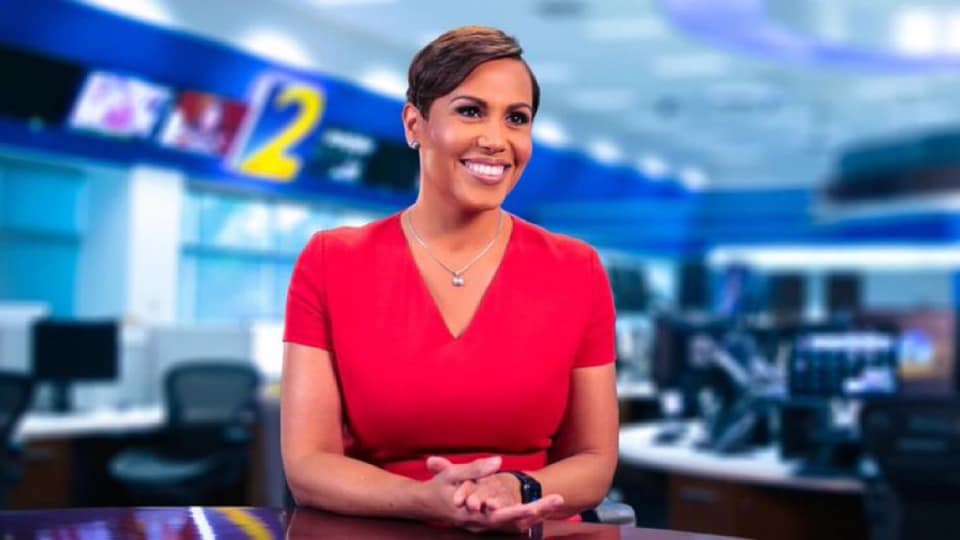
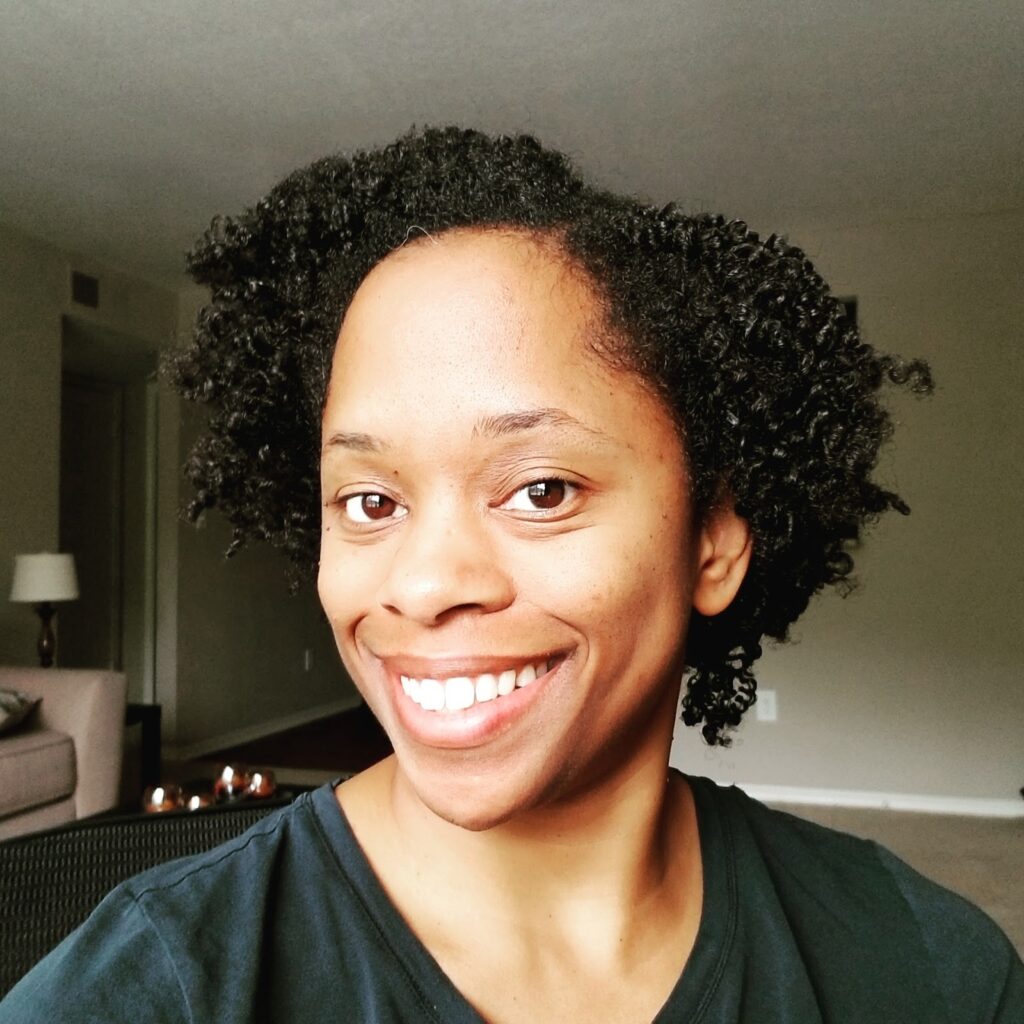
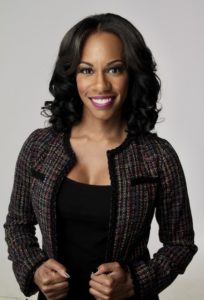
As an organization, we are mourning the loss of Jovita. She played an integral part in not only AABJ, but also as a presence in Atlanta. We understand many of our members were close with Jovita, and even if you did not know her personally, you may have felt connected to her through her work in the community. You can read more information about Jovita, her life and watch a very touching tribute video on WSB-TV’s website. AABJ has shared many memories with Jovita Moore through the story feature on our Instagram account.
AJC Higher Education Reporter Speaks on Challenges in Higher Education Learning
By Elisheva Wimberly
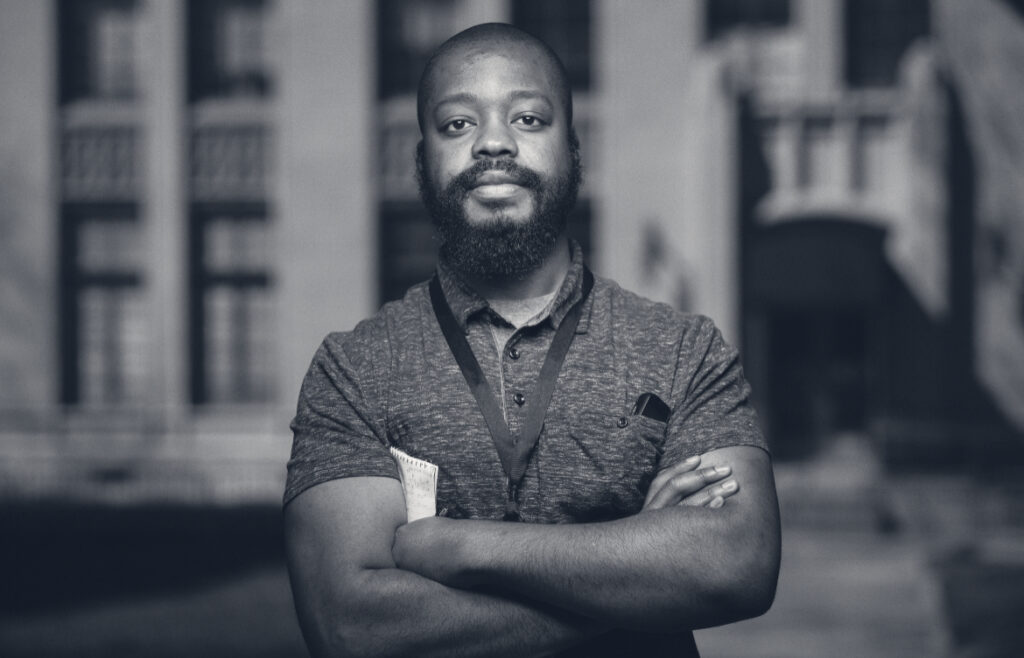
Eric Stirgus, AJC reporter
Eric Stirgus is the Higher Education Reporter at The Atlanta Journal-Constitution. He focuses on schools and universities throughout Georgia, primarily focusing on metro-Atlanta colleges and universities.
Two years ago, Stirgus focused on a variety of topics in higher education, including student loan debt, sexual misconduct and administration in higher learning. Today, Stirgus still covers those issues, but on a very small level. Stirgus looks at higher education from a completely different lens. About 90 percent of the issues he covers today are COVID-19 related, ranging from how colleges are managing the pandemic to the type of services they provide students. The Byline asked Stirgus if concerns of faculty are being heard regarding Atlanta colleges and universities not providing enough safety measures.
“Faculty will say no. They just finished weeks worth of rallies and demonstrations,” Stirgus said. “They want mask mandates and they’d like to have vaccine mandates but the University System of Georgia says no.”
The University System of Georgia (USG) strongly encourages faculty, students and staff to wear masks and get vaccinated, but Gov. Brian Kemp has been adamant that they don’t want to see mandates.
“The faculty are frustrated”, Stirgus said. “They feel the need to speak up and it keeps me quite busy trying to keep up with it.”
Stirgus said even through these rallies and demonstrations of protest from faculty he hasn’t heard much from students on the issue.
“In general, I feel like they’re supportive of these issues that faculty want but I don’t see them protesting,” Stirgus said. “I think that most of them want to be back on campus after over a year of not being on campus and experiencing online learning.”
The majority of students Stirgus sees on college campuses are wearing masks. However, the University of Georgia has had more positive cases than any other institution in Georgia.
When Stirgus visited UGA last week and went into the student center, he noticed half of the students present were not wearing masks. Last week, UGA had a big drop in their COVID-19 cases. Stirgus will be monitoring reports to see if the University of Georgia’s numbers show up low.
The Byline asked Stirgus if there’s a possibility of vaccine mandates becoming a requirement for all faculty, students and staff across the University System of Georgia.
“Biden has taken that step for federal workers and businesses with more than 100 employees but if he wanted to he would have done it by now,” Stirgus said. “If there is another spike, he might mandate it but we’ll see.”
Despite the feud over mask mandates, there are some positives to higher education according to Stirgus. He hears from many administrators and faculty. They share with him that remote learning has helped them become a lot more nimble in trying to find new ways to reach out to students. Stirgus says COVID-19 has given people in the education and outside world a better perspective of the challenges that it takes to be an educator.
“Before COVID I was writing on mental health,” Stirgus says, “That has become a greater challenge with COVID and they need to provide students with services that support their needs. Faculty realize those things are still very important.”
Compared to the University of Georgia, the Atlanta University Center’s (AUC’s) COVID-19 numbers have been very low, as they have been following mask mandates. Stirgus says they are different from the University System of Georgia because they require students to be vaccinated on campus. The AUC does not keep track of self-reported cases. And recently, they took the step last week to do weekly COVID testing. Along with the Atlanta UniversityCenter, Emory’s cases have also gone down.
Strigus believes the AUC is using more aggressive measures than the USG. Morehouse College and Spelman College have cancelled their Homecoming 2021 due to the lingering effects of COVID-19. Whereas universities such as UGA recently had 93,000 fans in their football stadium.
“A lot of schools are going full speed ahead,” Stirgus said. “I don’t see them adjusting.”
As for commencement ceremonies, Stirgus says the deciding factor on that decision will be the COVID-19 numbers.
“Hopefully the numbers will decline by commencement,” Stirgus says, “As long as we do what we have to do to keep the delta variant in check, I think we will see commencement ceremonies.”
Elisheva Wimberly is a student at Georgia State University.
Sandy Springs Mayoral Candidate, Dontaye Carter Discusses Career, Equality and Politics
By Da’Zhane Johnson
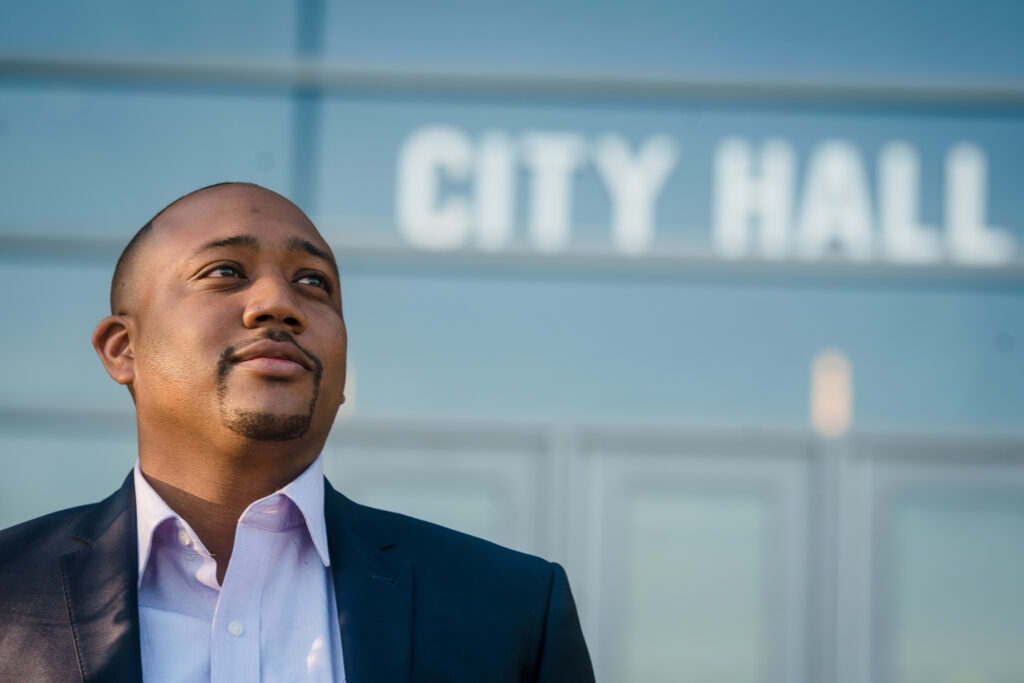
Dontaye Carter at City Hall in Sandy Springs, Georgia (Photo by Kevin Lowery)
Dontaye Carter is a Black man juggling a family, career, and now a campaign, proving once again that hard work and perseverance prevails. He is running for Mayor in the city of Sandy Springs against incumbent Mayor Rusty Paul, who has been in office since 2014, in hopes of providing a better future and world in which his young daughter can live.
While a sophomore in college at Florida A&M University, Carter already received his first journalism job at WCTV in Tallahassee, Florida. Inspired by his mother’s hard work ethic, Carter would wake up for work at 4 a.m. and then head to class at 9 a.m. He kept this routine for six months until the station promoted him to a producer. His success post-graduation matched his previous years too. Carter was a reporter in Tulsa, Oklahoma, then brought his talents to Atlanta.
The next couple of years, Carter continued reporting in the Georgia capital. Unfortunately, the work took a toll on his personal life, which caused him to switch careers.
“Personally, not only did I want to be a husband that was there, but a father that was there,” Carter said. “I wanted to be invested in my relationship, in my family, and I wanted to find something I was passionate about.”
The Fulton County’s District Attorney Office is where Carter found the passion he was searching for. While serving as a public affairs officer, Carter worked on cases that he felt had unjust verdicts. The case of four teens who were accused of murder specifically stuck with the mayoral candidate throughout the years. Often the cases showed signs of injustice and imbalance within the community.
Carter then decided to enhance the voices of unjust victims through his own business, Carter Media Group. The company served as a companion with attorneys to display the stories and challenges victims faced in their cases. In fact, Carter Media Group has been the public relations firm for several high-profile cases, like the case of R&B singer R. Kelly .
“I worked with Attorney Gerald Griggs, many of the survivors of that case and their families. We worked diligently because what we saw happening was everybody trying to turn that into a he-said-she-said case, but it was really a case about human sex-trafficking” Carter stated. “These plane tickets have to have these girls’ ages on them, so we put them out.”
Carter went on to speak about his work with the Jimmy Atchison case too. He recalled looking through files. Additionally, he highlighted the importance of keeping the public informed. Several agencies were even called to examine the case facts thoroughly.
Despite the backlash he’s recently received from some residents, Carter still believes politics is his best outlet for promoting change in Sandy Springs. He spoke of the significance of community, representation and trust. The three elements are key components to what has inspired him running in elections this year. The husband and father wants a city that, most importantly, gives his family a voice and protection, and obtaining the title of mayor will grant him access to create that city.
Sandy Springs is known to have a large white population and Carter has not ignored this fact. He understands that most residents of the city agree with the injustice displayed by policymakers in the past. Carter spoke in detail about his standards for people who are elected into office.
“There is nobody in office right now that I trust to take care of my daughter or anybody that looks like her. We have to put people in office that put their constituents first,” Carter stated. There was a lot of talk last year about change, but the way of those words haven’t met actions a year later. Until we get people in office whose words match their actions, we’re never going to be in an equitable society.”
While in office, Carter has explained before that he wants to focus on several issues, which include affordable housing, sustainable developments, schooling and diversity and inclusion. However, his passion for these issues does not negate from his immediate focus — managing the COVID-19 pandemic. Carter explained how he wanted to open the discussion of mandated vaccines to further the safety for all residents. The former reporter believes the conversation surrounding COVID-19 has been converted from survival to political.
“I know the mandating has been so politicized, but the reality of it is, in Fulton County, your child has to get 14 vaccinations before they start school,” Carter said. “We’re already getting vaccines, one more vaccine to ensure that people are going to survive is vitally important to me.”
The details of Carter’s campaign can be found on www.dontayeformayor.com. Election day is November 2.
Da’Zhane Johnson is a student at Clark Atlanta University.
Atlanta City Hall Reporter Speaks Politics
By Ariyana Griffin
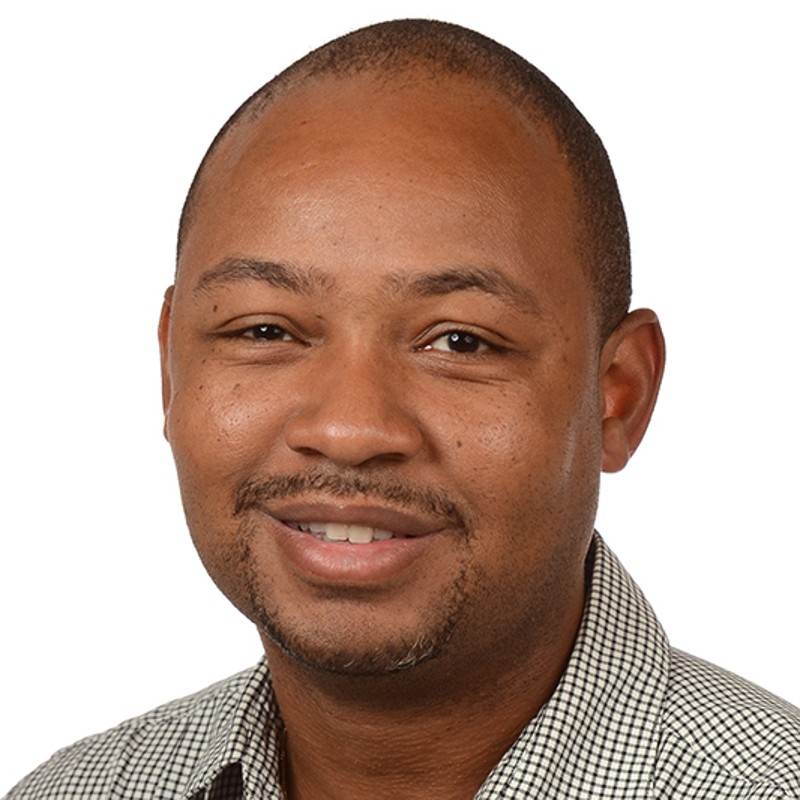
Wilborn P. Nobles III covers City Hall for the AJC.
Wilborn P. Nobles III is a journalist with The Atlanta Journal-Constitution (AJC), where he covers Atlanta City Hall. He originally joined the AJC staff to cover DeKalb County Public Schools in November 2020. Earlier this year, he started to cover Atlanta City Hall. He previously worked for The Baltimore Sun covering the government. There he covered police shootings, housing discrimination and other things revolving around issues within Baltimore County, Maryland. Nobles also interned at The Washington Post, where he covered local news. Additionally, the Louisiana native covered education for The Times-Picayune in New Orleans.
With politics being prominent in Atlanta right now due to the upcoming mayoral election, Atlanta residents also have to vote for a new council president and an entirely new city council, and the Atlanta Public School Board.
All 15 seats for the Atlanta city council are up for election. Among those 15 seats, six of those seats will not be filled by an incumbent due to leaders running for other positions or just not running for re-election. Nobles, however, is solely focused on covering the Atlanta Mayoral election. Early voting began on Oct. 12 and ended Oct. 29. The general election will take place on Nov. 2.
Each local election is crucial and dictates the future of a community, including where tax dollars go.
“Super voters are people who vote in every election. No matter if it has something to do with the president or raising taxes or legalizing some new aspect or service to the city,” Nobles said. There is also a large group of people who are “apathetic” because they feel like the elections do not care about them or their community, an issue Nobles found prominent in Atlanta. Some people also do not believe that the vote counts or is essential, making them sceptical to go out and vote. Nobles explained that it is crucial to learn and research people who are running for office or who are interested in running for office so people can be informed and then participate.
“Black voters are concerned about affordable housing, career opportunities, and public safety. The latter issue includes both crime and police reform,” Nobles explained.
Nobles said he always wanted to cover politics and government to help hold politicians and leaders accountable. His advice to reporters or anyone when covering politics is simple.
“As a new reporter on the beat, they want to give you their best impression, but it is important for you to do your homework, ” he said. “Talk to people and read what’s been written about them, any sort of homework you can do ahead of time.”
He said that as a journalist, your first obligation is accountability and transparency.
For more information, you can follow Wilborn Nobles or read his articles about the Atlanta mayoral race at www.ajc.com.
Ariyana Griffin is a student at Clark Atlanta University.
K-12 Reporter Gives Insight on how COVID-19 Affected Metro Atlanta Schools
By Ariyana Griffin
Kristal Dixon is the K-12 reporter for Axios Atlanta Local News
Kristal Dixon was an education reporter covering Cobb County for the Atlanta Journal-Constitution (AJC). She now serves as the K-12 reporter for Axios Atlanta local news, a publication that will be launching in October. She has also covered some public safety issues in Cobb County. Due to unprecedented times, there has been plenty to cover when it comes to the school systems, and here is what she has to say about that.
How did you get into education reporting and journalism?
I have always wanted to be a journalist since my teenage years, so I started focusing on that. I worked at the school newspaper at the University of West Georgia and I just continued my career that way. I started covering K-12 education in my first full time reporting job at the Cherokee Tribune in August 2007. I covered K-12 education for about three or four years. I took a bit of a break from it because I started covering the County Government Beat, and later started working for Patch.com. I kept following K-12 education for the last several years, but when I was hired at the AJC in February 2019, I kept that up. I narrowed my coverage down to Cobb County. In February of 2021, while I was at the AJC, I was promoted to the education team to cover Cobb and DeKalb County schools.
What are some key issues that you have noticed K-12 students face?
Right now, obviously the COVID-19 Pandemic is a brewing issue that schools have been contending with for the last 18 months. Also the COVID-19 pandemic actually brought to light a lot of inequities that school districts saw when it comes to K-12 education. A lot of districts realized that other students did not have the technology that they needed at home to do their virtual lessons. So a lot of districts began to fundraise and partner with community organizations to get laptops and hotspots donated for their students. Because of this, a lot of districts are contending with what they call a “learning loss.” They are actually checking in with students to see how much they’ve been able to retain, how much they may have gained, or how much they may have lost during the pandemic. Those are the two main issues that are happening right now.
Tell me a little more about the upcoming publication, Axios.
We haven’t launched yet, I am in training right now. We are going to launch a new Atlanta site. Axios has an initiative that they want to open websites that cover news featuring various topics in different communities around the country. Atlanta is one of several sites that they plan to open in 2021. My job will entitle writing stories that will go in a daily newsletter. We launch on October 4, 2021. We will be covering news around Atlanta. I would be interested in continuing to watch K-12 education at Axios.
Have you branched out and covered any stories on higher education?
Kennesaw State, located in Cobb County, was having a housing shortage for its students. They decided to break ground on some apartments that would house students who attend Kennesaw State.
What were some of your biggest stories you have covered regarding public safety?
One story I covered last year was police departments using license plate readers to help them solve crimes. They put them up in certain intersections or neighborhoods that they believe are “problem areas.” Anytime a vehicle has been flagged as being connected to a crime, whenever that vehicle passes through the license plate reader, the police department knows that this vehicle is connected to a crime possibly in that area. This is not really public safety related, but it is along the lines of law enforcement agencies.
I did cover some jail deaths at the Cobb County Adult Detention Center. Since December of 2018, there have been nine in custody jail deaths at Cobb County Adult Detention Center. It became a flashpoint in the 2020 elections of the Cobb County Sheriff, which the long time incumbent Neil Warren lost to incumbent Sheriff Creg Owens. This also led a lot of people who had family members that were detained at the jail and the ACLU of Georgia to reach out and bring attention to the conditions of the jail. There were also some issues with a lot of vacancies at the Sheriff’s Office, which some people say contributed to the lack of adequate staffing at the detention center.
For more information about Kristal Dixon, you can follow her at @KristalDixon.
Ariyana Griffin is a student at Clark Atlanta University.
This issue of The Byline was edited by Tianna Faulkner and Amir Vera.
Former CNN producer reflects on her career and being theonly Black woman in newsrooms
By Tenisha Taylor
As a young girl, I always wanted to own my own radio station, WTNT –
Dynamite. I always had something to say, and with the initials, TNT (Tenisha Nicole Taylor), I figured whatever I decided to do in life had to be dynamite.
Tenisha Bell.
While the dream of owning WTNT radio never came to fruition, the reality of working in media did. At 16, I dipped my toes in the industry when I became a typesetter for The Chicago Citizen, one of Chicago’s two Black newspapers at the time. After being immersed in black newsroom culture for a summer, I was hooked on media. I followed publisher Bill Garth to meetings, luncheons and business functions, taking copious notes. I shadowed managing editor Lisa Ely ad nauseum, learning everything I could about reporting and the journalism business. By the time I was a high school senior, I was writing stories for the paper, covering stories affecting Black communities. Working for the Black press carried a sense of pride; it was a badge of honor.
Unfortunately, in my naivety, I thought that every newsroom cared about Black voices and stories. After college and starting my first job, I quickly realized the world was different. At The Citizen, everyone was Black and championed Black culture. In my new world, I was often the only Black woman in the newsroom — and the only one who cared about our stories. I eventually became the woman who only pitched Black stories. The comfortable, supportive Citizen newsroom wasn’t representative of what I would experience. While I am grateful it solidified my presence as a Black woman journalist, I had to readjust my thinking if I wanted to survive as an African-American woman in this industry.
As my career progressed, I often carried the burden of being the lone Black person and pitching our stories without being pigeonholed. It was, and is, a delicate balance. Once I transitioned into management, I was careful not to show favoritism. But with time, I learned favoritism was how some races ensured their friends succeeded. Black women in media must play by a different set of rules; there needs to be a class taught about them. A Black woman can’t be too passionate about a story, or she’ll be labeled aggressive. On top of that, black women work twice as hard to earn half the respect.
Many Black women journalists carry the weight of representing their race and culture to the highest standard. How you dress, how you rock your hair, what you say, how early you arrive, how late you stay, who you support and promote — these all factor into how you are viewed in a newsroom. And with all that pressure, Black women are still not paid their worth. Black women make .61 cents for every $1 white men make.
Despite the challenges, I found that being true to myself was important. Yes, it cost me some battles but it didn’t cost me my inner peace. I vowed to fight on behalf of Black people who needed an advocate in the newsroom. I vowed to push for stories that were important to Black people and to treat people with dignity and respect.
After 16 years in newsrooms, I am pleased with myself and the work I accomplished. When I reflect on my newsroom career, I am confident the little girl who wanted to own WTNT radio, not only had something to say but used her voice to help other Black people in journalism.
Tenisha Taylor is a PR consultant, former CNN producer and served as AABJ President from 2010 to 2014.
Books You Should Read by Black Women Journalists
By Alexis Grace
In honor of Women’s History Month, AABJ is highlighting Black women journalists who have had an impact on the industry. One way to honor them is to read books written by some of these incredible women. Here are just a few books you should check out if you’re looking for some inspiration:
More Than Enough: Claiming Space for Who You Are (No Matter What They Say) by Elaine Welteroth
Credit: Penguin Random House
In 2017, Elaine Welteroth made history when she became the first black editor-in-chief of Teen Vogue. A year after leaving the monthly magazine, Welteroth became a New York Times Bestselling author with her book, “More Than Enough,” – a memoir for anyone who has ever felt “othered, overlooked, underestimated, undervalued, and still chooses greatness.” In the book, Welteroth discusses life lessons and breaking barriers while being the only black woman in the room. Readers are reminded they are more than enough despite their challenges. The book will help you face inner conflicts and build confidence.
The Light of Truth: Writings of an Anti-Lynching Crusader by Ida B. Wells
Credit: Penguin Classics
Journalism pioneer Ida B. Wells once said: “The way to right wrongs is to turn the light of truth upon them.” For Wells, that meant exposing the horrors of lynching. “The Light of Truth,” includes a broad assortment of Wells’ articles and discusses her journalism career and experiences while traveling abroad. Wells’ book also addresses her anti-lynching reporting. Her impact has made a lasting impression, with the creation of the Ida B. Wells Society, an organization dedicated to training investigative journalists of color. The National Association of Black Journalists also gives an annual, prestigious award in her honor.
Note to Self: Inspiring Words From Inspiring People by Gayle King
Credit: Penguin Random House
TV personality and CBS This Morning co-host Gayle King gathered her favorite letters of inspiration from a popular CBS This Morning segment and put them all in one place. Her book, “Note to Self,” includes encouraging messages and advice to the author’s younger self. The book provides a sense of appreciation for who the authors once were and who they are today. The New York Times bestseller includes essays from well-known figures like entrepreneur and former television talk show host Oprah Winfrey and the late, esteemed poet Maya Angelou. King’s book is excellent for anyone struggling with growing pains and can be uplifting for those who need a quick boost to their day. These tender words are also great for self-reflection.
Alexis Grace is a senior at Clark Atlanta University. She is also president of the school’s NABJ-CAU chapter.
FEATURE STORY: Errin Haines talks new online news nonprofit The 19th
By Darriea Clark
Errin Haines. Credit: The 19th
Errin Haines colored her journalism career with discussions and reports of race and ethnicity. The former Associated Press newswoman, got her bearings at Atlanta Daily Word, a black newspaper in the city. Haines, a former National Association of Black Journalists Vice President of Print, credits the newspaper for helping her realize she wanted to cover black communities. Now, the proud Atlanta native serves at editor-at-large for The 19th, a national news nonprofit focused on women issues. Haines spoke with Byline reporter Darriea Clark about the latest venture, NABJ and what readers can expect.
DC: How did you get involved in journalism and how did segue into political journalism?
EH: I got involved with journalism when I was a sophomore in college. My school paper wasn’t that great. I didn’t really see that as being a stepping stone to making a career out of [journalism]. I was looking through Creative Loafing, saw an ad for an AABJ meeting. So, I went, introduced myself and everyone embraced me and was helpful. One of my friends in the student chapter referred me to TheAtlanta Daily World. The day I walked in was the day they got me started. They gave me my first article, and I stayed. I eventually worked there for year covering all aspects of black life in Atlanta.
I got into covering politics during the 2008 election during Barack Obama’s historic candidacy and then presidency. Atlanta has a very storied past around issues of race: Martin Luther King Jr. obviously being from here, John Lewis being such a living icon, Andrew Young — they were all her. They were people I talked to about building a legacy from their efforts. The fruition of that embodied this historic presidency. I was drawn to politics for that reason and covering that black electorate out of the South which was pivotal in his nomination and election. From that point, I wanted to get a deeper understanding of politics.
DC: You are the first and only reporter for the 19th news until others are hired. How have your previous positions prepared you for the demand of the role?
EH: Working at the AP taught me a couple of things. First, metabolism. I was constantly having to think and write about [this topic] for a national audience. My stories have run in The New York Times and The Washington Post. They’ve also run in small newspapers in the middle of the country — places where they may have not had black or brown journalists who were going to write about these issues. That’s one avenue that has led me to where I am now.
My involvement as a member and in leadership with NABJ has prepared me for this role, because I’ve had to think about representation and why that matters in journalism, mainly around issues of race. NABJ is about creating the types of newsrooms that more accurately reflect our society, and we know we’re not there yet. At the 19th, we absolutely want to create a newsroom that is reflective of both the fact that black and brown people are soon to become the majority in this country and that women are already the majority of the electorate population.
Errin Haines. Credit: The 19th
DC: In what ways are the world ready for a platform like the 19th news, and what ways are they not?
EH: [The 19th’s] assertion is that this platform is overdue. We are certainly feeling that sense of urgency as we have been out for the past month. We’re hearing from so many women. On the campaign trail, people are coming up to me and saying how excited they are that we have launched. Like I said before, women are more than half the electorate, yet in politics, women are discussed as a special interest group. I say to people all the time, “All issues are women’s issues.” That’s whether you’re talking about the economy, or education, or healthcare, you name it.
DC: There are a lot of women who feel like their voices aren’t being heard or their stories are being told. How do you plan on approaching those people who may not tap into the traditional news articles?
EH: Trying to meet women where they are. We’re doing listening tours as part of a soft launch in multiple cities across the country. Going to women, listening to them, asking them: “What are the issues you most care about? What is the coverage that you want to see in the 19th?” It’s something that we want people to take ownership of, it’s a conversation we’re trying to start. We’re not just telling you what it means to be a woman engaged in politics. We want to engage with those women. And so, there will be those listening tours. We are going to do live events, because it’s important to be in conversation with women about the journalism and about these issues that we’re trying to raise through the journalism.
DC: How can newsrooms begin to make a more conscious shift toward diverse journalists?
EH: It has to be deliberate. I believe in our mission and I believe in our mission. I did feel like it was necessary to have the conversations we wanted to start. We had to build something new, but that’s not to say that media organizations should not be doing better in terms of race and gender. Our goal is equity. That is something we get to think about [everyday] and we build this.
DC: How will you define success in this venture? When will you be satisfied with the work and the mission?
EH: That’s a good question. Were the women who worked to ratify the 19th amendment satisfied what that amendment was passed? Was Shirley Chisholm satisfied when she ran for president and made history although she didn’t win? I want to continue in my job as a black person and as a woman and push the democracy forward as much as I can in the time that I’m here to do that job. Success to me looks like forward progress every single day. I think about the women and the people of color who came before me who did not necessarily see the victory or the “finish line” in their lifetime but did their efforts got people that much closer to where they need to be. Ida B Wells was certainly successful, even though she was not able to stop lynching in America. Success looks like for me and the 19th for us to do our part to change the conversation as much as we can and to the extent that we can while we are here. In a lot of ways, our being here and our existence tells me that we’ve already won.
DC: The 19th is launching, and then you’re going on a tour in April. What’s next for the nonprofit?
EH: A listening tour, the primary election, ramping up our hiring, and then we’re heading into the summer, the convention. We’re having an eventual nominee against our president, and then it’s on to the general election. We are obviously very much invested in honoring, marking the anniversary of the 19th amendment. You can stay tuned on our details to commemorate that. We are definitely growing, fundraising, committing to journalism, and trying to change this conversation every day.
Darriea Clark is an AABJ member and recent graduate of Syracuse University. This article was edited for length and clarity.