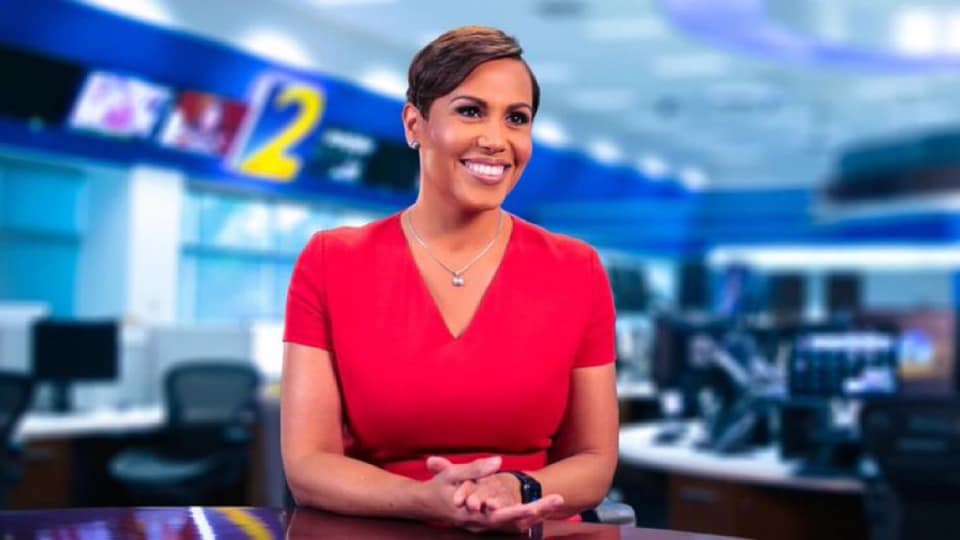
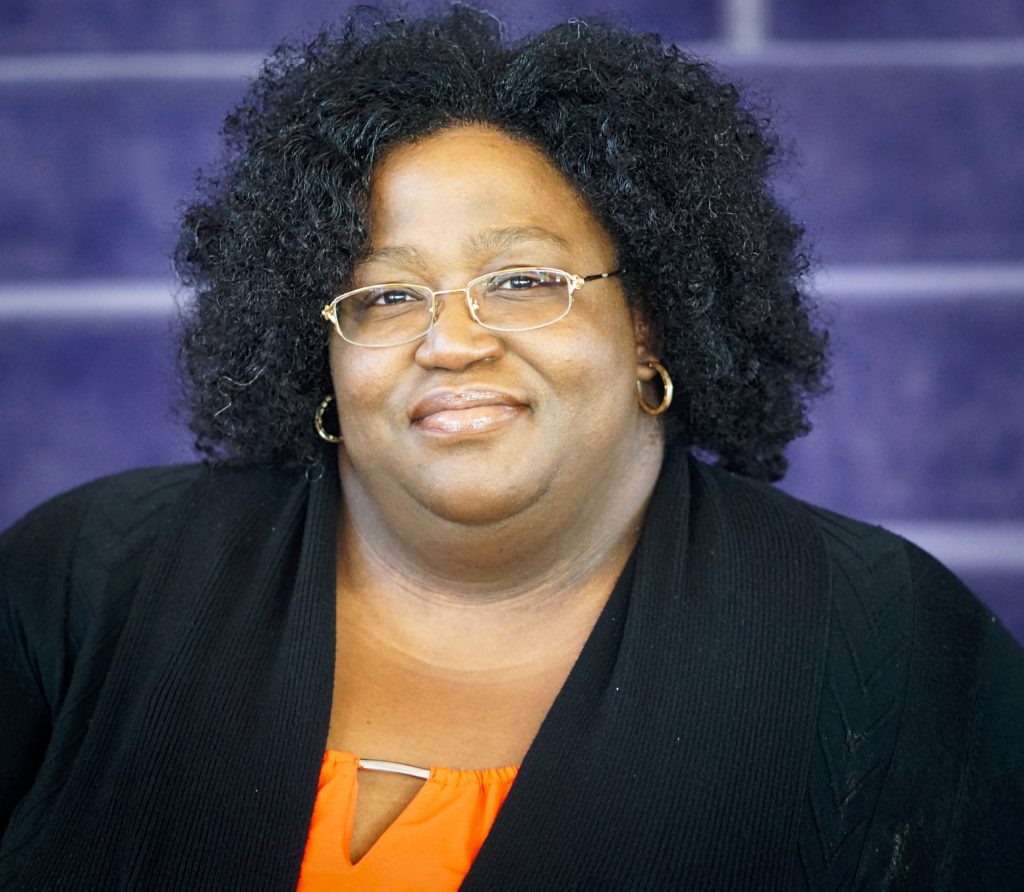
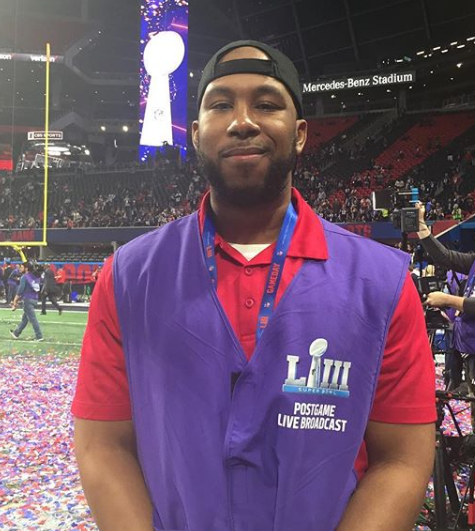
As an organization, we are mourning the loss of Jovita. She played an integral part in not only AABJ, but also as a presence in Atlanta. We understand many of our members were close with Jovita, and even if you did not know her personally, you may have felt connected to her through her work in the community. You can read more information about Jovita, her life and watch a very touching tribute video on WSB-TV’s website. AABJ has shared many memories with Jovita Moore through the story feature on our Instagram account.
AJC Higher Education Reporter Speaks on Challenges in Higher Education Learning
By Elisheva Wimberly
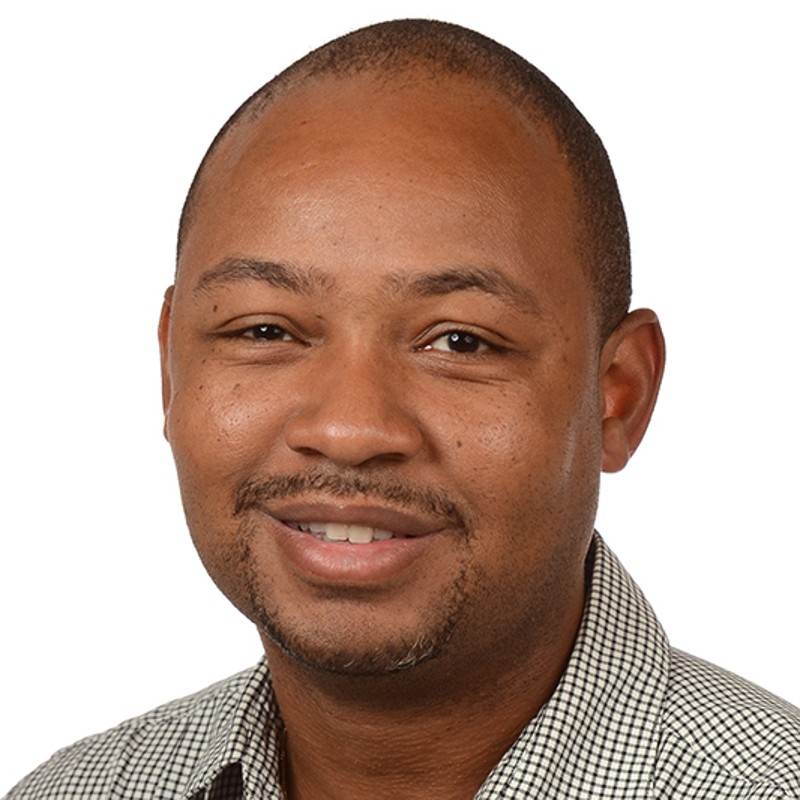
Eric Stirgus, AJC reporter
Eric Stirgus is the Higher Education Reporter at The Atlanta Journal-Constitution. He focuses on schools and universities throughout Georgia, primarily focusing on metro-Atlanta colleges and universities.
Two years ago, Stirgus focused on a variety of topics in higher education, including student loan debt, sexual misconduct and administration in higher learning. Today, Stirgus still covers those issues, but on a very small level. Stirgus looks at higher education from a completely different lens. About 90 percent of the issues he covers today are COVID-19 related, ranging from how colleges are managing the pandemic to the type of services they provide students. The Byline asked Stirgus if concerns of faculty are being heard regarding Atlanta colleges and universities not providing enough safety measures.
“Faculty will say no. They just finished weeks worth of rallies and demonstrations,” Stirgus said. “They want mask mandates and they’d like to have vaccine mandates but the University System of Georgia says no.”
The University System of Georgia (USG) strongly encourages faculty, students and staff to wear masks and get vaccinated, but Gov. Brian Kemp has been adamant that they don’t want to see mandates.
“The faculty are frustrated”, Stirgus said. “They feel the need to speak up and it keeps me quite busy trying to keep up with it.”
Stirgus said even through these rallies and demonstrations of protest from faculty he hasn’t heard much from students on the issue.
“In general, I feel like they’re supportive of these issues that faculty want but I don’t see them protesting,” Stirgus said. “I think that most of them want to be back on campus after over a year of not being on campus and experiencing online learning.”
The majority of students Stirgus sees on college campuses are wearing masks. However, the University of Georgia has had more positive cases than any other institution in Georgia.
When Stirgus visited UGA last week and went into the student center, he noticed half of the students present were not wearing masks. Last week, UGA had a big drop in their COVID-19 cases. Stirgus will be monitoring reports to see if the University of Georgia’s numbers show up low.
The Byline asked Stirgus if there’s a possibility of vaccine mandates becoming a requirement for all faculty, students and staff across the University System of Georgia.
“Biden has taken that step for federal workers and businesses with more than 100 employees but if he wanted to he would have done it by now,” Stirgus said. “If there is another spike, he might mandate it but we’ll see.”
Despite the feud over mask mandates, there are some positives to higher education according to Stirgus. He hears from many administrators and faculty. They share with him that remote learning has helped them become a lot more nimble in trying to find new ways to reach out to students. Stirgus says COVID-19 has given people in the education and outside world a better perspective of the challenges that it takes to be an educator.
“Before COVID I was writing on mental health,” Stirgus says, “That has become a greater challenge with COVID and they need to provide students with services that support their needs. Faculty realize those things are still very important.”
Compared to the University of Georgia, the Atlanta University Center’s (AUC’s) COVID-19 numbers have been very low, as they have been following mask mandates. Stirgus says they are different from the University System of Georgia because they require students to be vaccinated on campus. The AUC does not keep track of self-reported cases. And recently, they took the step last week to do weekly COVID testing. Along with the Atlanta UniversityCenter, Emory’s cases have also gone down.
Strigus believes the AUC is using more aggressive measures than the USG. Morehouse College and Spelman College have cancelled their Homecoming 2021 due to the lingering effects of COVID-19. Whereas universities such as UGA recently had 93,000 fans in their football stadium.
“A lot of schools are going full speed ahead,” Stirgus said. “I don’t see them adjusting.”
As for commencement ceremonies, Stirgus says the deciding factor on that decision will be the COVID-19 numbers.
“Hopefully the numbers will decline by commencement,” Stirgus says, “As long as we do what we have to do to keep the delta variant in check, I think we will see commencement ceremonies.”
Elisheva Wimberly is a student at Georgia State University.
Sandy Springs Mayoral Candidate, Dontaye Carter Discusses Career, Equality and Politics
By Da’Zhane Johnson
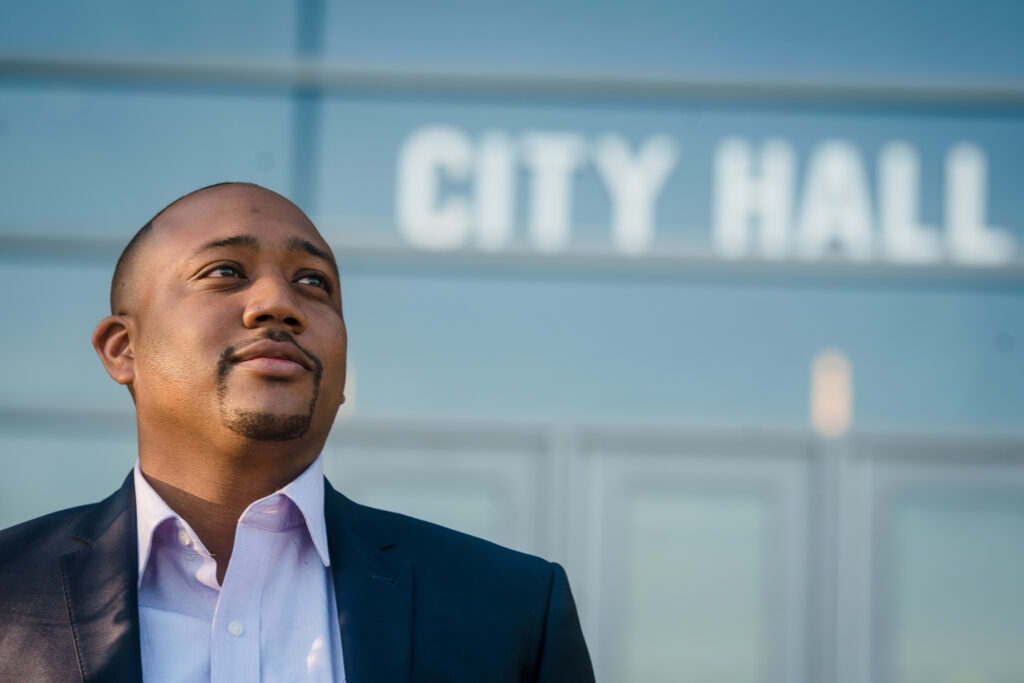
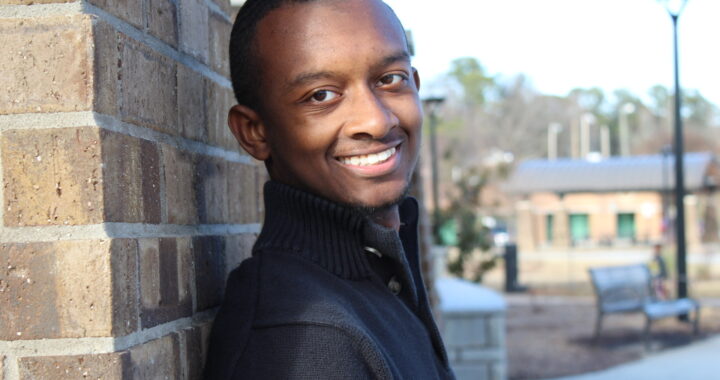
Dontaye Carter at City Hall in Sandy Springs, Georgia (Photo by Kevin Lowery)
Dontaye Carter is a Black man juggling a family, career, and now a campaign, proving once again that hard work and perseverance prevails. He is running for Mayor in the city of Sandy Springs against incumbent Mayor Rusty Paul, who has been in office since 2014, in hopes of providing a better future and world in which his young daughter can live.
While a sophomore in college at Florida A&M University, Carter already received his first journalism job at WCTV in Tallahassee, Florida. Inspired by his mother’s hard work ethic, Carter would wake up for work at 4 a.m. and then head to class at 9 a.m. He kept this routine for six months until the station promoted him to a producer. His success post-graduation matched his previous years too. Carter was a reporter in Tulsa, Oklahoma, then brought his talents to Atlanta.
The next couple of years, Carter continued reporting in the Georgia capital. Unfortunately, the work took a toll on his personal life, which caused him to switch careers.
“Personally, not only did I want to be a husband that was there, but a father that was there,” Carter said. “I wanted to be invested in my relationship, in my family, and I wanted to find something I was passionate about.”
The Fulton County’s District Attorney Office is where Carter found the passion he was searching for. While serving as a public affairs officer, Carter worked on cases that he felt had unjust verdicts. The case of four teens who were accused of murder specifically stuck with the mayoral candidate throughout the years. Often the cases showed signs of injustice and imbalance within the community.
Carter then decided to enhance the voices of unjust victims through his own business, Carter Media Group. The company served as a companion with attorneys to display the stories and challenges victims faced in their cases. In fact, Carter Media Group has been the public relations firm for several high-profile cases, like the case of R&B singer R. Kelly .
“I worked with Attorney Gerald Griggs, many of the survivors of that case and their families. We worked diligently because what we saw happening was everybody trying to turn that into a he-said-she-said case, but it was really a case about human sex-trafficking” Carter stated. “These plane tickets have to have these girls’ ages on them, so we put them out.”
Carter went on to speak about his work with the Jimmy Atchison case too. He recalled looking through files. Additionally, he highlighted the importance of keeping the public informed. Several agencies were even called to examine the case facts thoroughly.
Despite the backlash he’s recently received from some residents, Carter still believes politics is his best outlet for promoting change in Sandy Springs. He spoke of the significance of community, representation and trust. The three elements are key components to what has inspired him running in elections this year. The husband and father wants a city that, most importantly, gives his family a voice and protection, and obtaining the title of mayor will grant him access to create that city.
Sandy Springs is known to have a large white population and Carter has not ignored this fact. He understands that most residents of the city agree with the injustice displayed by policymakers in the past. Carter spoke in detail about his standards for people who are elected into office.
“There is nobody in office right now that I trust to take care of my daughter or anybody that looks like her. We have to put people in office that put their constituents first,” Carter stated. There was a lot of talk last year about change, but the way of those words haven’t met actions a year later. Until we get people in office whose words match their actions, we’re never going to be in an equitable society.”
While in office, Carter has explained before that he wants to focus on several issues, which include affordable housing, sustainable developments, schooling and diversity and inclusion. However, his passion for these issues does not negate from his immediate focus — managing the COVID-19 pandemic. Carter explained how he wanted to open the discussion of mandated vaccines to further the safety for all residents. The former reporter believes the conversation surrounding COVID-19 has been converted from survival to political.
“I know the mandating has been so politicized, but the reality of it is, in Fulton County, your child has to get 14 vaccinations before they start school,” Carter said. “We’re already getting vaccines, one more vaccine to ensure that people are going to survive is vitally important to me.”
The details of Carter’s campaign can be found on www.dontayeformayor.com. Election day is November 2.
Da’Zhane Johnson is a student at Clark Atlanta University.
Atlanta City Hall Reporter Speaks Politics
By Ariyana Griffin
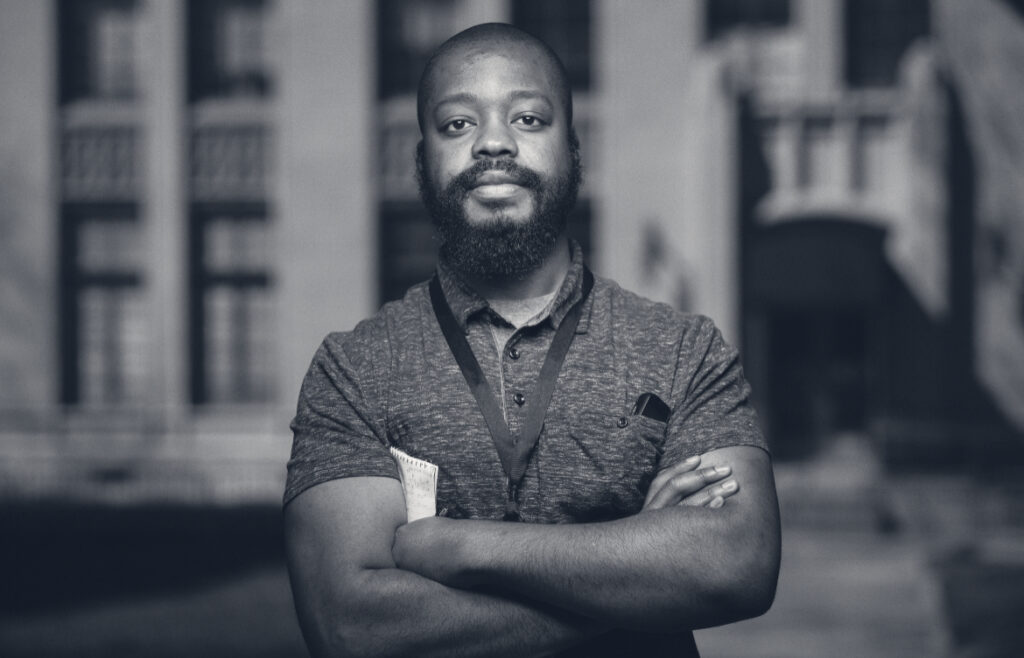
Wilborn P. Nobles III covers City Hall for the AJC.
Wilborn P. Nobles III is a journalist with The Atlanta Journal-Constitution (AJC), where he covers Atlanta City Hall. He originally joined the AJC staff to cover DeKalb County Public Schools in November 2020. Earlier this year, he started to cover Atlanta City Hall. He previously worked for The Baltimore Sun covering the government. There he covered police shootings, housing discrimination and other things revolving around issues within Baltimore County, Maryland. Nobles also interned at The Washington Post, where he covered local news. Additionally, the Louisiana native covered education for The Times-Picayune in New Orleans.
With politics being prominent in Atlanta right now due to the upcoming mayoral election, Atlanta residents also have to vote for a new council president and an entirely new city council, and the Atlanta Public School Board.
All 15 seats for the Atlanta city council are up for election. Among those 15 seats, six of those seats will not be filled by an incumbent due to leaders running for other positions or just not running for re-election. Nobles, however, is solely focused on covering the Atlanta Mayoral election. Early voting began on Oct. 12 and ended Oct. 29. The general election will take place on Nov. 2.
Each local election is crucial and dictates the future of a community, including where tax dollars go.
“Super voters are people who vote in every election. No matter if it has something to do with the president or raising taxes or legalizing some new aspect or service to the city,” Nobles said. There is also a large group of people who are “apathetic” because they feel like the elections do not care about them or their community, an issue Nobles found prominent in Atlanta. Some people also do not believe that the vote counts or is essential, making them sceptical to go out and vote. Nobles explained that it is crucial to learn and research people who are running for office or who are interested in running for office so people can be informed and then participate.
“Black voters are concerned about affordable housing, career opportunities, and public safety. The latter issue includes both crime and police reform,” Nobles explained.
Nobles said he always wanted to cover politics and government to help hold politicians and leaders accountable. His advice to reporters or anyone when covering politics is simple.
“As a new reporter on the beat, they want to give you their best impression, but it is important for you to do your homework, ” he said. “Talk to people and read what’s been written about them, any sort of homework you can do ahead of time.”
He said that as a journalist, your first obligation is accountability and transparency.
For more information, you can follow Wilborn Nobles or read his articles about the Atlanta mayoral race at www.ajc.com.
Ariyana Griffin is a student at Clark Atlanta University.
K-12 Reporter Gives Insight on how COVID-19 Affected Metro Atlanta Schools
By Ariyana Griffin
Kristal Dixon is the K-12 reporter for Axios Atlanta Local News
Kristal Dixon was an education reporter covering Cobb County for the Atlanta Journal-Constitution (AJC). She now serves as the K-12 reporter for Axios Atlanta local news, a publication that will be launching in October. She has also covered some public safety issues in Cobb County. Due to unprecedented times, there has been plenty to cover when it comes to the school systems, and here is what she has to say about that.
How did you get into education reporting and journalism?
I have always wanted to be a journalist since my teenage years, so I started focusing on that. I worked at the school newspaper at the University of West Georgia and I just continued my career that way. I started covering K-12 education in my first full time reporting job at the Cherokee Tribune in August 2007. I covered K-12 education for about three or four years. I took a bit of a break from it because I started covering the County Government Beat, and later started working for Patch.com. I kept following K-12 education for the last several years, but when I was hired at the AJC in February 2019, I kept that up. I narrowed my coverage down to Cobb County. In February of 2021, while I was at the AJC, I was promoted to the education team to cover Cobb and DeKalb County schools.
What are some key issues that you have noticed K-12 students face?
Right now, obviously the COVID-19 Pandemic is a brewing issue that schools have been contending with for the last 18 months. Also the COVID-19 pandemic actually brought to light a lot of inequities that school districts saw when it comes to K-12 education. A lot of districts realized that other students did not have the technology that they needed at home to do their virtual lessons. So a lot of districts began to fundraise and partner with community organizations to get laptops and hotspots donated for their students. Because of this, a lot of districts are contending with what they call a “learning loss.” They are actually checking in with students to see how much they’ve been able to retain, how much they may have gained, or how much they may have lost during the pandemic. Those are the two main issues that are happening right now.
Tell me a little more about the upcoming publication, Axios.
We haven’t launched yet, I am in training right now. We are going to launch a new Atlanta site. Axios has an initiative that they want to open websites that cover news featuring various topics in different communities around the country. Atlanta is one of several sites that they plan to open in 2021. My job will entitle writing stories that will go in a daily newsletter. We launch on October 4, 2021. We will be covering news around Atlanta. I would be interested in continuing to watch K-12 education at Axios.
Have you branched out and covered any stories on higher education?
Kennesaw State, located in Cobb County, was having a housing shortage for its students. They decided to break ground on some apartments that would house students who attend Kennesaw State.
What were some of your biggest stories you have covered regarding public safety?
One story I covered last year was police departments using license plate readers to help them solve crimes. They put them up in certain intersections or neighborhoods that they believe are “problem areas.” Anytime a vehicle has been flagged as being connected to a crime, whenever that vehicle passes through the license plate reader, the police department knows that this vehicle is connected to a crime possibly in that area. This is not really public safety related, but it is along the lines of law enforcement agencies.
I did cover some jail deaths at the Cobb County Adult Detention Center. Since December of 2018, there have been nine in custody jail deaths at Cobb County Adult Detention Center. It became a flashpoint in the 2020 elections of the Cobb County Sheriff, which the long time incumbent Neil Warren lost to incumbent Sheriff Creg Owens. This also led a lot of people who had family members that were detained at the jail and the ACLU of Georgia to reach out and bring attention to the conditions of the jail. There were also some issues with a lot of vacancies at the Sheriff’s Office, which some people say contributed to the lack of adequate staffing at the detention center.
For more information about Kristal Dixon, you can follow her at @KristalDixon.
Ariyana Griffin is a student at Clark Atlanta University.
This issue of The Byline was edited by Tianna Faulkner and Amir Vera.
Journalists provide post-Election Day analysis for Morehouse College event
By Elisheva Wimberly
A week after Election Day, Morehouse College’s Journalism and Sports Program hosted its annual post-election analysis discussion. The college has held the discussion since Barack Obama was elected president in 2008.
Led by program director and Morehouse College professor Ron Thomas, this year’s event, which included a panel discussion with diverse journalists, focused on the presidential race, Georgia Senate runoffs and the state’s transformation to a “blue state.”
NBC News White House correspondent Geoff Bennett said covering President Donald Trump changed his life and spoke on what made the past for years difficult for him as a reporter.
“You can’t trust people who are saying things which are close to the president,” Bennet said. “The biggest part is separating the noise.” Bennett said relaying words precisely as they appear from President Trump is crucial in not hiding the truth.
Morehouse College hosted it’s annual post-Election Day analysis event. (Credit: Morehouse Journalism & Sports Program).
“If the president is using racist language, call it racist and not racially charged. Be empowered in the newsroom and say it on air.”
Panelists also discussed the varied reactions to Kamala Harris becoming Vice President-elect. Christina Greer, a Fordham University at Lincoln Center political science professor, has reviewed women’s history in politics over time and said President Trump’s resistance to accept the election results is not about Joe Biden, but Harris.
Biden will be 78 years old on January 20. If inaugurated, he will be the most senior president ever to take office, and could lead to Biden not seeking a second term, Greer said.
“They cannot fathom a Black woman, an Indian woman, a child of immigrants, a graduate of an HBCU possibly as a leader of the free world,” Greer said. “It’s not about Joe. I think it’s about this idea that a black woman could be in charge of the United States of America.”
The divide between both the Democratic and Republican parties in this country has led Greer to believe we’re at a point of no return.
“We’ve shown time and time again in the past four years that white supremacy, anti-Black racism, and patriarchy are the foundation and bedrock of this nation, and we have not moved very far away from it,” Greer said.
Apart from the presidential race, Georgia will have two Senate runoff races between Democratic nominee Jon Ossoff and Republican incumbent David Perdue and between Democratic Nominee Rev. Raphael Warnock and Republican appointee Kelly Loeffler.
“It’s important to note over the past 20 years, Democrats have always lost the runoffs. But their showing in the 2018 runoffs was stronger than it has been,” Morehouse College political science professor Adrienne Jones said. “For this particular runoff election, all eyes are on Georgia. Hopefully, people will stay motivated and realize the high stakes.” Jones added Biden and Harris’ ability to run the government will be enhanced by Georgia democrats winning the Senate races.
“There’s a risk in both races, but this is a different kind of runoff Georgia has seen before,” Jones said. “We should expect different and improved results.”
Republicans invested in Latino voter registration all over the country. President Trump received Latino support in Florida and Texas. Mariela Romero, the producer of Univision news magazine Conexión Fin de Semana, said the support of a Hispanic person comes from either what country they’re from or where their family is from.
Romero said many Latinos voted for Trump due to false claims that Democrats are socialists. Ads compared Joe Biden and Kamala Harris to Venezuelan socialists and Cuba’s Castro family.
“It was shocking. It was completely false,” Romero said. “It executed rapidly, and people were fighting like the democrats were the worst thing that happened to this country.”
Many Latinos living in rural areas are also exposed to talk radio. Romero said Democrats have to do a better job in reaching those communities, adding the message that comes from propaganda, social media, and radio is compelling.
Romero also said religion plays a role: Many Latinos are Catholic or becoming Evangelica and some of those churches are very anti-LGBTQ and anti-abortion. While Trump lost the support of white Catholics, he gained approval from Latino Catholics, she said.
“The lesson for the Democratic party is: The Latino electorate is too diverse to pigeon hole,” Romero says. “Democrats have to send targeted Latinoes to the Hispanic community.”
Elisheva Wimberly is a student at Georgia State University.
Robin Roberts inspires women during United Way leadership breakfast
The intimate event was a virtual conversation with topics ranging from the progress of women to how COVID-19 and racial injustice have thrusted issues of inequity into the headlines.
“We’re not complaining — we’re explaining. Full justice is not served until those who are not affected are as outraged as those who are,” Roberts said.
Monica Kaufman Pearson, a retired anchor for WSB-TV, served as moderator for the program. Pearson, a staple in Atlanta, has a long friendship with Roberts. Back in 2012, Roberts served as emcee for Pearson’s retirement party held in the Fox Theatre while battling her newly diagnosed myelodysplastic syndrome, or MDS.
Robin Roberts spoke about her career and triumphs at the United Way of Greater Atlanta’s annual women’s breakfast. (Credit:United Way of Greater Atlanta)
As keynote speaker, Roberts detailed the highs and lows of her lifetime. She fondly shared her journey to becoming a successful anchor and the struggles of being a Black woman in journalism.
“I made it very clear: I am proud of who I am doing the work like everyone else,” Roberts said. She recalled working multiple jobs, even working as a school bus driver on her quest to make a name for herself in media.
The youngest of four children, Roberts grew up in Pass Christian, Mississippi.
“I grew up knowing 3 D’s in my family: discipline, determination and da-Lord.” The euphemisms instilled by her family led her to the path of success and stressed the importance of a familial unit.
Before landing a permanent role as co-anchor for Good Morning America in 2005, Roberts worked with ESPN for 15 years, hosting Sportscenter and covering the 1992 Olympic Games in Barcelona. Roberts also helped shape ESPN’s coverage of women’s college basketball. Her reporting repertoire earned her many accolades throughout her career, including the Walter Cronkite Award for Excellence in Journalism and an induction into the Broadcasting & Cable Hall of Fame.
But apart from her success, Roberts had her share of struggles. In 2012, Roberts was diagnosed with MDS, a rare blood disorder affecting the bone marrow. Rather than dealing with the diagnosis privately, Roberts became a public advocate using her platform to spread the message and encourage viewers to become more educated on the diagnosis. The coverage of her diagnosis earned her a Peabody Award. Roberts believed she was a messenger as a public figure to overcome adversity and inspire others worldwide.
“It’s not what you accomplish, it’s what you overcome to get there,” she said.
Greer Wilson is a recent Spelman College graduate.
Georgia State student recounts virtual NABJ student project experience
By Tyrik Winn
Georgia State University student Tyrik Wynn participated in his first NABJ/NAHJ virtual convention this past summer as part of the organization’s Student Projects.
The program provides students with reporting, writing and leadership experience during the convention held in August. Initially, Wynn wasn’t sure if he would be able to participate in the program, but program organizers learned of his journalism experience and brought him on board. Wynn shared his experience about NABJ Student Projects with AABJ:
When I first joined the project, NABJ hosted anchor auditions for the newscasts. The next day, I was able to meet everyone who was a part of the project, and try out for the anchor audition. The mentors said I did an amazing job with reading the script, but they said I was extremely loud and I needed to tone my voice down. I took their advice and began to work on volume control while on camera.
Shortly after the audition, Denise James, one of my broadcast mentors, gave me my next assignment which required me to produce three packages within one week. When the convention week came, I was ready and thought student projects were going to be a breeze, I was sadly mistaken. I had my work cut out for me.
Tyrik Wynn (Credit: Tyrik Wynn)
Since I had three packages, I had to schedule over 10 virtual interviews. I was also told I had to anchor two newscasts as well. I was learning how to work under pressure and tackle multiple projects at once.
One of my news packages focused on Dorothy Tucker’s first year as NABJ president. My other two packages were on NABJ elections and the NABJ/NAHJ’s first joint virtual convention.
Working on Tucker’s first year as NABJ president was my favorite assignment because I was able to interview her, which I considered a big honor. Tucker opened up to me about her first year and even talked about her experience having the coronavirus and how it affected her work.
The schedule for the NABJ Student Projects was very demanding. Each day, we began at 9:30 a.m. and my workday often ended with late nights. For one week, my life revolved around student projects; I couldn’t focus on anything else.
Tyrik Wynn is a junior at Georgia State University.
AABJ Members can donate money to AABJ using their Kroger Card
Did you know that AABJ is part Kroger’s Community Rewards program?
Yes, every time you use your Kroger Plus card when you checkout at any Atlanta division Kroger location (Georgia, east Alabama and South Carolina), AABJ can earn money — but you must sign up online for a Kroger.com account.
Signing up for a Kroger.com account also allows you to manage your card information, including address, phone number (in case you don’t have your Kroger Plus card, you can still get your savings by entering your phone number on file), track your fuel point, load digital coupons to your card and if you are a Kroger Pharmacy customer, even manage your prescriptions and refills.
This is edition of The Byline was edited by Raisa Habersham and Tianna Faulkner. The Byline will be taking a hiatus for Decemeber and will return in January. Have a happy holidays and new year!
AJC Washington Correspondent talks elections, Black voters and Georgia’s role in the election
By Elisheva Wimberly
With Election Day fast approaching, long lines are already wrapped around early voting locations in Georgia — a state considered battleground territory this presidential election and one that has come under fire for rampant voter suppression. The Atlanta Journal-Constitution’s Washington, D.C. reporter Tia Mitchell has a virtual front seat to all the action.
Mitchell came to the AJC in 2017 after covering crime, education, local government and state politics in Florida with various newspapers. As the AJC’s Washington correspondent, Mitchell covers Georgia’s delegation and national issues for a Georgia audience. The Byline spoke with her about the upcoming election season and the roll Georgia plays in it:
Q: What does this election mean for Black voters in Georgia?
TM: This is a very important election because people realize that it matters who represents you in all government levels. The President of the United States is one. The President of the United States has a tremendous amount of executive powers. We see it play out as far as the Supreme Court, and we see it play out as far as healthcare and abortion rights; we’re seeing it play
Tia Mitchell, AJC Washington Correspondent
out as far as immigration, policing, and racism. We should remember we have to pay attention up and down the ballot because yes, who is president matters, but the Congress members also matter. As voters, we have to decide which policy we like best and use that to inform us of who we want to represent us in Washington.
Q: How do you think we, as voters, should take time to learn about the candidates?
TM: It’s a personal responsibility and a civic duty. We talk about the “John Lewises” of the world and the Civil Rights leaders. We say we honor them. Well, John Lewis laid his life on the line many times for African Americans’ right to be able to vote. It wasn’t easy, we romanticize it, and now that Black folks have been voting for a generation, it’s easy to take it for granted. If we truly say we want to honor him and others, we’ve got to spend a little time doing our part. You have to take half an hour to google the candidates and see what they’re talking about. You have to take 15 minutes to tune into their debate or read articles about the race. You can go to the AJC or your local paper to see what’s being written about them. Take a minute and google them so you can see on their websites what they care about.
Q: How do you feel about Georgia being a purple state? What are some key races in Georgia? How does it feel that Georgia is a battleground state?
TM: It’s really interesting to see Georgia enter the conversation as a battleground state. I’m always skeptical because most of my career was in Florida, a battleground state. In the past 10 to 12 years, statewide elections have all been won by Republicans. For me, it’s harder to say Georgia is purple, but we cannot deny Georgia is purpling. We can’t deny how close Stacey Abrams got (to being elected Georgia’s first Black woman governor), but the question is: Is this the year a Democrat finally wins statewide in Georgia. Trends have to start with Democrats winning statewide to say that Georgia is a purple state.
Q: What are you covering election-wise right now?
TM: Because of coronavirus, it changed. I’m not doing as much traveling as I used to. However, we’re still covering the debates, covering the candidates, and covering the fact that Joe Biden is more competitive in Georgia than any Democrat has been in recent years. We’re also covering endorsements and advertisements, and I’m covering congressional races. I plan to travel to Atlanta ahead of the general election to cover the final days of the general election campaign.
Q: Are you expecting any surprises in this upcoming election?
TM: It’s hard to say because it’s so unpredictable. When I started in Washington, we were covering impeachment. We never thought we’d be writing about a pandemic. I don’t know if anyone predicted how competitive Joe Biden would be in Georgia. Things come up, scandals come up, and it’s just never what you would expect.
Q: Aside from being an AJC reporter, you’re also chair of the NABJ Political Task Force. How did you get started with the task force?
TM: In early 2019, one of the major news networks announced their political task force team, who will be covering the presidential race, and their team was all white. Everyone was coming for that network, saying their team had no diversity. NABJ, rightfully so, put out a press release saying the lack of diversity was a problem. And Marlon Walker, NABJ’s VP of Print at the time, told me to send him a proposal after I told him there was no action being done. And I said that’s what I get for opening my mouth. At the time, I was just a local government reporter, but I had a passion for politics.
It was always hard to get my foot in the door, even in NABJ, because there weren’t many political journalist opportunities. I saw there was a political task force, but they weren’t very active. I started reinvigorating the task force. We had elections, and that is when I was elected chair. I connect managers to our task force, who want a diverse staff.
Since then, we’ve had programs, webinars, and networking events in Atlanta. We share ideas, resources, best practices, and job openings. We’re currently increasing our board so more people can work on the task force.
Q: What tips can you give people who are engaging in political reporting
TM: For me, it’s two things. Some journalists have an ultimate goal, and everything they do is an incriminate step toward that goal. I am not one of those people. I’ve always been someone to look at the opportunities before me and either pursue it or don’t. I started as a night cops reporter right out of college. I tried it, enjoyed it, and got a local government job through my educational beat. I realized then that I liked political and government reporting. I wouldn’t have known that had I not tried it. One of my pieces of advice is to try it. Even if it appeals to you in a small way, try it. Take those opportunities that come before you because you never know what doors it’ll open. Take those opportunities but also make your opportunities.
Elisheva Wimberly is a senior at Georgia State University and a member of the school’s NABJ student chapter.
AABJ webinar explores the challenges in recruiting athletes in NASCAR, baseball
By Greer Wilson
If you were to count the number of Black athletes on your fingers and toes, you’d probably wouldn’t have enough to finish the count. Black athletes comprise 74% and 70% of the NBA and the NFL, respectively. But when you look at other major sports, such as NASCAR and Major League Baseball (MLB), Black people are highly underrepresented.
On opening day this year, Black players comprise 7.8% — 80 players — of 30-man rosters, injured and restricted lists, according to an analysis by USA Today Sports. In NASCAR’s 73-year history, only two Black drivers have competed in the sport’s full Cup series: William Darrell “Bubba” Wallace and Wendell Scott, according to a Washington Post article about the lack of diversity in the sport.
Pictured from top to bottom: NASCAR Senior Team Coordinator Jasmine Neely about and Fox Sports Associate Producer David Cason
The Atlanta Association of Black Journalists hosted “Minorities in Sports,” a webinar that focused on Black journalists covering sports that lack racial diversity. The webinar, which featured NASCAR Senior Team Coordinator Jasmine Neely and Fox Sports Associate Producer David Cason, also covered the limited reporting opportunities Black journalists have in sports reporting compared to their white counterparts.
Neely, a native of Charlotte, North Carolina, was introduced to the auto racing company after accepting the NASCAR Drive for Diversity Internship as an undergraduate student. Neely said she was not exposed to Nascar growing up, but was drawn to the sport while working as an intern.
After experiencing a positive work environment as an intern, Neely sought out full time employment with NASCAR. During her tenure, she was a part of discussions for NASCAR to remove the Confederate flag, which was steeply associated with the sport.
This past June, Wallace, the only black driver in NASCAR’s top racing series, publicly made a plea for the organization’s removal of the Confederate flag.
“I think even before that, when the George Floyd situation happened, we had come together as a company more so in a smaller setting on Zoom of course,” Neely said. “It was a NASCAR ally counsel, and I was excited to be a part of it.”
Cason was inspired to work within the sports field, after watching Atlanta Braves games with his mother growing up. The Atlanta native accepted a position with Fox Sports, which deepened his love of baseball.
“We did the Braves post-game shows, which led me to being in the locker rooms and eventually being able to travel with the team,” he said.
Both panelists work in sports industries typically not occupied by blacks. While both acknowledged the lack of diversity within their respective companies, they also emphasized the importance of representation needed within the spaces.
“I think the reason African Americans are not drawn to baseball, at least as of yet, is for one it’s slow, and it’s kind of boring to some people. There’s not alot of us that play baseball professionally, on (television),” Cason said. “If you don’t see someone that looks like you, you don’t have representation. You don’t relate to it. It’s also an expensive sport to play. Whereas with basketball and football you just need a ball and some friends. Baseball, you need a ball, bat, gloves, a big open field to play.”
Despite the challenges and accessibility of the sport, Cason said he hopes interest of baseball in the Black community will return.
“I know there’s a lot of programs to get young people more involved with baseball,” he said. “Baseball’s trying to promote the younger players. The Afro and Latino players are being promoted a lot. Hopefully more diversity, and people who look like us will start participating in baseball.”
Despite preconceived notions people have about the sport, Neely said NASCAR is working to attract more coverage that will lead to a more diverse audience, but she said there are challenges.
“African American media are not quick to cover NASCAR because of the stigma that is put on it. Things that people have heard about in the past, I do get those questions ‘Hey are there Confederate flags?’ ‘The people there, are they racist?’ I get those questions,” Neely said. “It’s really just a matter of seeing for yourself and coming with an open mind. That’s how we get new people to cover the sport.”
Greer Wilson is a recent Spelman College graduate.
ANNOUNCEMENTS
AABJ offers digital events for members
Througout October and November, AABJ is hosting series of digital workshops focused on repprting, podcasting and mental health. Be sure to check your email for the Zoom registration link for these upcoming events:
October 27 at 6 p.m.: Mental health workshop with MIMs Connect November 12 at 7 p.m.: Podcasting Workshop with Pope Productions November 19 at 6 p.m.: Writing for Digital Workshop with MIMs Connect
NABJ hosting its digital and joint regional conference
The National Association of Black Journalists is hosting its first-ever virtual, joint regional conference Nov. 21. Members can register for the daylong conference for $35. The registration deadline is November 18, 2020, at 11:59 p.m. ET.
This edition of The Byline was edited by Tianna Faulkner and Raisa Habersham.
We are at the halfway mark of 2019, and we have accomplished so much! First, if you haven’t heard, AABJ’s documentary, “Black & Reporting: The Struggle Behind the Lens,” has been nominated for an Emmy! We are proud and extremely excited about this. Thanks to AABJ member, Donell Suggs, the documentary is in the June edition of Atlanta Magazine. If you have not purchased your copy, please do so today. The monies go toward AABJ’s Xernona Clayton Scholarship Fund.
I want to thank each of you for your support thus far, but we still have more to do this year. We are planning more workshops, community service projects, and fundraisers we need your help to make work. We also need volunteers to help with our newsletter, The Byline and our public affairs show, In Contact. In the coming month, we’ll be sending out a proposed revision of our bylaws. It’s been over ten years since they’ve last been updated. We will be voting on adopting them later this year.
Speaking of voting, if you or anyone you know have some interest in leading this organization, now is the time to begin thinking about a leadership role. Our term will end this year with elections slated to take place in November 2019. The nomination process will start in September.
Yours in service,
Carol M. Gantt
President
###
AABJ Online Fundraiser: 43 Years Campaign
AABJ’s $43 for 43 fundraising campaign is still ongoing. In its 43rd year, we are asking members to donate $43 to go towards programming, scholarships, and events throughout the year. Be sure to invite your friends, coworkers and anyone you know that supports our members in print, communications, public relations, radio, broadcast, digital and the many trailblazers in the literary world. Be sure to share our campaign on your social media by using the hashtag #AABJ43.
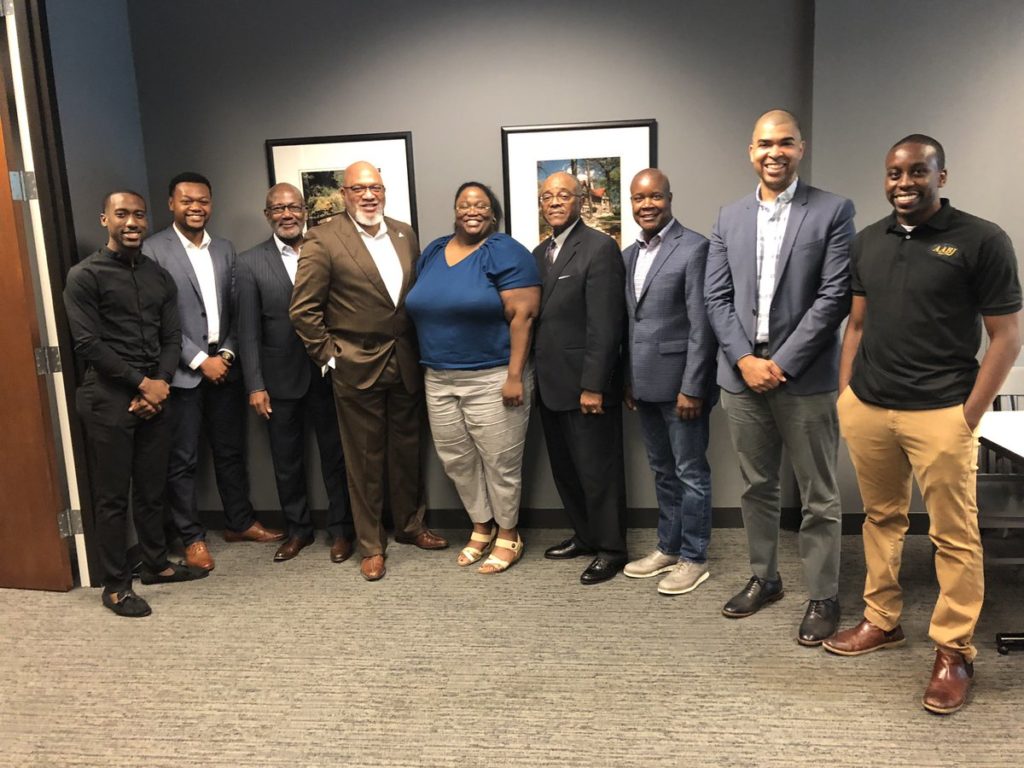
(L-R): AABJ Parliamentarian Wilton Jackson, Glenn Marshall, Eric Ludgood, Drew Dawson, AABJ President Carol Gantt, Collie Burnett, Eric Burns, Tolly Carr and AABJ VP of Print Amir Vera
Kendall “Kenny” Murray walked into a room of six black men working in media, unsure of how to approach them and nervous about how they would react to him.
“Unfortunately, I just automatically assumed that they were going to be standoffish, that they were going to be intimidating to talk to, not necessarily the kindest people,” the junior at Georgia State University said.
That assumption, Murray said, was broken once he sat down with the six men during 10-minute sessions.
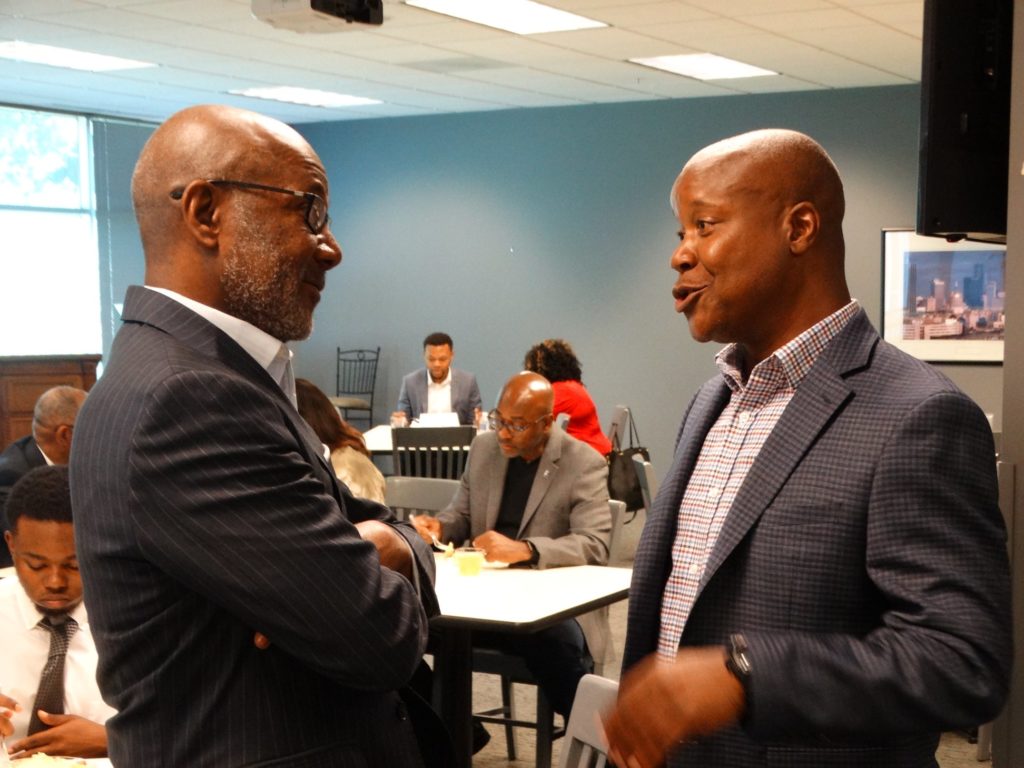
Kendall Murray (left) speaks with Eric Ludgood, assistant news director at WAGA-TV, during the Black Male Media Project June 1, 2019.
Discussions about the representation of black men in the media were all part of the Atlanta Association of Black Journalists’ (AABJ) Black Male Media Project on June 1.
The event featured six guest speakers who discussed how they earned their management positions where they can make decisions on how black men are represented. It also featured a tour of WSB-TV led by former NABJ President Condace Pressley.
The event was part of a larger project, mandated by the National Association of Black Journalists, designed to help change the narrative around the lives and images of black men in the news and in society through a series of workshops nationwide.
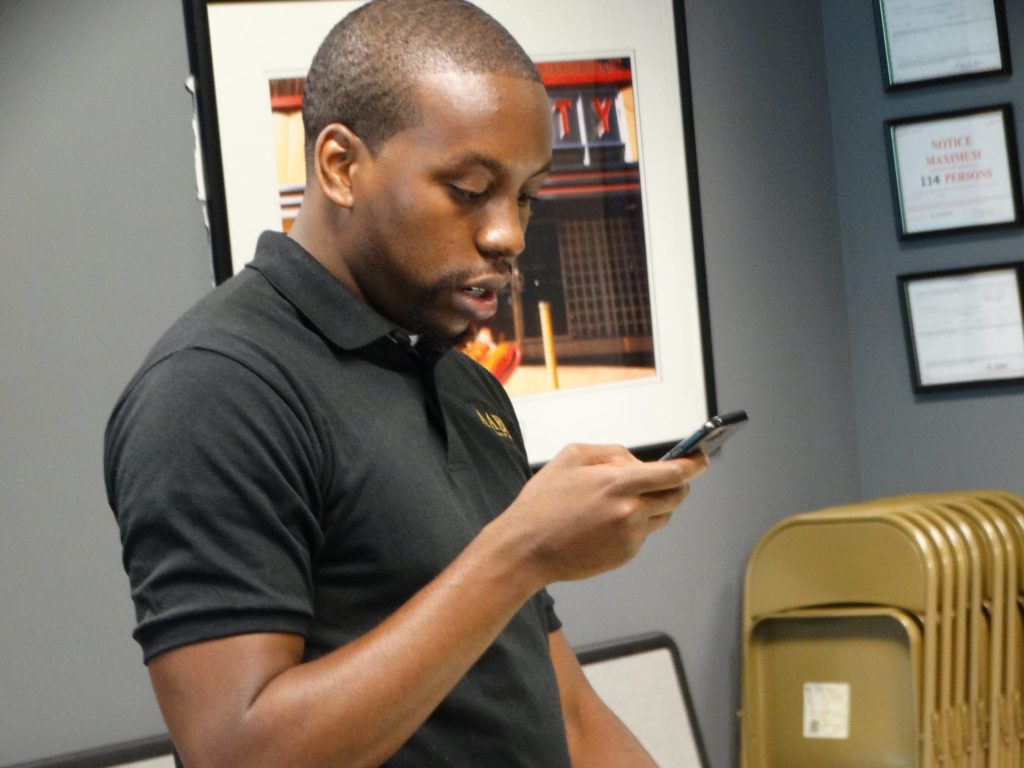
Drew Dawson, station manager at Georgia Public Broadcasting (GPB) speaks with a guest during the Black Male Media Project on June 1, 2019.
Drew Dawson, one of the guest speakers and station manager for Georgia Public Broadcasting, told Murray that it’s common to see news executives, directors, producers and other people who aren’t black in management approach stories, editing and decision-making from a eurocentric point-of-view. As one pitches stories, he said, the point is to take ownership of stories that are about your community.
“Your job is to position that story in such a way that will appeal to more than a black audience,” Dawson said.
But, Dawson also told Murray that one must watch for the “otherization” of minority groups.
“Sometimes, you’re going to be the only black person in the room, but it’s your job to find a way, before that story gets on the air, to say ‘this is what that looks like,’” Dawson said. “Why are we telling the story this way? Are we trying to demonize someone?”
Eric Ludgood, another one of the guest speakers and assistant news director for Atlanta Fox affiliate WAGA-TV, told Murray he had to be passionate about his work in order to truly succeed.
“I can teach you how to write. I can teach you how to produce. I can teach you how to report. I cannot teach you to care,” Ludgood he said. “But if you care, all that teaching is much easier. Care and want to tell stories about what you care about.”
Murray said it can be scary and hard overall to try to get your foot in the door and understand the information.
“If you talk to 10 different people, you’ll get 10 different stories about how they got where they got to,” said Tolly Carr, one of the guest speakers and a managing partner for HBCU Gameday. “Have you thought about doing anything original just on your own?”
Carr started in TV and did stories he knew would never be on air. He wrote them like they were real and gave them to news directors. Over the course of a couple of months, Carr said he wore down the director to accept his work.
“Even though it’s not given to the masses, that’s still experience under your belt,” he said.
Each interaction with the panelists ended with encouragement and connections made. By the end, Murray said he felt like he was talking to his professors and mentors. The conversations he had, which let him peek into different experiences, showed him kindness and demonstrated success through hard work. It was what he needed, Murray said.
“Everybody here, even though they accomplished so much, they were so approachable,” Murray said.
Ludgood, in particular, had told Murray it was OK to want dreams and that Murray could make them come true.
Murray aspires to write for television.
“Trust yourself,” Ludgood said.
Murray held onto that message.
“He showed me that you can be yourself,” he said.
For those who were unable to make it, take a look at the June 1 event through the gallery below:
Breanna Durham is a free lance writer and staff writer at The McDuffie Progress
What do you like most about being a member of AABJ?
I love the community and the mentorship opportunities.
What initially got you interested in the media/communications field?
My church back home runs a summer camp all about multimedia where I was able to get my hands on video and editing software at a young age. I’ve been all about media ever since.
What are your favorite publications/outlets to get your news?
I like to start the day with the daily podcasts from NYT, BBC, and others. I also keep up with AP alerts for breaking news updates. For perspective content, I think NPR does a great job.