Health information can be highly technical and complex, occasionally perplexing even to the most highly educated. Understanding this information — broadly defined as health literacy — is key to a person taking a proactive role in their health and well-being. What happens, though, if people do not understand what the doctor tells them or make sense of their medication instructions?
Health literacy was initially defined in 2000 as “the capacity of individuals to obtain, process, and understand basic health information and services needed to make appropriate health decisions.” This definition has since undergone several iterations as health literacy has come to be understood as multi-dimensional, involving more than just the individual patient, according to the researchers Scott C. Ratzan and Ruth M. Parker in the introduction to “Health Literacy: Improving Health, Health Systems, and Health Policy Around the World.”
Health literacy encompasses a set of skills, including accessing health care, communicating with health care providers and calculating drug dosages. An individual’s health literacy level depends on many factors, such as ethnicity, education and income. Disproportionately, individuals who are minorities, have limited education or live in poverty have poor health literacy, according to the 2003 National Assessment of Adult Literacy. This survey — the first nationwide survey to assess health literacy — reported that only 12 percent of adult Americans had a high level of health literacy.
Poor health literacy has wide-ranging effects. Individuals with low health literacy visit the emergency room more frequently for routine medical care, engage less with the health care system and report a worse overall health status. Health care efficiency suffers because of poor health literacy. Also poor health literacy costs the U.S. economy hundreds of billions of dollars annually, as stated in the report “Low Health Literacy: Implications for National Health Policy.”
Despite the prevalence of poor health literacy and its
consequences, many health care providers are unaware that their patients
struggle with comprehending health information. This communication divide only
further compounds low health literacy in that providers continue talking “above”
their patients, and patients are reluctant to acknowledge their lack of
understanding.
Improving health literacy can help eliminate health inequality, improve health outcomes and improve health care efficiency, according to the 2016 paper “Considerations for a New Definition of Health Literacy.” Health care providers have many strategies for communicating health information more clearly to their patients.
For example, health care providers can use plain language, which involves using the active voice, substituting complex terms or phrases for simpler ones and presenting information in small chunks, as described in the U.S. Department of Health and Human Services’ “Quick Guide to Health Literacy.”
The teach-back method helps health care providers ensure that patients understand health information, according to the Agency for Healthcare Research and Quality. To use this method, a health care provider explains a particular concept to a patient, asks the patient what they understand about the concept, clarifies any misunderstandings and repeats this process until the patient demonstrates mastery of the concept.
Health literacy is multi-faceted and complex. Improving health literacy has benefits for the individual and health care system as a whole. Through a concerted effort, health care providers can tailor health information to make it clear and understandable to patients.
JoAnna Pendergrass, DVM, is a freelance medical writer.
AABJ Online Fundraiser: 43 Years Campaign
AABJ’s $43 for 43 fundraising campaign is still ongoing. In its 43rd year, we are asking members to donate $43 to go towards programming, scholarships, and events throughout the year. Be sure to invite your friends, coworkers and anyone you know who supports our members in print, communications, public relations, radio, broadcast, digital and the many trailblazers in the literary world. Be sure to share our campaign on your social media by using the hashtag #AABJ43.
Atlanta vlogger chosen for YouTube mentorship progam
By Joi Light
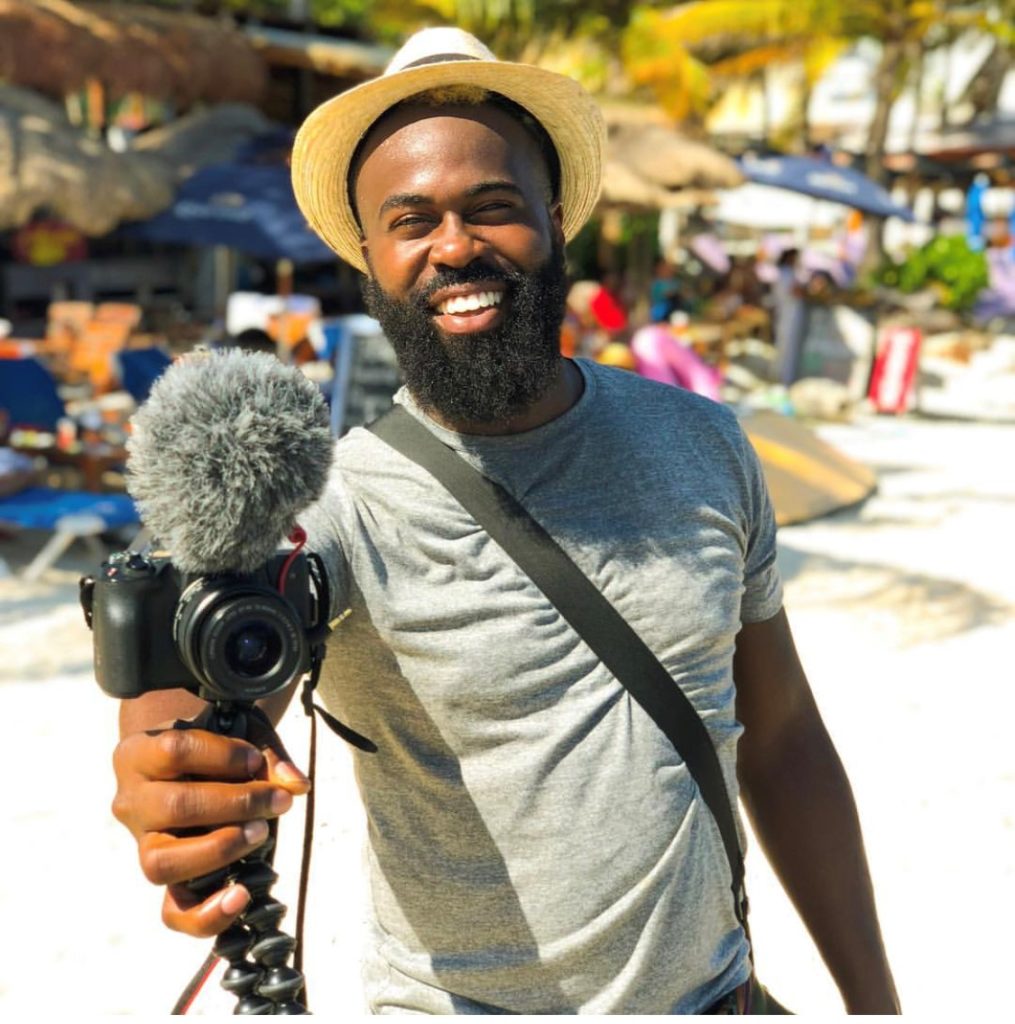
Will Edmond
It’s no doubt that the world is changing due to significant technological advancements — so naturally the world of journalism has to follow suit. Some of the world’s largest publications are now in competition with someone’s favorite mom blogger or popular social media influencer turned red carpet correspondent. To a “classically trained” journalist, this might sound like a change for the worse, but for someone who has the skills and the entrepreneurial spirit, it’s go time!
That’s exactly what Atlanta resident, Will Edmond is capitalizing on — the new way of making your own way. After pitching a show idea to the Travel Channel that didn’t end up taking off, Will decided to make his own way as a YouTube extraordinaire.
Fast forward to just two years after his first video, Will was hand-picked by the good folks at Youtube in September for their NextUP Black Creators Class of 2019. This week-long free mentorship program in Los Angeles, California, consisted of classes on lighting, equipment and editing.
“What I learned most was that it’s not about the best camera,
it’s all about the best lighting,”
Edmond said. “The lighting techniques are what inspires me to set up my
own studio.”
Besides the courses provided by YouTube, that some invest
thousands of dollars into, he was able to connect and network with other
like-minded black creators. After graduating from the program, creators in the
class were gifted with new equipment to elevate their videos to a new level and
an assigned personal mentor from the YouTube staff.
“YouTube is changing the world of journalism,”Edmond said. “It’s truly putting storytelling back into the hands of people and telling stories their own way.”
Joi Light is a full-time digital brand journalist and part-time freelance writer and blogger.
Be sure to buy the AABJ documentary “Black and Reporting”
Get your Emmy Award-Nominated copy of AABJ’s Documentary, “Black & Reporting: The Struggle Behind the Lens.”
Proceeds go to AABJ’s Xernona Clayton Scholarship Fund .
Anyone who wants to watch the entire documentary can buy it for $9.95 here.
Marketing Communications Professional (Kennesaw State University) and Adjunct Instructor in Mass Media (Clark Atlanta University)
What do you like most about being a member of AABJ?
I really enjoy networking with black media professionals and the monthly workshops.
What initially got you interested in the media/communications field?
I have always been a creative and a suit, meaning I bridge the worlds of the arts and business. I enjoy shaping and refining the vision, mission, messages and visuals of a brand.
What are your favorite publications/outlets to get your news?
I am a fan of Tyra Banks. I have followed her story of desiring to major in mass communications when she was a teen, to her modeling career, to her entrepreneurial accomplishments in television and film.
What’s an interesting fact about you people wouldn’t have otherwise known?
I absolutely love to sing and wouldn’t mind experiencing Broadway.
This edition of The Byline was edited by Amir Vera.
We are at the halfway mark of 2019, and we have accomplished so much! First, if you haven’t heard, AABJ’s documentary, “Black & Reporting: The Struggle Behind the Lens,” has been nominated for an Emmy! We are proud and extremely excited about this. Thanks to AABJ member, Donell Suggs, the documentary is in the June edition of Atlanta Magazine. If you have not purchased your copy, please do so today. The monies go toward AABJ’s Xernona Clayton Scholarship Fund.
I want to thank each of you for your support thus far, but we still have more to do this year. We are planning more workshops, community service projects, and fundraisers we need your help to make work. We also need volunteers to help with our newsletter, The Byline and our public affairs show, In Contact. In the coming month, we’ll be sending out a proposed revision of our bylaws. It’s been over ten years since they’ve last been updated. We will be voting on adopting them later this year.
Speaking of voting, if you or anyone you know have some interest in leading this organization, now is the time to begin thinking about a leadership role. Our term will end this year with elections slated to take place in November 2019. The nomination process will start in September.
Yours in service,
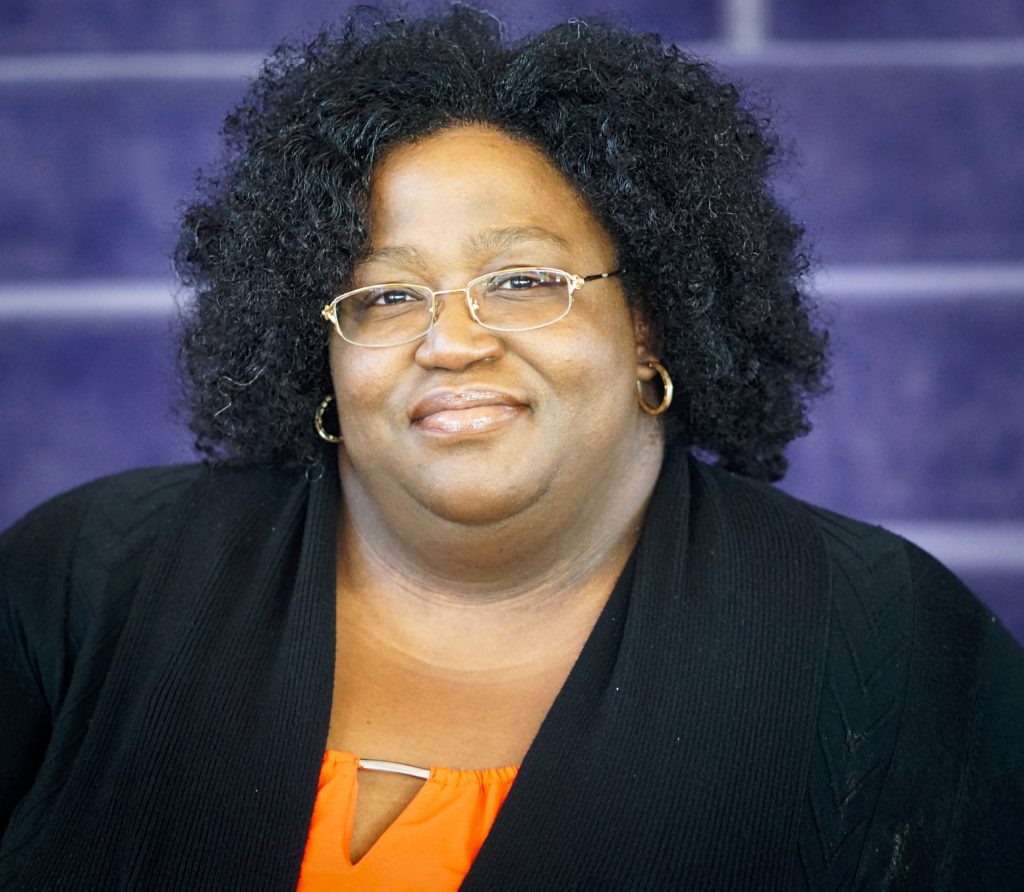
Carol M. Gantt
President
###
AABJ Online Fundraiser: 43 Years Campaign
AABJ’s $43 for 43 fundraising campaign is still ongoing. In its 43rd year, we are asking members to donate $43 to go towards programming, scholarships, and events throughout the year. Be sure to invite your friends, coworkers and anyone you know that supports our members in print, communications, public relations, radio, broadcast, digital and the many trailblazers in the literary world. Be sure to share our campaign on your social media by using the hashtag #AABJ43.
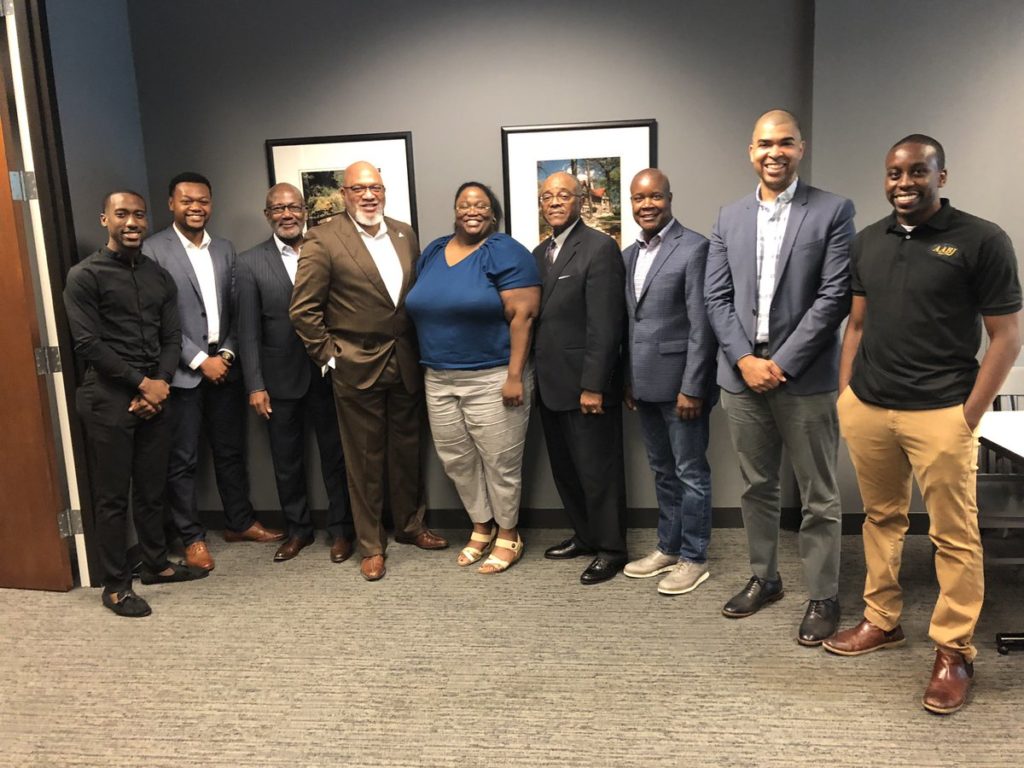
(L-R): AABJ Parliamentarian Wilton Jackson, Glenn Marshall, Eric Ludgood, Drew Dawson, AABJ President Carol Gantt, Collie Burnett, Eric Burns, Tolly Carr and AABJ VP of Print Amir Vera
Kendall “Kenny” Murray walked into a room of six black men working in media, unsure of how to approach them and nervous about how they would react to him.
“Unfortunately, I just automatically assumed that they were going to be standoffish, that they were going to be intimidating to talk to, not necessarily the kindest people,” the junior at Georgia State University said.
That assumption, Murray said, was broken once he sat down with the six men during 10-minute sessions.
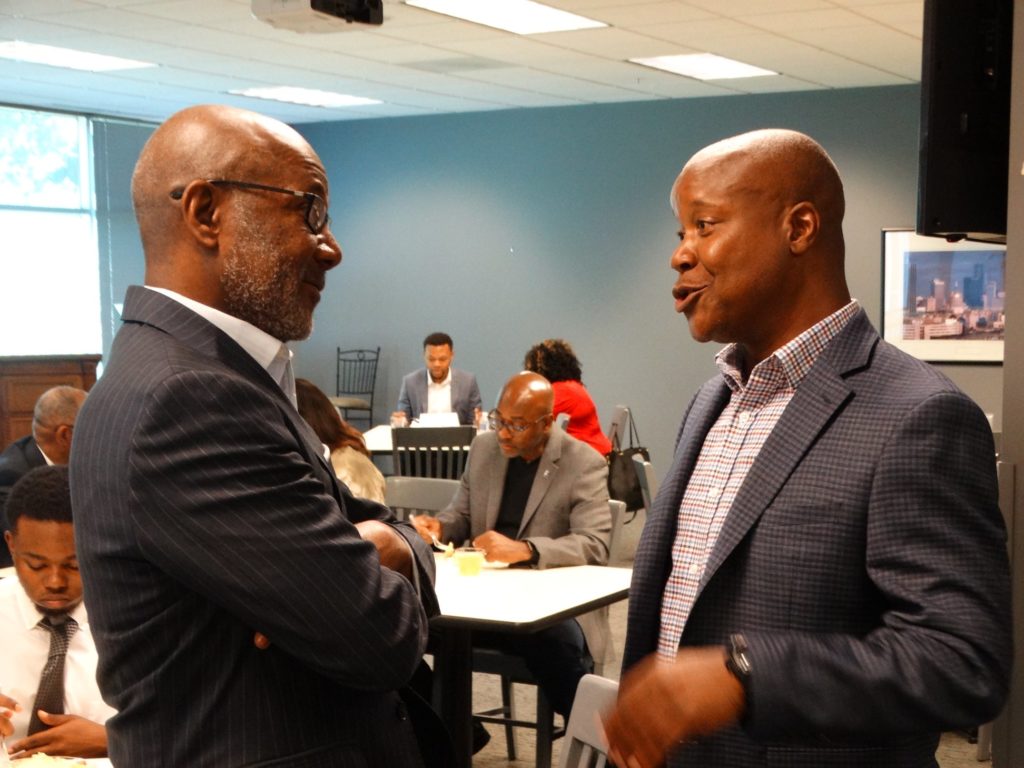
Kendall Murray (left) speaks with Eric Ludgood, assistant news director at WAGA-TV, during the Black Male Media Project June 1, 2019.
Discussions about the representation of black men in the media were all part of the Atlanta Association of Black Journalists’ (AABJ) Black Male Media Project on June 1.
The event featured six guest speakers who discussed how they earned their management positions where they can make decisions on how black men are represented. It also featured a tour of WSB-TV led by former NABJ President Condace Pressley.
The event was part of a larger project, mandated by the National Association of Black Journalists, designed to help change the narrative around the lives and images of black men in the news and in society through a series of workshops nationwide.
Drew Dawson, station manager at Georgia Public Broadcasting (GPB) speaks with a guest during the Black Male Media Project on June 1, 2019.
Drew Dawson, one of the guest speakers and station manager for Georgia Public Broadcasting, told Murray that it’s common to see news executives, directors, producers and other people who aren’t black in management approach stories, editing and decision-making from a eurocentric point-of-view. As one pitches stories, he said, the point is to take ownership of stories that are about your community.
“Your job is to position that story in such a way that will appeal to more than a black audience,” Dawson said.
But, Dawson also told Murray that one must watch for the “otherization” of minority groups.
“Sometimes, you’re going to be the only black person in the room, but it’s your job to find a way, before that story gets on the air, to say ‘this is what that looks like,’” Dawson said. “Why are we telling the story this way? Are we trying to demonize someone?”
Eric Ludgood, another one of the guest speakers and assistant news director for Atlanta Fox affiliate WAGA-TV, told Murray he had to be passionate about his work in order to truly succeed.
“I can teach you how to write. I can teach you how to produce. I can teach you how to report. I cannot teach you to care,” Ludgood he said. “But if you care, all that teaching is much easier. Care and want to tell stories about what you care about.”
Murray said it can be scary and hard overall to try to get your foot in the door and understand the information.
“If you talk to 10 different people, you’ll get 10 different stories about how they got where they got to,” said Tolly Carr, one of the guest speakers and a managing partner for HBCU Gameday. “Have you thought about doing anything original just on your own?”
Carr started in TV and did stories he knew would never be on air. He wrote them like they were real and gave them to news directors. Over the course of a couple of months, Carr said he wore down the director to accept his work.
“Even though it’s not given to the masses, that’s still experience under your belt,” he said.
Each interaction with the panelists ended with encouragement and connections made. By the end, Murray said he felt like he was talking to his professors and mentors. The conversations he had, which let him peek into different experiences, showed him kindness and demonstrated success through hard work. It was what he needed, Murray said.
“Everybody here, even though they accomplished so much, they were so approachable,” Murray said.
Ludgood, in particular, had told Murray it was OK to want dreams and that Murray could make them come true.
Murray aspires to write for television.
“Trust yourself,” Ludgood said.
Murray held onto that message.
“He showed me that you can be yourself,” he said.
For those who were unable to make it, take a look at the June 1 event through the gallery below:
Breanna Durham is a free lance writer and staff writer at The McDuffie Progress
What do you like most about being a member of AABJ?
I love the community and the mentorship opportunities.
What initially got you interested in the media/communications field?
My church back home runs a summer camp all about multimedia where I was able to get my hands on video and editing software at a young age. I’ve been all about media ever since.
What are your favorite publications/outlets to get your news?
I like to start the day with the daily podcasts from NYT, BBC, and others. I also keep up with AP alerts for breaking news updates. For perspective content, I think NPR does a great job.