Health information can be highly technical and complex, occasionally perplexing even to the most highly educated. Understanding this information — broadly defined as health literacy — is key to a person taking a proactive role in their health and well-being. What happens, though, if people do not understand what the doctor tells them or make sense of their medication instructions?
Health literacy was initially defined in 2000 as “the capacity of individuals to obtain, process, and understand basic health information and services needed to make appropriate health decisions.” This definition has since undergone several iterations as health literacy has come to be understood as multi-dimensional, involving more than just the individual patient, according to the researchers Scott C. Ratzan and Ruth M. Parker in the introduction to “Health Literacy: Improving Health, Health Systems, and Health Policy Around the World.”
Health literacy encompasses a set of skills, including accessing health care, communicating with health care providers and calculating drug dosages. An individual’s health literacy level depends on many factors, such as ethnicity, education and income. Disproportionately, individuals who are minorities, have limited education or live in poverty have poor health literacy, according to the 2003 National Assessment of Adult Literacy. This survey — the first nationwide survey to assess health literacy — reported that only 12 percent of adult Americans had a high level of health literacy.
Poor health literacy has wide-ranging effects. Individuals with low health literacy visit the emergency room more frequently for routine medical care, engage less with the health care system and report a worse overall health status. Health care efficiency suffers because of poor health literacy. Also poor health literacy costs the U.S. economy hundreds of billions of dollars annually, as stated in the report “Low Health Literacy: Implications for National Health Policy.”
Despite the prevalence of poor health literacy and its
consequences, many health care providers are unaware that their patients
struggle with comprehending health information. This communication divide only
further compounds low health literacy in that providers continue talking “above”
their patients, and patients are reluctant to acknowledge their lack of
understanding.
Improving health literacy can help eliminate health inequality, improve health outcomes and improve health care efficiency, according to the 2016 paper “Considerations for a New Definition of Health Literacy.” Health care providers have many strategies for communicating health information more clearly to their patients.
For example, health care providers can use plain language, which involves using the active voice, substituting complex terms or phrases for simpler ones and presenting information in small chunks, as described in the U.S. Department of Health and Human Services’ “Quick Guide to Health Literacy.”
The teach-back method helps health care providers ensure that patients understand health information, according to the Agency for Healthcare Research and Quality. To use this method, a health care provider explains a particular concept to a patient, asks the patient what they understand about the concept, clarifies any misunderstandings and repeats this process until the patient demonstrates mastery of the concept.
Health literacy is multi-faceted and complex. Improving health literacy has benefits for the individual and health care system as a whole. Through a concerted effort, health care providers can tailor health information to make it clear and understandable to patients.
JoAnna Pendergrass, DVM, is a freelance medical writer.
AABJ Online Fundraiser: 43 Years Campaign
AABJ’s $43 for 43 fundraising campaign is still ongoing. In its 43rd year, we are asking members to donate $43 to go towards programming, scholarships, and events throughout the year. Be sure to invite your friends, coworkers and anyone you know who supports our members in print, communications, public relations, radio, broadcast, digital and the many trailblazers in the literary world. Be sure to share our campaign on your social media by using the hashtag #AABJ43.
Atlanta vlogger chosen for YouTube mentorship progam
By Joi Light
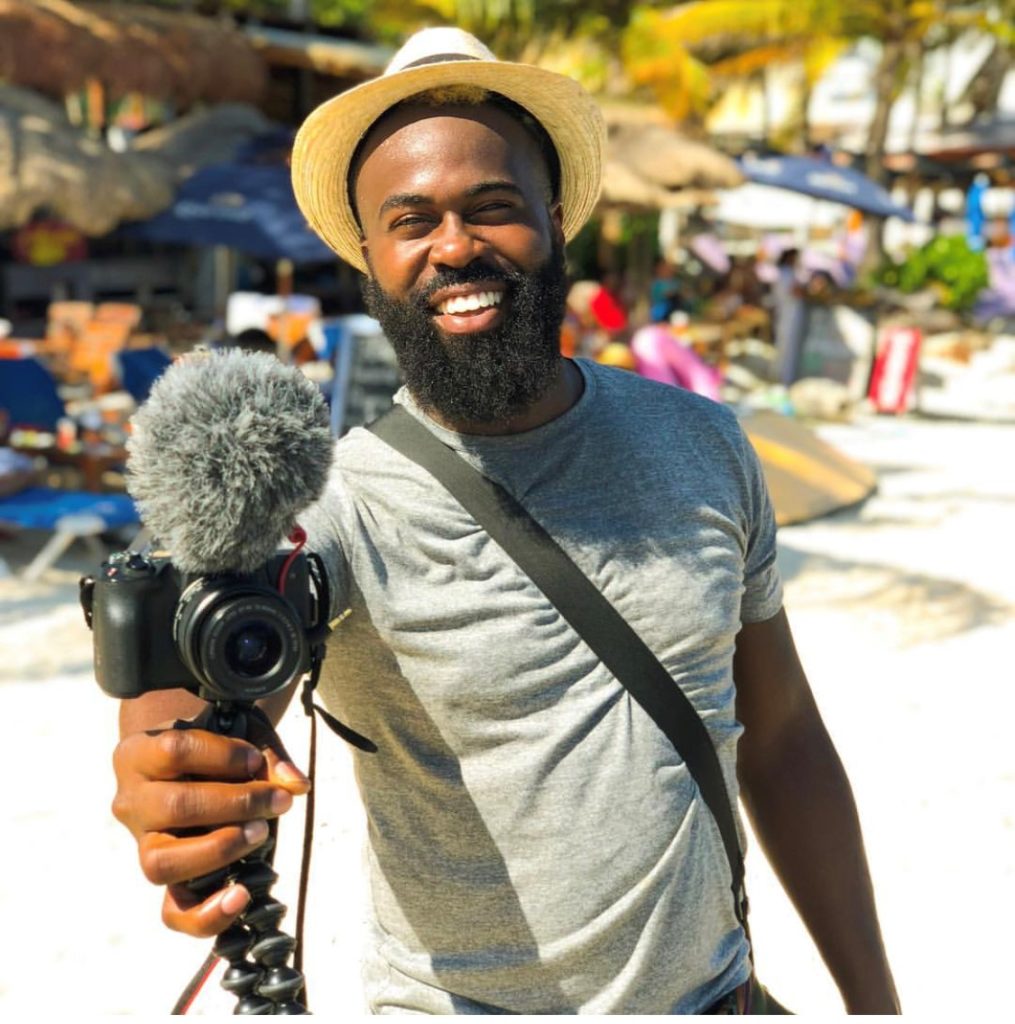
Will Edmond
It’s no doubt that the world is changing due to significant technological advancements — so naturally the world of journalism has to follow suit. Some of the world’s largest publications are now in competition with someone’s favorite mom blogger or popular social media influencer turned red carpet correspondent. To a “classically trained” journalist, this might sound like a change for the worse, but for someone who has the skills and the entrepreneurial spirit, it’s go time!
That’s exactly what Atlanta resident, Will Edmond is capitalizing on — the new way of making your own way. After pitching a show idea to the Travel Channel that didn’t end up taking off, Will decided to make his own way as a YouTube extraordinaire.
Fast forward to just two years after his first video, Will was hand-picked by the good folks at Youtube in September for their NextUP Black Creators Class of 2019. This week-long free mentorship program in Los Angeles, California, consisted of classes on lighting, equipment and editing.
“What I learned most was that it’s not about the best camera,
it’s all about the best lighting,”
Edmond said. “The lighting techniques are what inspires me to set up my
own studio.”
Besides the courses provided by YouTube, that some invest
thousands of dollars into, he was able to connect and network with other
like-minded black creators. After graduating from the program, creators in the
class were gifted with new equipment to elevate their videos to a new level and
an assigned personal mentor from the YouTube staff.
“YouTube is changing the world of journalism,”Edmond said. “It’s truly putting storytelling back into the hands of people and telling stories their own way.”
Joi Light is a full-time digital brand journalist and part-time freelance writer and blogger.
Be sure to buy the AABJ documentary “Black and Reporting”
Get your Emmy Award-Nominated copy of AABJ’s Documentary, “Black & Reporting: The Struggle Behind the Lens.”
Proceeds go to AABJ’s Xernona Clayton Scholarship Fund .
Anyone who wants to watch the entire documentary can buy it for $9.95 here.
Marketing Communications Professional (Kennesaw State University) and Adjunct Instructor in Mass Media (Clark Atlanta University)
What do you like most about being a member of AABJ?
I really enjoy networking with black media professionals and the monthly workshops.
What initially got you interested in the media/communications field?
I have always been a creative and a suit, meaning I bridge the worlds of the arts and business. I enjoy shaping and refining the vision, mission, messages and visuals of a brand.
What are your favorite publications/outlets to get your news?
I am a fan of Tyra Banks. I have followed her story of desiring to major in mass communications when she was a teen, to her modeling career, to her entrepreneurial accomplishments in television and film.
What’s an interesting fact about you people wouldn’t have otherwise known?
I absolutely love to sing and wouldn’t mind experiencing Broadway.
This edition of The Byline was edited by Amir Vera.
AABJ volunteers trade experiences with seniors at AG Rhodes Health and Rehab
By Breanna Durham
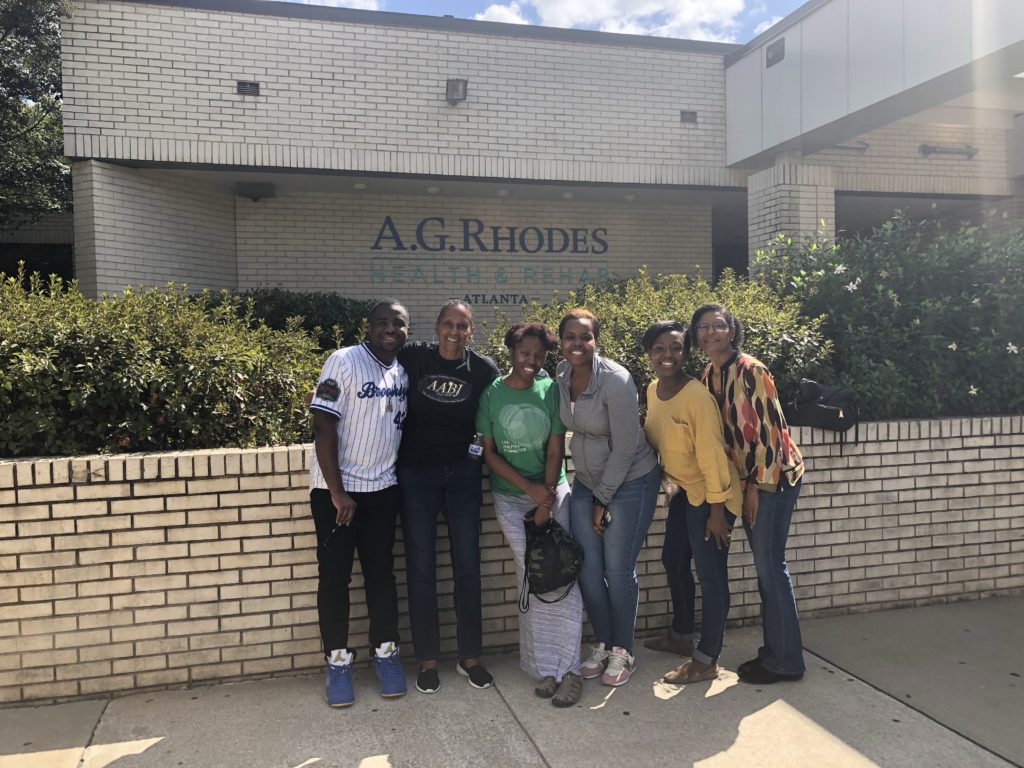
AABJ members pose for a photo outside of the AG Rhodes Health and Rehab on Sept. 21, 2019.
Members of Atlanta Association of Black Journalist (AABJ) gathered to spend time with senior citizens Sept. 21 for a volunteer event at the Atlanta branch of AG Rhodes Health and Rehab, a nursing home.
For two hours, the seven volunteers played games and heard about the lives and opinions of the seniors while sharing their own experiences and answering some of the residents’ questions. Typically, AABJ holds four volunteer events per year. After the nursing home visit, the chapter plans to hold one more volunteer event this year.
Barbara McDew, AG’s activities assistant, has worked with senior citizens for the past 30 years and spoke about the impact the seniors had on her and the potential impact they can have on others. Seniors, she said, have experienced life in ways she wouldn’t have ever imagined and hold interesting stories. By working with them, McDew learned things that would equip her for life.
“They taught me how to live and how to be a lady,” she said.
Helene Mills, a 94-year-old resident of the center, told the volunteers about her life and her advocacy. Mills has worked as a community advocate for Atlanta’s Fourth Ward and for senior citizens for years.
“I’m still working as an advocate for senior citizens right here,” she said. “I’m now a (National) Silver Haired Congress person who — when I was able — went to congress to advocate for various items in regards to senior citizens … That’s something I’m proud of.”
Jasimine Murray, who joined AABJ two months ago, said she volunteered due to her past experiences and her love of seniors. Because of her close relationship with her great grandmother, she said she has volunteered at her great grandmother’s senior citizens home.
“Anytime I can do something with the seniors, I do it,” Murray said. “I always think that there’s so many hidden stories here … I think that you can have all the books, but I think the best truths and stories come from people.”
Joy Woodson, the AABJ committee chairperson for community relations, said she chose the center in hopes of exposing the public to reporters.
“We [as AABJ members] thinks it’s important for people to see journalists as people and not just as people you see on the news who are telling a story and the only time they want to know you is when you’re having a bad day,” she said.
In addition, Woodson said she picked the center due to her belief that it’s important for black residents to see reporters that look like them serving the public. A large portion of the residents that came out for the volunteer event were black. Woodson described the group as lively and said she saw a lot of smiles.
“I think part of that is an outside group coming in,” she said. “It’s a help to the community. You’re helping expand the knowledge of whoever you’re helping.”
At this volunteer event, Woodson said that enough people did not come out, but she expressed hope for more to come out for the winter volunteer event. Over the course of a reporter’s career, Woodson pointed out the graciousness people have shown by sharing their stories with reporters and answering their questions. Besides returning that act of grace to the community, Woodson centered service as a pillar of the journalism profession.
“That’s what the core of what journalism should be about,” she said. “It’s a public service.”
Breanna Durham is a free lance writer.
AABJ Online Fundraiser: 43 Years Campaign
AABJ’s $43 for 43 fundraising campaign is still ongoing. In its 43rd year, we are asking members to donate $43 to go towards programming, scholarships, and events throughout the year. Be sure to invite your friends, coworkers and anyone you know who supports our members in print, communications, public relations, radio, broadcast, digital and the many trailblazers in the literary world. Be sure to share our campaign on your social media by using the hashtag #AABJ43.
“My professor encouraged me to run on the state level instead of the federal level because there are a lot of progressive policies and initiatives that must start to happen here in Georgia, and since this is home, take care of home first,” the 33-year-old sophomore at Clark Atlanta University said.
The threat to women’s rights is what prompted Doss-Hunter to run for the state position.
“Men
are controlling women’s rights, and we need more women of color at the table
voicing our rights,” Doss-Hunter said.
“Before I moved to Atlanta I was prepared to enroll in school. I didn’t know where I wanted to go so I was waiting to apply for colleges once I moved here,” Doss-Hunter said. She added that her family worked in film and she started working in film as well.
“I immediately started working in the field I wanted to without a college degree so going back to school seemed unnecessary,” she said.
Doss-Hunter said she was inspired by the teachings of W.E.B. Du Bois, and decided to go back to school to further her education in the fall of 2018.
“I wanted to go back to school to understand policy and legislation thoroughly. What better place to learn politics than at Clark Atlanta University? Georgia is the home of the first black woman state representative, Grace Towns Hamilton. There is no other place I should be,” Doss-Hunter said.
She believes Georgians “deserve transformative
education programs that nurture and guide the excellence of” all children. Doss-Hunter
also said she supports reform that de-criminalizes non-violent minor marijuana
offenses and wants quality healthcare coverage and facilities for everyone.
“No one should be refused quality health care services because they do not have health insurance,” she said.
Students at Clark Atlanta University have shown excitement in seeing their classmate run for state office .
“I believe Amber will represent Clark Atlanta well. I am certain the institution will support her through her campaign journey,” CAU senior Alexis Grace said.
Hunter’s vision for this campaign season is to touch everyone within arm’s reach of her district.
“I
never want to be a person who speaks of the issues and never tries to help
those in need of solutions. I want to help bring the change my community
needs,” Doss-Hunter said.
Union City, Fairburn, Chattahoochee Hills, Douglasville, Palmetto, and South Fulton are all part of District 65.
The primary voting is on May 19, 2020, followed by general elections on November 3, 2020.
Almiya White is a senior at Clark Atlanta University.
Be sure to buy the AABJ documentary “Black and Reporting”
Get your Emmy Award-Nominated copy of AABJ’s Documentary, “Black & Reporting: The Struggle Behind the Lens.”
Proceeds go to AABJ’s Xernona Clayton Scholarship Fund .
Anyone who wants to watch the entire documentary can buy it for $9.95 here.
Member Spotlight: Lisa Cox
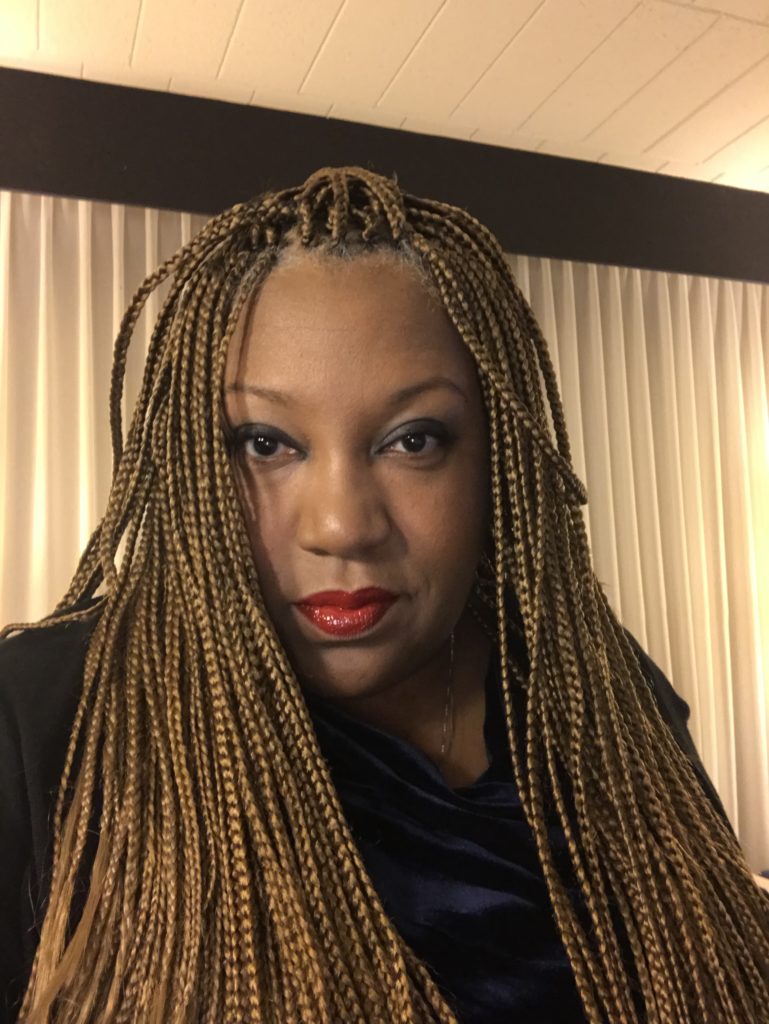
Lisa Cox
Current position in AABJ?
Member
How long have you
been a member of AABJ?
5 years
Where did you attend
college?
UC Berkeley-Undergrad
Columbia University Graduate School of Journalism- Graduate
What do you like most
about being a member of AABJ?
The fellowship, networking, making new friends, learning the history and impact of black journos in Atlanta, and being surrounded by fellow black journalists.
What initially got
you interested in the media/communications field?
I grew up in the business so I was naturally attracted to it. My father is a broadcast journalist and professor. He used to be a top local TV news anchor in my hometown of Los Angeles and a former network radio host and correspondent. Plus — I got good grades in English and composition and writing came naturally to me.
What are your
favorite publications/outlets to get your news?
Not really but there are a multitude of people I admire and respect for their accomplishments and acumen (several local news professionals, Carole Simpson, Wolf Blitzer, Byron Pitts, Bernie Shaw among them). I love Whoopi Goldberg. She’s not traditional media but I love her anyways … her spirit and conviction. She keeps it real.
What’s an interesting
fact about you people wouldn’t have otherwise known?
My maternal grandmother was from Guadalajara, Mexico; I’m an
excellent interior decorator; if I could have any job and money was no object
I’d be a masseuse and own an herbal apothecary/fragrance shoppe.
This edition of The Byline was edited by Amir Vera