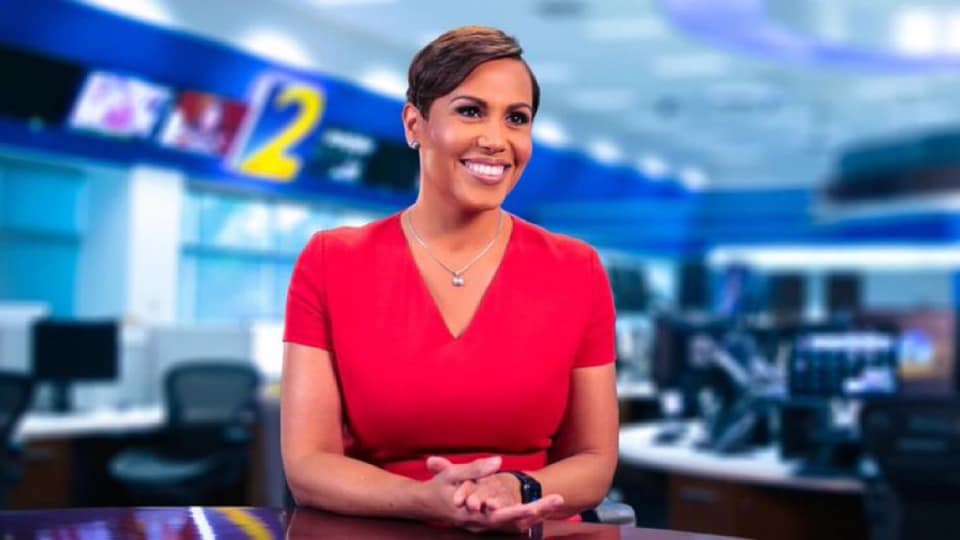
As an organization, we are mourning the loss of Jovita. She played an integral part in not only AABJ, but also as a presence in Atlanta. We understand many of our members were close with Jovita, and even if you did not know her personally, you may have felt connected to her through her work in the community. You can read more information about Jovita, her life and watch a very touching tribute video on WSB-TV’s website. AABJ has shared many memories with Jovita Moore through the story feature on our Instagram account.
AJC Higher Education Reporter Speaks on Challenges in Higher Education Learning
By Elisheva Wimberly
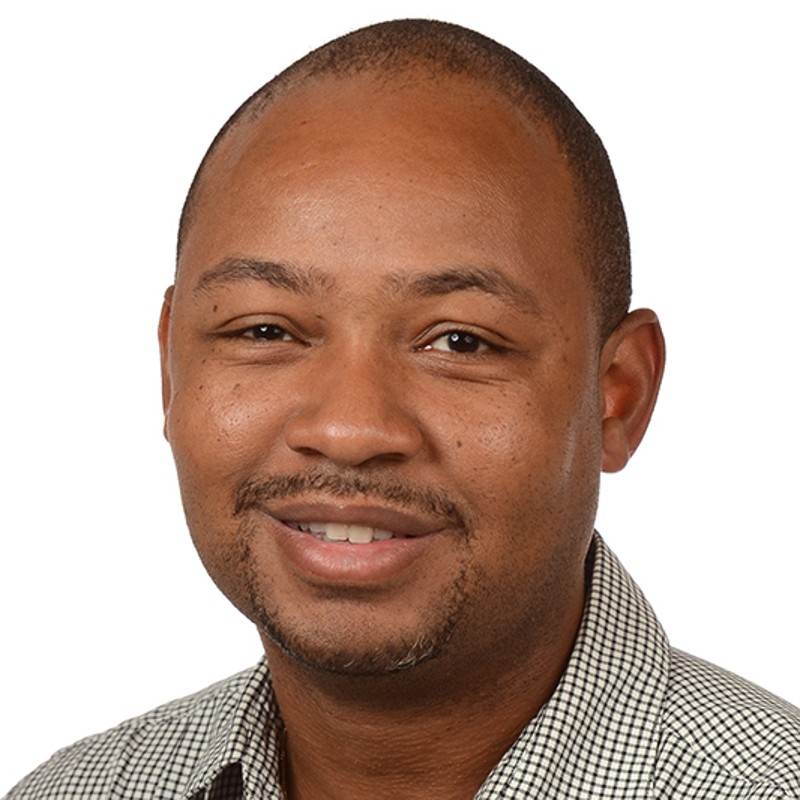
Eric Stirgus, AJC reporter
Eric Stirgus is the Higher Education Reporter at The Atlanta Journal-Constitution. He focuses on schools and universities throughout Georgia, primarily focusing on metro-Atlanta colleges and universities.
Two years ago, Stirgus focused on a variety of topics in higher education, including student loan debt, sexual misconduct and administration in higher learning. Today, Stirgus still covers those issues, but on a very small level. Stirgus looks at higher education from a completely different lens. About 90 percent of the issues he covers today are COVID-19 related, ranging from how colleges are managing the pandemic to the type of services they provide students. The Byline asked Stirgus if concerns of faculty are being heard regarding Atlanta colleges and universities not providing enough safety measures.
“Faculty will say no. They just finished weeks worth of rallies and demonstrations,” Stirgus said. “They want mask mandates and they’d like to have vaccine mandates but the University System of Georgia says no.”
The University System of Georgia (USG) strongly encourages faculty, students and staff to wear masks and get vaccinated, but Gov. Brian Kemp has been adamant that they don’t want to see mandates.
“The faculty are frustrated”, Stirgus said. “They feel the need to speak up and it keeps me quite busy trying to keep up with it.”
Stirgus said even through these rallies and demonstrations of protest from faculty he hasn’t heard much from students on the issue.
“In general, I feel like they’re supportive of these issues that faculty want but I don’t see them protesting,” Stirgus said. “I think that most of them want to be back on campus after over a year of not being on campus and experiencing online learning.”
The majority of students Stirgus sees on college campuses are wearing masks. However, the University of Georgia has had more positive cases than any other institution in Georgia.
When Stirgus visited UGA last week and went into the student center, he noticed half of the students present were not wearing masks. Last week, UGA had a big drop in their COVID-19 cases. Stirgus will be monitoring reports to see if the University of Georgia’s numbers show up low.
The Byline asked Stirgus if there’s a possibility of vaccine mandates becoming a requirement for all faculty, students and staff across the University System of Georgia.
“Biden has taken that step for federal workers and businesses with more than 100 employees but if he wanted to he would have done it by now,” Stirgus said. “If there is another spike, he might mandate it but we’ll see.”
Despite the feud over mask mandates, there are some positives to higher education according to Stirgus. He hears from many administrators and faculty. They share with him that remote learning has helped them become a lot more nimble in trying to find new ways to reach out to students. Stirgus says COVID-19 has given people in the education and outside world a better perspective of the challenges that it takes to be an educator.
“Before COVID I was writing on mental health,” Stirgus says, “That has become a greater challenge with COVID and they need to provide students with services that support their needs. Faculty realize those things are still very important.”
Compared to the University of Georgia, the Atlanta University Center’s (AUC’s) COVID-19 numbers have been very low, as they have been following mask mandates. Stirgus says they are different from the University System of Georgia because they require students to be vaccinated on campus. The AUC does not keep track of self-reported cases. And recently, they took the step last week to do weekly COVID testing. Along with the Atlanta UniversityCenter, Emory’s cases have also gone down.
Strigus believes the AUC is using more aggressive measures than the USG. Morehouse College and Spelman College have cancelled their Homecoming 2021 due to the lingering effects of COVID-19. Whereas universities such as UGA recently had 93,000 fans in their football stadium.
“A lot of schools are going full speed ahead,” Stirgus said. “I don’t see them adjusting.”
As for commencement ceremonies, Stirgus says the deciding factor on that decision will be the COVID-19 numbers.
“Hopefully the numbers will decline by commencement,” Stirgus says, “As long as we do what we have to do to keep the delta variant in check, I think we will see commencement ceremonies.”
Elisheva Wimberly is a student at Georgia State University.
Sandy Springs Mayoral Candidate, Dontaye Carter Discusses Career, Equality and Politics
By Da’Zhane Johnson
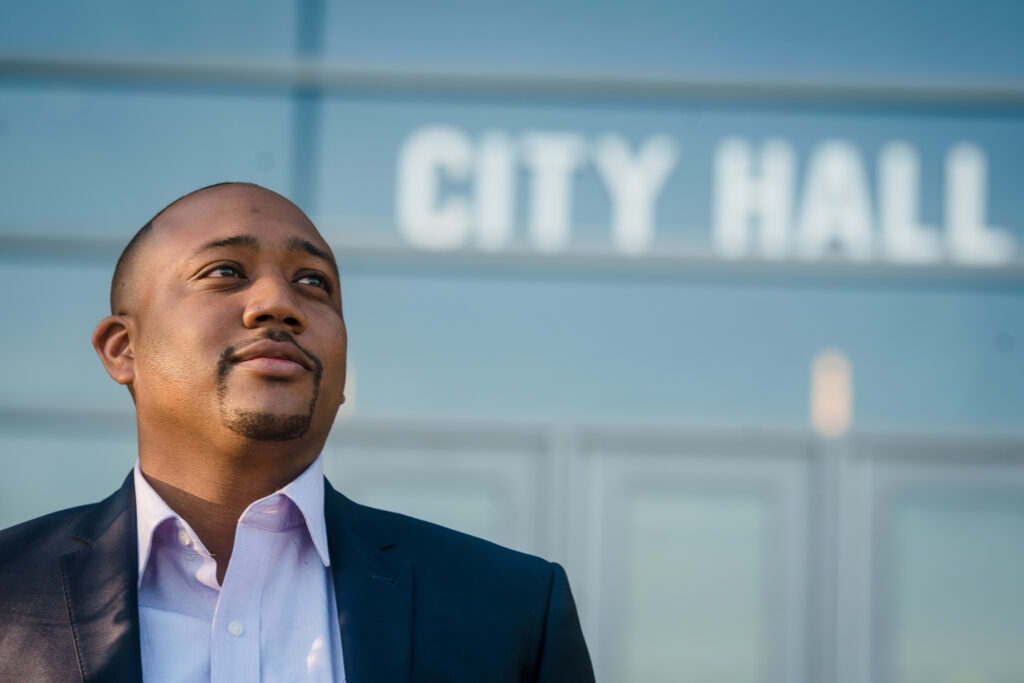
Dontaye Carter at City Hall in Sandy Springs, Georgia (Photo by Kevin Lowery)
Dontaye Carter is a Black man juggling a family, career, and now a campaign, proving once again that hard work and perseverance prevails. He is running for Mayor in the city of Sandy Springs against incumbent Mayor Rusty Paul, who has been in office since 2014, in hopes of providing a better future and world in which his young daughter can live.
While a sophomore in college at Florida A&M University, Carter already received his first journalism job at WCTV in Tallahassee, Florida. Inspired by his mother’s hard work ethic, Carter would wake up for work at 4 a.m. and then head to class at 9 a.m. He kept this routine for six months until the station promoted him to a producer. His success post-graduation matched his previous years too. Carter was a reporter in Tulsa, Oklahoma, then brought his talents to Atlanta.
The next couple of years, Carter continued reporting in the Georgia capital. Unfortunately, the work took a toll on his personal life, which caused him to switch careers.
“Personally, not only did I want to be a husband that was there, but a father that was there,” Carter said. “I wanted to be invested in my relationship, in my family, and I wanted to find something I was passionate about.”
The Fulton County’s District Attorney Office is where Carter found the passion he was searching for. While serving as a public affairs officer, Carter worked on cases that he felt had unjust verdicts. The case of four teens who were accused of murder specifically stuck with the mayoral candidate throughout the years. Often the cases showed signs of injustice and imbalance within the community.
Carter then decided to enhance the voices of unjust victims through his own business, Carter Media Group. The company served as a companion with attorneys to display the stories and challenges victims faced in their cases. In fact, Carter Media Group has been the public relations firm for several high-profile cases, like the case of R&B singer R. Kelly .
“I worked with Attorney Gerald Griggs, many of the survivors of that case and their families. We worked diligently because what we saw happening was everybody trying to turn that into a he-said-she-said case, but it was really a case about human sex-trafficking” Carter stated. “These plane tickets have to have these girls’ ages on them, so we put them out.”
Carter went on to speak about his work with the Jimmy Atchison case too. He recalled looking through files. Additionally, he highlighted the importance of keeping the public informed. Several agencies were even called to examine the case facts thoroughly.
Despite the backlash he’s recently received from some residents, Carter still believes politics is his best outlet for promoting change in Sandy Springs. He spoke of the significance of community, representation and trust. The three elements are key components to what has inspired him running in elections this year. The husband and father wants a city that, most importantly, gives his family a voice and protection, and obtaining the title of mayor will grant him access to create that city.
Sandy Springs is known to have a large white population and Carter has not ignored this fact. He understands that most residents of the city agree with the injustice displayed by policymakers in the past. Carter spoke in detail about his standards for people who are elected into office.
“There is nobody in office right now that I trust to take care of my daughter or anybody that looks like her. We have to put people in office that put their constituents first,” Carter stated. There was a lot of talk last year about change, but the way of those words haven’t met actions a year later. Until we get people in office whose words match their actions, we’re never going to be in an equitable society.”
While in office, Carter has explained before that he wants to focus on several issues, which include affordable housing, sustainable developments, schooling and diversity and inclusion. However, his passion for these issues does not negate from his immediate focus — managing the COVID-19 pandemic. Carter explained how he wanted to open the discussion of mandated vaccines to further the safety for all residents. The former reporter believes the conversation surrounding COVID-19 has been converted from survival to political.
“I know the mandating has been so politicized, but the reality of it is, in Fulton County, your child has to get 14 vaccinations before they start school,” Carter said. “We’re already getting vaccines, one more vaccine to ensure that people are going to survive is vitally important to me.”
The details of Carter’s campaign can be found on www.dontayeformayor.com. Election day is November 2.
Da’Zhane Johnson is a student at Clark Atlanta University.
Atlanta City Hall Reporter Speaks Politics
By Ariyana Griffin
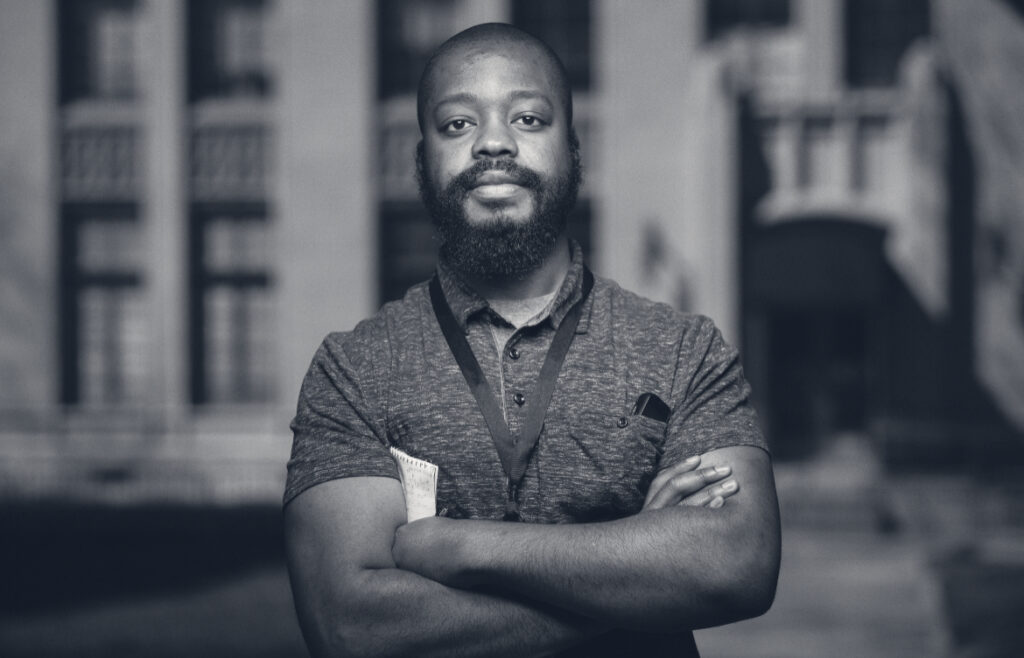
Wilborn P. Nobles III covers City Hall for the AJC.
Wilborn P. Nobles III is a journalist with The Atlanta Journal-Constitution (AJC), where he covers Atlanta City Hall. He originally joined the AJC staff to cover DeKalb County Public Schools in November 2020. Earlier this year, he started to cover Atlanta City Hall. He previously worked for The Baltimore Sun covering the government. There he covered police shootings, housing discrimination and other things revolving around issues within Baltimore County, Maryland. Nobles also interned at The Washington Post, where he covered local news. Additionally, the Louisiana native covered education for The Times-Picayune in New Orleans.
With politics being prominent in Atlanta right now due to the upcoming mayoral election, Atlanta residents also have to vote for a new council president and an entirely new city council, and the Atlanta Public School Board.
All 15 seats for the Atlanta city council are up for election. Among those 15 seats, six of those seats will not be filled by an incumbent due to leaders running for other positions or just not running for re-election. Nobles, however, is solely focused on covering the Atlanta Mayoral election. Early voting began on Oct. 12 and ended Oct. 29. The general election will take place on Nov. 2.
Each local election is crucial and dictates the future of a community, including where tax dollars go.
“Super voters are people who vote in every election. No matter if it has something to do with the president or raising taxes or legalizing some new aspect or service to the city,” Nobles said. There is also a large group of people who are “apathetic” because they feel like the elections do not care about them or their community, an issue Nobles found prominent in Atlanta. Some people also do not believe that the vote counts or is essential, making them sceptical to go out and vote. Nobles explained that it is crucial to learn and research people who are running for office or who are interested in running for office so people can be informed and then participate.
“Black voters are concerned about affordable housing, career opportunities, and public safety. The latter issue includes both crime and police reform,” Nobles explained.
Nobles said he always wanted to cover politics and government to help hold politicians and leaders accountable. His advice to reporters or anyone when covering politics is simple.
“As a new reporter on the beat, they want to give you their best impression, but it is important for you to do your homework, ” he said. “Talk to people and read what’s been written about them, any sort of homework you can do ahead of time.”
He said that as a journalist, your first obligation is accountability and transparency.
For more information, you can follow Wilborn Nobles or read his articles about the Atlanta mayoral race at www.ajc.com.
Ariyana Griffin is a student at Clark Atlanta University.
K-12 Reporter Gives Insight on how COVID-19 Affected Metro Atlanta Schools
By Ariyana Griffin
Kristal Dixon is the K-12 reporter for Axios Atlanta Local News
Kristal Dixon was an education reporter covering Cobb County for the Atlanta Journal-Constitution (AJC). She now serves as the K-12 reporter for Axios Atlanta local news, a publication that will be launching in October. She has also covered some public safety issues in Cobb County. Due to unprecedented times, there has been plenty to cover when it comes to the school systems, and here is what she has to say about that.
How did you get into education reporting and journalism?
I have always wanted to be a journalist since my teenage years, so I started focusing on that. I worked at the school newspaper at the University of West Georgia and I just continued my career that way. I started covering K-12 education in my first full time reporting job at the Cherokee Tribune in August 2007. I covered K-12 education for about three or four years. I took a bit of a break from it because I started covering the County Government Beat, and later started working for Patch.com. I kept following K-12 education for the last several years, but when I was hired at the AJC in February 2019, I kept that up. I narrowed my coverage down to Cobb County. In February of 2021, while I was at the AJC, I was promoted to the education team to cover Cobb and DeKalb County schools.
What are some key issues that you have noticed K-12 students face?
Right now, obviously the COVID-19 Pandemic is a brewing issue that schools have been contending with for the last 18 months. Also the COVID-19 pandemic actually brought to light a lot of inequities that school districts saw when it comes to K-12 education. A lot of districts realized that other students did not have the technology that they needed at home to do their virtual lessons. So a lot of districts began to fundraise and partner with community organizations to get laptops and hotspots donated for their students. Because of this, a lot of districts are contending with what they call a “learning loss.” They are actually checking in with students to see how much they’ve been able to retain, how much they may have gained, or how much they may have lost during the pandemic. Those are the two main issues that are happening right now.
Tell me a little more about the upcoming publication, Axios.
We haven’t launched yet, I am in training right now. We are going to launch a new Atlanta site. Axios has an initiative that they want to open websites that cover news featuring various topics in different communities around the country. Atlanta is one of several sites that they plan to open in 2021. My job will entitle writing stories that will go in a daily newsletter. We launch on October 4, 2021. We will be covering news around Atlanta. I would be interested in continuing to watch K-12 education at Axios.
Have you branched out and covered any stories on higher education?
Kennesaw State, located in Cobb County, was having a housing shortage for its students. They decided to break ground on some apartments that would house students who attend Kennesaw State.
What were some of your biggest stories you have covered regarding public safety?
One story I covered last year was police departments using license plate readers to help them solve crimes. They put them up in certain intersections or neighborhoods that they believe are “problem areas.” Anytime a vehicle has been flagged as being connected to a crime, whenever that vehicle passes through the license plate reader, the police department knows that this vehicle is connected to a crime possibly in that area. This is not really public safety related, but it is along the lines of law enforcement agencies.
I did cover some jail deaths at the Cobb County Adult Detention Center. Since December of 2018, there have been nine in custody jail deaths at Cobb County Adult Detention Center. It became a flashpoint in the 2020 elections of the Cobb County Sheriff, which the long time incumbent Neil Warren lost to incumbent Sheriff Creg Owens. This also led a lot of people who had family members that were detained at the jail and the ACLU of Georgia to reach out and bring attention to the conditions of the jail. There were also some issues with a lot of vacancies at the Sheriff’s Office, which some people say contributed to the lack of adequate staffing at the detention center.
For more information about Kristal Dixon, you can follow her at @KristalDixon.
Ariyana Griffin is a student at Clark Atlanta University.
This issue of The Byline was edited by Tianna Faulkner and Amir Vera.
AABJ volunteers trade experiences with seniors at AG Rhodes Health and Rehab
By Breanna Durham
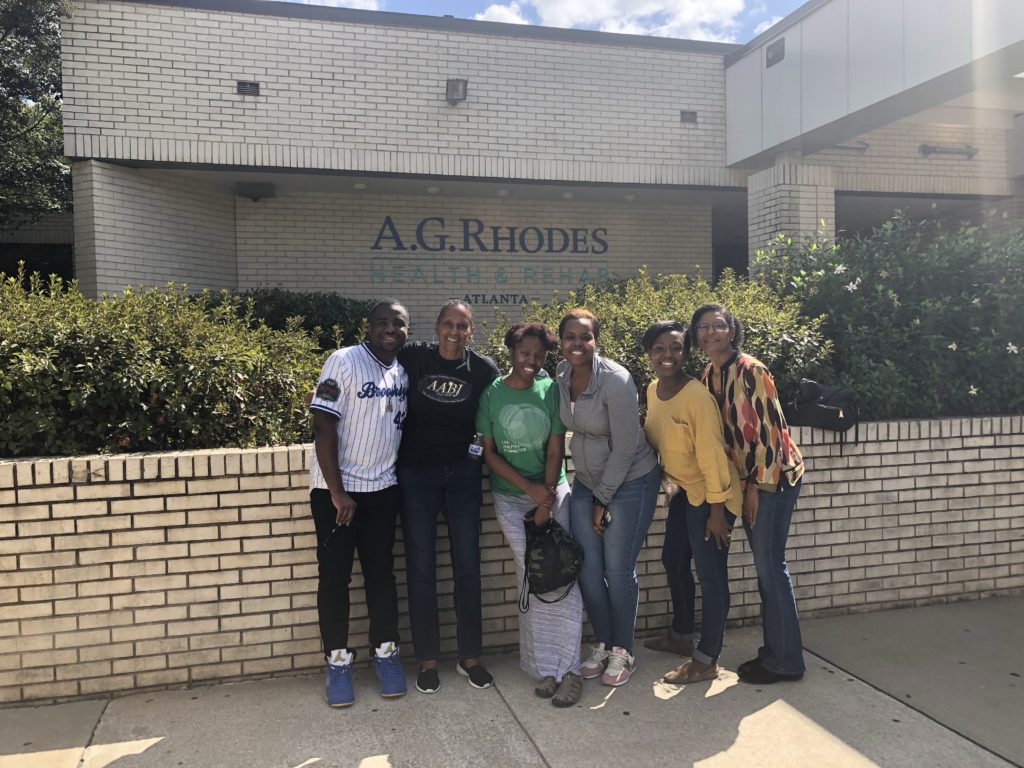
AABJ members pose for a photo outside of the AG Rhodes Health and Rehab on Sept. 21, 2019.
Members of Atlanta Association of Black Journalist (AABJ) gathered to spend time with senior citizens Sept. 21 for a volunteer event at the Atlanta branch of AG Rhodes Health and Rehab, a nursing home.
For two hours, the seven volunteers played games and heard about the lives and opinions of the seniors while sharing their own experiences and answering some of the residents’ questions. Typically, AABJ holds four volunteer events per year. After the nursing home visit, the chapter plans to hold one more volunteer event this year.
Barbara McDew, AG’s activities assistant, has worked with senior citizens for the past 30 years and spoke about the impact the seniors had on her and the potential impact they can have on others. Seniors, she said, have experienced life in ways she wouldn’t have ever imagined and hold interesting stories. By working with them, McDew learned things that would equip her for life.
“They taught me how to live and how to be a lady,” she said.
Helene Mills, a 94-year-old resident of the center, told the volunteers about her life and her advocacy. Mills has worked as a community advocate for Atlanta’s Fourth Ward and for senior citizens for years.
“I’m still working as an advocate for senior citizens right here,” she said. “I’m now a (National) Silver Haired Congress person who — when I was able — went to congress to advocate for various items in regards to senior citizens … That’s something I’m proud of.”
Jasimine Murray, who joined AABJ two months ago, said she volunteered due to her past experiences and her love of seniors. Because of her close relationship with her great grandmother, she said she has volunteered at her great grandmother’s senior citizens home.
“Anytime I can do something with the seniors, I do it,” Murray said. “I always think that there’s so many hidden stories here … I think that you can have all the books, but I think the best truths and stories come from people.”
Joy Woodson, the AABJ committee chairperson for community relations, said she chose the center in hopes of exposing the public to reporters.
“We [as AABJ members] thinks it’s important for people to see journalists as people and not just as people you see on the news who are telling a story and the only time they want to know you is when you’re having a bad day,” she said.
In addition, Woodson said she picked the center due to her belief that it’s important for black residents to see reporters that look like them serving the public. A large portion of the residents that came out for the volunteer event were black. Woodson described the group as lively and said she saw a lot of smiles.
“I think part of that is an outside group coming in,” she said. “It’s a help to the community. You’re helping expand the knowledge of whoever you’re helping.”
At this volunteer event, Woodson said that enough people did not come out, but she expressed hope for more to come out for the winter volunteer event. Over the course of a reporter’s career, Woodson pointed out the graciousness people have shown by sharing their stories with reporters and answering their questions. Besides returning that act of grace to the community, Woodson centered service as a pillar of the journalism profession.
“That’s what the core of what journalism should be about,” she said. “It’s a public service.”
Breanna Durham is a free lance writer.
AABJ Online Fundraiser: 43 Years Campaign
AABJ’s $43 for 43 fundraising campaign is still ongoing. In its 43rd year, we are asking members to donate $43 to go towards programming, scholarships, and events throughout the year. Be sure to invite your friends, coworkers and anyone you know who supports our members in print, communications, public relations, radio, broadcast, digital and the many trailblazers in the literary world. Be sure to share our campaign on your social media by using the hashtag #AABJ43.
“My professor encouraged me to run on the state level instead of the federal level because there are a lot of progressive policies and initiatives that must start to happen here in Georgia, and since this is home, take care of home first,” the 33-year-old sophomore at Clark Atlanta University said.
The threat to women’s rights is what prompted Doss-Hunter to run for the state position.
“Men
are controlling women’s rights, and we need more women of color at the table
voicing our rights,” Doss-Hunter said.
“Before I moved to Atlanta I was prepared to enroll in school. I didn’t know where I wanted to go so I was waiting to apply for colleges once I moved here,” Doss-Hunter said. She added that her family worked in film and she started working in film as well.
“I immediately started working in the field I wanted to without a college degree so going back to school seemed unnecessary,” she said.
Doss-Hunter said she was inspired by the teachings of W.E.B. Du Bois, and decided to go back to school to further her education in the fall of 2018.
“I wanted to go back to school to understand policy and legislation thoroughly. What better place to learn politics than at Clark Atlanta University? Georgia is the home of the first black woman state representative, Grace Towns Hamilton. There is no other place I should be,” Doss-Hunter said.
She believes Georgians “deserve transformative
education programs that nurture and guide the excellence of” all children. Doss-Hunter
also said she supports reform that de-criminalizes non-violent minor marijuana
offenses and wants quality healthcare coverage and facilities for everyone.
“No one should be refused quality health care services because they do not have health insurance,” she said.
Students at Clark Atlanta University have shown excitement in seeing their classmate run for state office .
“I believe Amber will represent Clark Atlanta well. I am certain the institution will support her through her campaign journey,” CAU senior Alexis Grace said.
Hunter’s vision for this campaign season is to touch everyone within arm’s reach of her district.
“I
never want to be a person who speaks of the issues and never tries to help
those in need of solutions. I want to help bring the change my community
needs,” Doss-Hunter said.
Union City, Fairburn, Chattahoochee Hills, Douglasville, Palmetto, and South Fulton are all part of District 65.
The primary voting is on May 19, 2020, followed by general elections on November 3, 2020.
Almiya White is a senior at Clark Atlanta University.
Be sure to buy the AABJ documentary “Black and Reporting”
Get your Emmy Award-Nominated copy of AABJ’s Documentary, “Black & Reporting: The Struggle Behind the Lens.”
Proceeds go to AABJ’s Xernona Clayton Scholarship Fund .
Anyone who wants to watch the entire documentary can buy it for $9.95 here.
Member Spotlight: Lisa Cox
Lisa Cox
Current position in AABJ?
Member
How long have you
been a member of AABJ?
5 years
Where did you attend
college?
UC Berkeley-Undergrad
Columbia University Graduate School of Journalism- Graduate
What do you like most
about being a member of AABJ?
The fellowship, networking, making new friends, learning the history and impact of black journos in Atlanta, and being surrounded by fellow black journalists.
What initially got
you interested in the media/communications field?
I grew up in the business so I was naturally attracted to it. My father is a broadcast journalist and professor. He used to be a top local TV news anchor in my hometown of Los Angeles and a former network radio host and correspondent. Plus — I got good grades in English and composition and writing came naturally to me.
What are your
favorite publications/outlets to get your news?
Not really but there are a multitude of people I admire and respect for their accomplishments and acumen (several local news professionals, Carole Simpson, Wolf Blitzer, Byron Pitts, Bernie Shaw among them). I love Whoopi Goldberg. She’s not traditional media but I love her anyways … her spirit and conviction. She keeps it real.
What’s an interesting
fact about you people wouldn’t have otherwise known?
My maternal grandmother was from Guadalajara, Mexico; I’m an
excellent interior decorator; if I could have any job and money was no object
I’d be a masseuse and own an herbal apothecary/fragrance shoppe.
This edition of The Byline was edited by Amir Vera