AABJ volunteers trade experiences with seniors at AG Rhodes Health and Rehab
By Breanna Durham
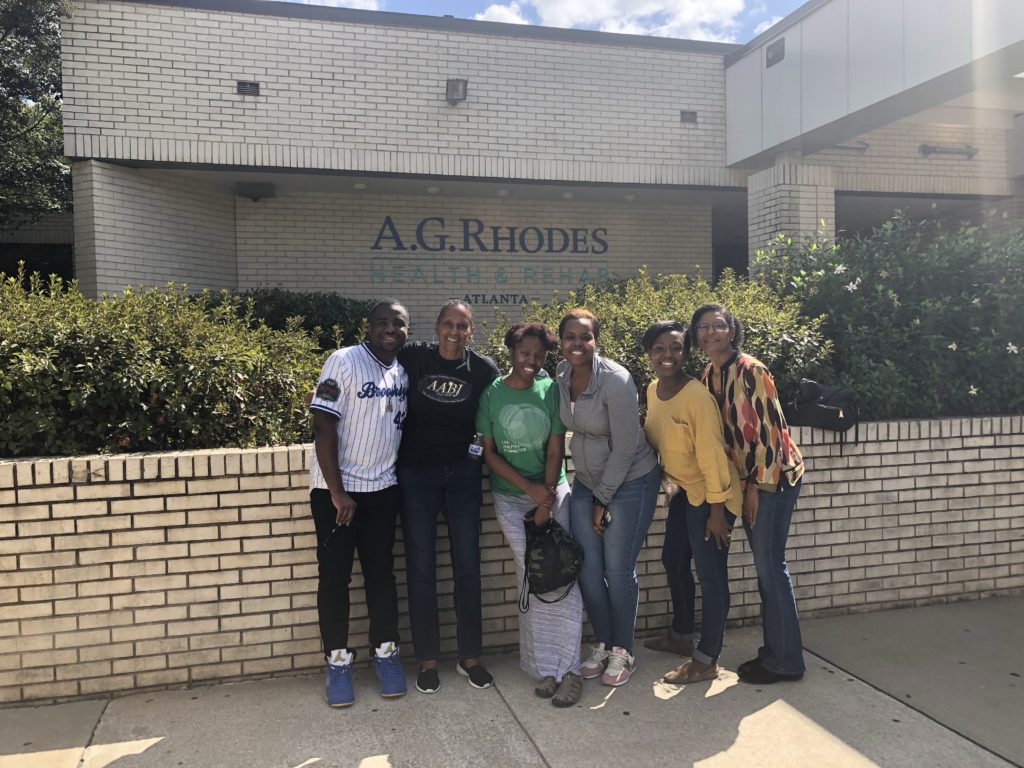
AABJ members pose for a photo outside of the AG Rhodes Health and Rehab on Sept. 21, 2019.
Members of Atlanta Association of Black Journalist (AABJ) gathered to spend time with senior citizens Sept. 21 for a volunteer event at the Atlanta branch of AG Rhodes Health and Rehab, a nursing home.
For two hours, the seven volunteers played games and heard about the lives and opinions of the seniors while sharing their own experiences and answering some of the residents’ questions. Typically, AABJ holds four volunteer events per year. After the nursing home visit, the chapter plans to hold one more volunteer event this year.
Barbara McDew, AG’s activities assistant, has worked with senior citizens for the past 30 years and spoke about the impact the seniors had on her and the potential impact they can have on others. Seniors, she said, have experienced life in ways she wouldn’t have ever imagined and hold interesting stories. By working with them, McDew learned things that would equip her for life.
“They taught me how to live and how to be a lady,” she said.
Helene Mills, a 94-year-old resident of the center, told the volunteers about her life and her advocacy. Mills has worked as a community advocate for Atlanta’s Fourth Ward and for senior citizens for years.
“I’m still working as an advocate for senior citizens right here,” she said. “I’m now a (National) Silver Haired Congress person who — when I was able — went to congress to advocate for various items in regards to senior citizens … That’s something I’m proud of.”
Jasimine Murray, who joined AABJ two months ago, said she volunteered due to her past experiences and her love of seniors. Because of her close relationship with her great grandmother, she said she has volunteered at her great grandmother’s senior citizens home.
“Anytime I can do something with the seniors, I do it,” Murray said. “I always think that there’s so many hidden stories here … I think that you can have all the books, but I think the best truths and stories come from people.”
Joy Woodson, the AABJ committee chairperson for community relations, said she chose the center in hopes of exposing the public to reporters.
“We [as AABJ members] thinks it’s important for people to see journalists as people and not just as people you see on the news who are telling a story and the only time they want to know you is when you’re having a bad day,” she said.
In addition, Woodson said she picked the center due to her belief that it’s important for black residents to see reporters that look like them serving the public. A large portion of the residents that came out for the volunteer event were black. Woodson described the group as lively and said she saw a lot of smiles.
“I think part of that is an outside group coming in,” she said. “It’s a help to the community. You’re helping expand the knowledge of whoever you’re helping.”
At this volunteer event, Woodson said that enough people did not come out, but she expressed hope for more to come out for the winter volunteer event. Over the course of a reporter’s career, Woodson pointed out the graciousness people have shown by sharing their stories with reporters and answering their questions. Besides returning that act of grace to the community, Woodson centered service as a pillar of the journalism profession.
“That’s what the core of what journalism should be about,” she said. “It’s a public service.”
Breanna Durham is a free lance writer.
AABJ Online Fundraiser: 43 Years Campaign
AABJ’s $43 for 43 fundraising campaign is still ongoing. In its 43rd year, we are asking members to donate $43 to go towards programming, scholarships, and events throughout the year. Be sure to invite your friends, coworkers and anyone you know who supports our members in print, communications, public relations, radio, broadcast, digital and the many trailblazers in the literary world. Be sure to share our campaign on your social media by using the hashtag #AABJ43.
“My professor encouraged me to run on the state level instead of the federal level because there are a lot of progressive policies and initiatives that must start to happen here in Georgia, and since this is home, take care of home first,” the 33-year-old sophomore at Clark Atlanta University said.
The threat to women’s rights is what prompted Doss-Hunter to run for the state position.
“Men
are controlling women’s rights, and we need more women of color at the table
voicing our rights,” Doss-Hunter said.
“Before I moved to Atlanta I was prepared to enroll in school. I didn’t know where I wanted to go so I was waiting to apply for colleges once I moved here,” Doss-Hunter said. She added that her family worked in film and she started working in film as well.
“I immediately started working in the field I wanted to without a college degree so going back to school seemed unnecessary,” she said.
Doss-Hunter said she was inspired by the teachings of W.E.B. Du Bois, and decided to go back to school to further her education in the fall of 2018.
“I wanted to go back to school to understand policy and legislation thoroughly. What better place to learn politics than at Clark Atlanta University? Georgia is the home of the first black woman state representative, Grace Towns Hamilton. There is no other place I should be,” Doss-Hunter said.
She believes Georgians “deserve transformative
education programs that nurture and guide the excellence of” all children. Doss-Hunter
also said she supports reform that de-criminalizes non-violent minor marijuana
offenses and wants quality healthcare coverage and facilities for everyone.
“No one should be refused quality health care services because they do not have health insurance,” she said.
Students at Clark Atlanta University have shown excitement in seeing their classmate run for state office .
“I believe Amber will represent Clark Atlanta well. I am certain the institution will support her through her campaign journey,” CAU senior Alexis Grace said.
Hunter’s vision for this campaign season is to touch everyone within arm’s reach of her district.
“I
never want to be a person who speaks of the issues and never tries to help
those in need of solutions. I want to help bring the change my community
needs,” Doss-Hunter said.
Union City, Fairburn, Chattahoochee Hills, Douglasville, Palmetto, and South Fulton are all part of District 65.
The primary voting is on May 19, 2020, followed by general elections on November 3, 2020.
Almiya White is a senior at Clark Atlanta University.
Be sure to buy the AABJ documentary “Black and Reporting”
Get your Emmy Award-Nominated copy of AABJ’s Documentary, “Black & Reporting: The Struggle Behind the Lens.”
Proceeds go to AABJ’s Xernona Clayton Scholarship Fund .
Anyone who wants to watch the entire documentary can buy it for $9.95 here.
Member Spotlight: Lisa Cox
Lisa Cox
Current position in AABJ?
Member
How long have you
been a member of AABJ?
5 years
Where did you attend
college?
UC Berkeley-Undergrad
Columbia University Graduate School of Journalism- Graduate
What do you like most
about being a member of AABJ?
The fellowship, networking, making new friends, learning the history and impact of black journos in Atlanta, and being surrounded by fellow black journalists.
What initially got
you interested in the media/communications field?
I grew up in the business so I was naturally attracted to it. My father is a broadcast journalist and professor. He used to be a top local TV news anchor in my hometown of Los Angeles and a former network radio host and correspondent. Plus — I got good grades in English and composition and writing came naturally to me.
What are your
favorite publications/outlets to get your news?
Not really but there are a multitude of people I admire and respect for their accomplishments and acumen (several local news professionals, Carole Simpson, Wolf Blitzer, Byron Pitts, Bernie Shaw among them). I love Whoopi Goldberg. She’s not traditional media but I love her anyways … her spirit and conviction. She keeps it real.
What’s an interesting
fact about you people wouldn’t have otherwise known?
My maternal grandmother was from Guadalajara, Mexico; I’m an
excellent interior decorator; if I could have any job and money was no object
I’d be a masseuse and own an herbal apothecary/fragrance shoppe.
This edition of The Byline was edited by Amir Vera
AABJ is kicking off our $43 for 43 fundraising campaign. In its 43rd year, we are asking members to donate $43 to go towards programming, scholarships, and events throughout the year. Be sure to invite your friends, coworkers and anyone you know that supports our members in print, communications, public relations, radio, broadcast, digital and the many trailblazers in the literary world. Be sure to share our campaign on your social media by using the hashtag #AABJ43.
AABJ honors Black media trailblazers at film screening
By Amir Vera
Some of the first reporters and anchors in Atlanta pose for a photo on February 9, 2019.
Until late 2018, there hasn’t been an organized record of the first black journalists in Atlanta.
There was no record of the challenges they faced unless it was by word of mouth.
The Atlanta Association of Black Journalists changed all that. In the span of two years, a lot of volunteer hours and countless interviews, members of AABJ organized all of that history to create a film dedicated to these stories.
“Black & Reporting: The Struggle Behind the Lens” is a firsthand account that charts the paths of 10 Atlanta broadcast pioneers. The organization held a screening in December during its annual scholarship reception and then again on February 9.
The February event featured eight of the 10 pioneers for a post-screening discussion on their experiences, the current state of journalism, it’s future and tips for young journalists.
“It took AABJ to tell the stories of the first black journalists,” said Collie Burnett, a former reporter at WSB Radio and one of the panelists, adding that major and local networks are just covering rappers, athletes and business leaders.
“Only when you control the means of distribution do have the capacity to tell the stories that need to be told and make a difference.”
AABJ Vice President of Print Amir Vera interviews Lorenzo “Lo” Jelks, the first black reporter in Atlanta, after a screening of “Black & Reporting: The Struggle Behind the Lens” on February 9, 2019.
Lorenzo “Lo” Jelks, the first black reporter in Atlanta, came to WSB in the late 1960s. He said he enjoyed the documentary screening and couldn’t wait to see the finished product. He also said he hopes viewers really understand not only the experiences of the trailblazers, but also “the pride associated with African Americans in the media.”
Jocelyn Dorsey, another trailblazer and former anchor/reporter at WSB-TV, spoke to that pride saying her fellow reporters helped her learn about the city. She even described some of the other trailblazers as brothers and sisters.
“There was a community movement, a civil rights movement that got us on the air,” Dorsey said. “We knew if we screwed up, it’d be difficult for another black person to take our place.”
Kerry Charles, a reporter and anchor at WAGA Fox 5, said watching the “more than 300 years of experience in the panel” was inspiring.
“They opened the door for me to have a voice in my newsroom and in the community.”
Cierra Johnson, a senior at Clark Atlanta University, was almost brought to tears during the panel.
“I tried not to cry because I really appreciate journalists that came before me,” she said. “Just watching them take the time to give their wisdom so I can excel, it made me feel no matter what I face in this industry I can get through it because they’re still here.”
Anyone who wants to watch the entire documentary can buy it for $9.95 here.
Amir Vera is AABJ’s vice president of print.
Editor’s Note: The Atlanta Association of Black Journalists would like to pass their condolences to the family of Civil Rights leader Lonnie King Jr., who died Tuesday at the age of 82.
###
AABJ member reflects on volunteering for Super Bowl LIII
By Almiya White
AABJ member Karvis Jones volunteered during Super Bowl LIII.
With a passion for service, FOX Sports South’s very own production assistant Karvis Jones found time to give back to the city that once welcomed him with open arms.
When Jones found out Super Bowl LIII was coming to Atlanta, he didn’t hesitate to sign up as a volunteer and demonstrate his southern hospitality.
“I think the biggest incentive of being a volunteer is to help raise Atlanta’s
profile as a city that continues to show the world that it can host some of the world’s biggest sporting events, as well as show the nation how diversity continues to make Atlanta a special place,” Jones said.
According WXIA-TV, more than 30,000 people applied and interviewed to be volunteers with the Atlanta Super Bowl host committee and only 10,000 were chosen.
“I found out that I was selected as a volunteer via e-mail. I was really excited when I got the news that I got selected because with the record number of applicants who applied to be volunteers, I knew I had a one-third shot of making the cut.,” Jones said, adding that the first person he told was his wife, Carrisa Jones.
“Volunteers spent two hours in training leading up to the Super Bowl where they learned the area around the Super Bowl campus, how to greet fans and how to report suspicious activities. The Super Bowl host committee spoke heavily on the topic of sex trafficking being that Atlanta is a hub for sex trafficking nationwide,” Jones said.
Jones was selected to serve on the street team where he said he welcomed visitors and gave directions to all of the must-see places in Atlanta. Jones said he worked three days out of the 10 days surrounding the Super Bowl.
“The culture of the Street Team was very friendly. The Street Team gave fans materials on how to get to the NFL Experience at the Georgia World Congress
Center, as well as Super Bowl LIVE at Centennial Olympic Park. The Street Team also helped fans find hotels, restaurants, the closest MARTA rail station and places around downtown Atlanta such as the King Center, the Sky View, the World of Coke and the National Center for Civil & Human Rights.” Jones said.
Volunteering for the Super Bowl didn’t guarantee tickets inside the game. However, volunteers were able to experience any and everything else by being in the heart of the action with events like Super Bowl Live and anywhere the game left its footprint. It was all to assist the 250,000 guests, WXIA-TV reported, who came to the city without even having an actual ticket to the game.
Not only were volunteers able to give back to the community, but they were able to do it in style. According to The Atlanta Journal-Constitution, the Super Bowl Host Committee provided 10,000 volunteers with uniforms from The Icebox, an Atlanta apparel and merchandise agency. Jones said the uniforms consisted of six cool swag components that included a jacket, a beanie cap/baseball cap, gloves, a polo shirt, scarf and a book bag.
According to The AJC, more than 500,000 people came to Atlanta, including 150,000 out-of-state visitors to experience Super Bowl LIII and the numerous events.
With two Super Bowls already in Atlanta, Jones said “we’re the city to show the world what we have to offer. We made history hosting Super Bowl LIII in Atlanta.”
Not only that, but Jones said volunteering for the Super Bowl was his way of giving back to the community that welcomed him with open arms when he moved to the city in 2006.
“I love serving people around the community and I believe when you serve others, it makes the world a better place to live as global citizens,” Jones said.
Almiya White is a junior at Clark Atlanta University.
###
Women’s History Month: Inventions by Black Women
By Ashlea Brown
Women’s History Month takes place every March. According to the United Nations’ website, the first National Woman’s Day was February 28, 1909, in the United States. From there it grew internationally in 1910 during a meeting in Copenhagen, Denmark, for a conference with over 100 women in attendance who decided there should be a Women’s Day to honor the movement for women’s rights and support for women’s suffrage, the UN website states. In 1913, the International Women’s Day website states it was established that March 8 would remain the global date for International Women’s Day. In 1981, Congress passed a resolution that authorized Women’s History Week that began on March 7. However, after much petitioning by the National Women’s History Project in 1987 the Women’s Week turned into Women’s History Month that is celebrated in March, according to the federal Women’s History Month website.
Women have made major contributions throughout history by being actresses, writers, activists and inventors. Every day, people encounter inventions made by black women that they may overlook.
Here is a list of women who have invented items you may have not known.
Patricia Bath
Patricia Bath was the first African American to complete residency in ophthalmology in 1973 according to biography.com. She invented the Laserphaco Probe for cataract treatment in 1986. This device is used to remove the cataracts, or cloudy blemishes formed over the lens of a person’s eye. She was able to restore the vision of several people who were unable to see prior to her invention.
The blue print of the closed-circuit television system that was used for home monitoring.
When people think about their modern home security, people can thank Marie Van Brittan Brown. She invented an early closed-circuit television system that was used for home monitoring and filed for patent for the invention in 1966 according to the history website America Comes Alive. Brown was influenced to create this security system, the website states, because of concern for crime and slow response from police. She was also influenced to create this security system so that she could identify those surrounding her home, America Comes Alive states.
Annie Malone
Annie Malone was a chemist and entrepreneur who became one of the country’s wealthiest African-American women in the early 1900s, according to the State Historical Society of Missouri. Malone developed a hair product that straightened black women’s hair with damaging it, the historical society states on their website. Malone moved her business to St. Louis in 1902 where she began selling a safe hair care for people of color. She went on to open the cosmetology school and training center known as Poro College in St. Louis in 1918, according to the historical society. Despite Malone’s success, the historical society says she is often overshadowed by a former employee, Madam C.J. Walker.
Mary Kenner
Mary Kenner invented the sanitary napkin with moisture-proof napkin pocket according to the Black History website Black Then. Her invention was a safer and much cleaner way for women to handle their menstrual cycles. However, her invention was not used until 1956, which was thirty years after she invented it. The company first interested turned her invention down once realizing she was black. She also invented the bathroom tissue holder and back washer, according to Black Then.
Sarah Boone earned patent rights to her improvements of the ironing board in 1892 according to the reference website ThoughtCo. Her new and improved invention led to better quality of shirt sleeves and women’s garments. Her new board, according to ThoughtCo, was narrow and curved which was a nice size to fit sleeve and women’s clothing. She stated in her patent application that the purpose of her invention was to “produce a cheap, simple, convenient and highly effective device, particularly adapted to be used in ironing the sleeves and bodies of ladies’ garments” according to biography.com.
Ashlea Brown is a senior at Spelman College.
A previous edition of this article had the incorrect picture of Marie Van Brittan Brown. That photo has since been replaced.
###
AABJ Member Spotlight: Kamaria Jackson
AABJ member Kamaria Jackson
How long have you been a member of AABJ?
I have been a member of AABJ for 2 years now.
Where did you attend college?
I attended Clark Atlanta University (CAU) for undergrad in which I obtained a degree in Mass Media Arts, concentrating in Television Production. I also obtained my Masters Degree in New Media Journalism from Full Sail University.
How long have you lived in Atlanta?
I’m a homegrown Georgia Peach, and have lived in Atlanta my entire life!
What is your current occupation?
I’m currently a video playback operator and trainer at the Mercedes Benz Stadium here in the heart of downtown Atlanta. I import and organize videos and clips for playback during live events such as Atlanta Falcons, as well as Atlanta United games. I’m also an educator in the Dekalb County School District.
What do you like most about being a member of AABJ?
AABJ is a great organization that connects media professionals, new and seasoned. I particularly love the fact that college students are encouraged to join as well, giving them early exposure to the industry by offering programs, conventions, and workshops that provide the necessary skills essential to being successful in the media field. AABJ has allowed me to reconnect with some of my fellow CAU alumni and build professional relationships through organized fellowship and networking.
What initially got you interested in the media/communications field?
For the majority of my childhood I had the goal of becoming a pediatrician. It wasn’t until I reached my junior year at Stephenson High School, that I actively became a member of the Production Department (JAG 8 News). There, I first learned how to operate a camera and edit via Casablanca. My teacher pulled me aside and noted that I had a great speaking voice, and should encourage me to audition for the JAG 8 news anchor position (which were the anchors who hosted school morning announcements and other school productions.) I auditioned and received the role. Upon further research on perfecting my TV presence, I was inspired by Atlanta native and popular local news anchor, Monica Kauffman, who had attained notable accolades as a journalist. From then on, I just knew that the media production industry was for me. Nothing beats having fun while loving what you do professionally!
What are your favorite publications/outlets to get your news?
Because I think it’s very paramount to know what’s going on in my community, local news is very important to me. I support all of the local stations in Atlanta, but in particular WSB-TV and well as FOX 5; in which I was afforded the opportunity to “job shadow” popular news anchor Lisa Rayam my junior year in high school.
Is there anyone in media you look up to? Why?
With the mass media field being a male-dominated industry, I’m inspired by all of the women who have paved the way for me to not only be a successful woman, but successful black woman in this fast paced industry. On many of my production-related social media posts, I love to represent by using the hashtags #BLACKWOMENINPRODUCTION, #BLACKGIRLMAGIC and #PRODUCTIONCHICKSROCK, giving distinct notoriety to the women who “blaze” the industry daily with fierceness, style, and grace.
What’s an interesting fact about you people wouldn’t have otherwise known?
Most people don’t know that I possess many talents. I play two instruments (clarinet and bass clarinet), I am a dance instructor and baton twirler, specializing in fire baton twirling. I’m also a freelance sketch artist. Most importantly, I am a mother to the best 10 year-old son I could have ever prayed for! He is the reason why I strive so hard for success everyday. Mommy loves you Kamden!