Your cart

THE BYLINE 06/2020

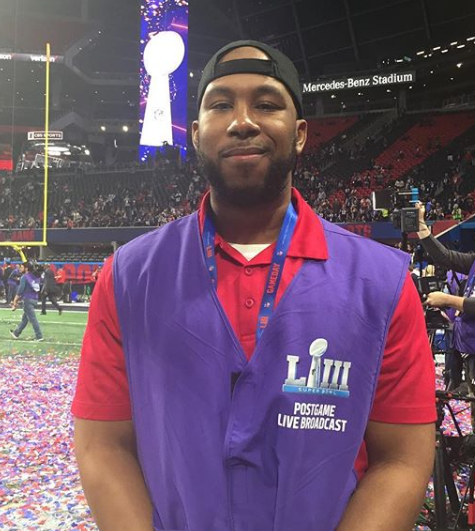
AABJ President talks Black Twitter’s reaction to his Verzuz battle story 

By Amir Vera

We’ve all seen what happens when you cross Black Twitter. 

When someone who isn’t in tune with the culture gets relentlessly attacked for being anti-black, clueless or simply having a controversial opinion. Black Twitter can and will fry you without mercy. 

I knew that and yet had no idea I would be the next victim between the night of April 18 and stretching all the way until the evening of April 20.

It all started with a simple story idea. Like many R&B fans, I had been anticipating the Verzuz Instagram Live battle between singer-producers Kenneth “Babyface” Edmonds and Teddy Riley. But things didn’t go according to plan because of technical issues, specifically on Teddy Riley’s end. 

As a viewer, I thought it was funny, but as a journalist, this immediately looked like a story for CNN. So I wrote the story with the headline “Instagram Live battle between Babyface and Teddy Riley was a complete fail.” The headline wasn’t inaccurate. The two artists attempted to do something and it didn’t happen. Thus, it was a fail. 

There were also no issues with the reporting; everything I had written was either based on social media feedback of the failed live or posts from the artists themselves. 

Black Twitter’s main criticisms were the “harsh” headline and many thought it unfair I wrote about the failed Verzuz as opposed to writing about the other successful battles. 

It is true, I hadn’t written about the other Verzuz battles, but nothing newsworthy took place during them as far as I know. Another CNN entertainment reporter, however, did write about the two producers, Swizz Beatz and Timbaland, who were behind  Verzuz and why they created it.

And so began the barrage of comments, including calling me an Uncle Tom and a token and chastising me for “telling the family business” on what many see as a mostly white platform. 

I was unfazed by the comments; as a journalist, I know my work will be critiqued. However, I was baffled by comments saying CNN had no right to cover the event, and instead preferred the event be covered by Black cultural websites Vibe, Complex, or BET.com. 

Part of the reasoning is some view CNN as a platform that doesn’t cover cultural events like the Verzuz battles, but instead focuses on hard news and politics. The deeper issue wasn’t with me or the headline. It was the fact people felt CNN had invaded a black space and used a token (me) to invade that space. 

I can tell you that’s simply not true. 

While some would feel pigeon-holed by being the “black reporter” — which often happens in newsrooms — I believe it is my mission to report those stories that otherwise wouldn’t be reported at CNN. 

That means being an ambassador for, not an invader of, black issues, events, and cultural phenomena. Sometimes that means I will have to alert editors about rappers dying, entertainers and their raunchy live videos and cultural sports stories.

It doesn’t mean I am or feel pigeon-holed because as that ambassador I also bring attention to stories about HBCUs, viral moments that put us in a positive spotlight, and criminal justice.  

I later wrote a follow-up to the Riley and Babyface battle, but not because of the lashing I took on Twitter. The world needed to see what happens when two legends (successfully) go head-to-head. I’ve also reported on the other Verzuz battles since then because if I didn’t write them, who would?

Amir Vera is president of the Atlanta Association of Black Journalists. 


Outgoing NABJ VP-Print on his advocacy for Black print journalists 

By Marlon A. Walker

NABJ doesn’t care about print journalists.

That could easily be rephrased to be put in a better light, but many members of the largest advocacy organization for journalists of color feel that way, often cast aside for their more visible broadcast counterparts.

That doesn’t mean the work stops.

The job of a print journalism advocate within the confines of the National Association of Black Journalists can be best reflected through the main conflict many black journalists face in mainstream newsrooms across the country as they seek to tell stories from black communities. That people outside the black community have to be convinced there is, indeed, relevance in issues those outside do not see or understand.

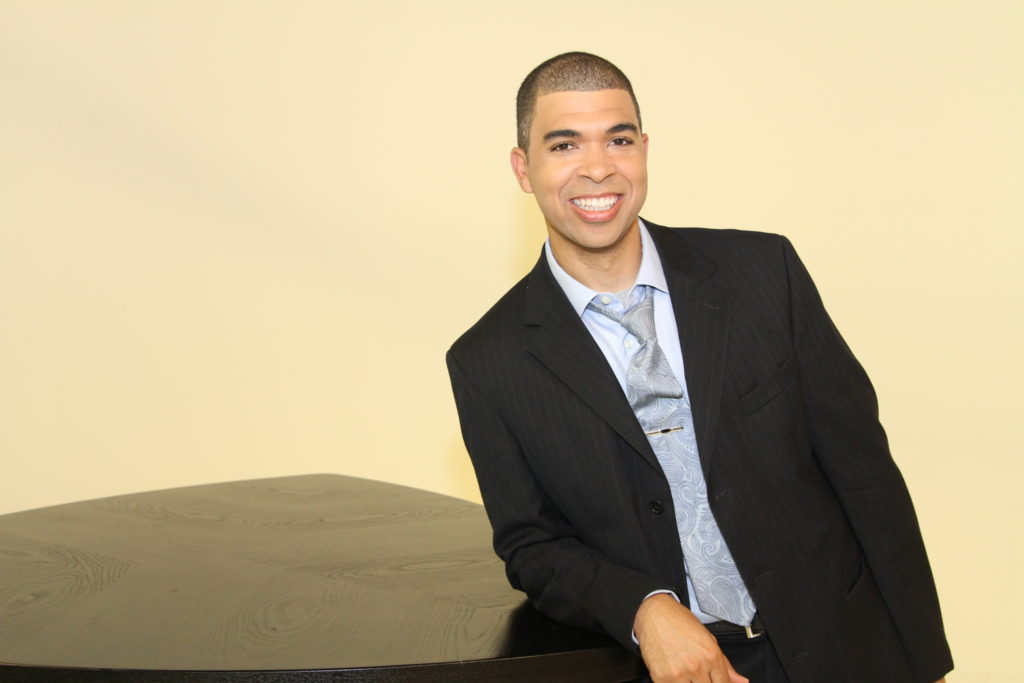
Marlon Walker, NABJ Vice President of Print.

Black journalists get it. Black print journalists also fall victim to the same ideologies, being forced to convince others outside print newsrooms of the relevance to their concerns.

“There’s something to the premise that you’ve got to be a part of something to understand it,” the late Roosevelt Wilson told me several years ago as I sought to better understand my role as NABJ’s vice president of print.

Wilson was a retired professor in Tallahassee, Fla., at Florida A&M University’s School of Journalism and Graphic Communication and a long-time journalist who spent 18 years as publisher of the Capital Outlook, the city’s black newspaper. He had been my teacher at the school, my boss at the paper.

“Diversity for diversity’s sake – I can’t make a case for that. It’s like having a plain cake but putting the layers in various colors. It’s the same cake. That doesn’t mean it tastes any differently. If you want a rainbow cake, you get a chocolate layer, a strawberry layer, and so on.

“That’s where I think there’s miscommunication.”

Again, that doesn’t mean the work stops.

Through conversations with mentors, former professors, newsroom leaders, and reporters across the country, I developed programming outside of the annual convention that would speak to the deficiencies seen in professional development offerings. NABJ’s current model for success includes an annual conference heavy on digital resources and a career fair many convention attendees see as the main reason for their attendance.

NABJ Presents: The Basics Bootcamp is a training ground to not only make sure members know what they need to know to get jobs but puts them in small classroom environments with hiring managers who accept the invitation knowing they could find their next police reporter or social media manager.

Through that program, about half the participants have taken jobs, internships, fellowships, and freelance opportunities as well as finding mentors and guides as they work their way through the industry.

I’ve spent countless hours with newsroom managers pitching them black journalists who they would not have found through their traditional networks – college friends, other recruiters, even job boards – because our members are more often matriculating through programs that don’t have journalism resources, or lack in-house professionals with the network to spread their name and work ethic. 

We do it because in 1978 when the American Society of News Editors set a goal to push newsrooms to have the same diversity as the communities they covered, just 4 percent of newsroom employees were people of color. People of color make up less than 20 percent in newsrooms across the country today, while people of color are nearly 40 percent of the country’s population.

I do it because of people like Pearl Stewart, the first black woman to lead a major daily newsroom, who was a professor of mine. Her network helped in major ways.

I want my network to do the same for somebody else.

Marlon A. Walker is Vice President of Print for the National Association of Black Journalists.


Black male journalists discuss challenges breaking into the field

By Anfernee Patterson 

The Black Man Lab hosted their weekly meeting June 1 in conjunction with the Atlanta Association of Black Journalists as part of the journalist group’s Black Male Media Project The event featured The Atlanta Journal-Constitution’s deputy managing editor Leroy Chapman and opinions editor Andre Jackson, and Dennis Byron, editor-in-chief of Hip Hop Enquirer Magazine.

In the wake of the massive number of protests across the country and worldwide in response to George Floyd’s death at the hands of the Minneapolis Police, the meeting touched on black journalists’ role within the media, the panelists’ journalism careers, and police brutality.

As the meeting began, Chapman and Jackson discussed how their journalism careers began and demonstrated why it is important that black voices be heard in the media.

Leroy Chapman. (Chris Hunt/AJC Special)

“Once I got in, I had the right kind of mentors who said you should think about being a leader,” Chapman said. “We need African-American men who lead in journalism because in these big corporate entities our voices are needed. We need to express issues in our community and open our door to be a connection to the community who do not know how to connect with the media.”

“I came to Atlanta to segway to the opinion side of the business,” Jackson said. “Journalists aren’t paid to have an opinion, we are paid to keep our opinion out of what we do. Newspaper opinion sections are the one place where you can have an opinion.”

As their journalism careers began and they started working, both men said they realized quickly how different of a world they were in, but also the importance of their position.

“I was a business reporter and I was covering banks,” Chapman said. “I go to a bank and they have all their regional vice presidents in there, I was the only black person there not serving food. Being a journalist is a passport to being in rooms that you never thought you would be in. When you are there as an observer, you’re able to have a real understanding of where power rests.”

Chapman also added how different he saw things during his time as a sports reporter. “I was a sports writer for a while. On the field, we are everywhere. In the administration and front office, we are not there.”

Jackson said his experience taught him much more about himself as he learned from other people.

Andre Jackson, AJC Opinions Editor

“I grew up in an all-black school and neighborhood. You move from that environment to a university that is more diverse,” Jackson said. “You gain experience with people who didn’t grow up in the same background and same ethnicity as you and you have to get comfortable with that 

“You quickly have to get comfortable with yourself and who you are. You quickly learn that some of the things that are said about yourself as a representative of a group are not necessarily true. In my youth, in the newsrooms I worked in, I was labeled the office militant because I was quick to call things out about things that could have been better. Sometimes you want to be listened to more than heard.”

Black journalists have fought hard for years to help change the number of people of color covering issues and how the Black community is portrayed. For these journalists, they are fighting hard during these times to make sure African-Americans not only are depicted in positive light but that the full truth is told.

“The biggest thing I see is how the mainstream media covers us and how we are depicted in a manner that is not true,” Byron said. “I have covered several court cases and if I was not in the courtroom, your clients may have had a different story. It was important for me to be in those courtrooms.”

Dennis Byron, Editor-in-Chief of Hip Hop Enquirer Magazine

How black men are depicted in the media is of high importance now with several protests going on in multiple cities, including Atlanta. Chapman reiterated the importance of reporting during times like this.

“What we want to do is provide the fullest picture possible. The thing we want to do is tell the whole story,” he said. “We have been on the street, we have had African-American journalists there and we are asking, ‘Why are you here?’ (when referring to the protests). We are always doing our best to get behind the whys. 

“The why is a lot of things, it is the routines of having black men who are victims of police violence and that is the heart of the why. We have to be able to understand the context; many of the people are not old enough to have been on the streets of Ferguson, some of these kids are 18 and 19. They’re under a lot of trauma and stress and it is up to us to explain a lot of that. The story is not looting, it is all the facts. It is about socioeconomic, education, having a seat at the table and having safety.”

Jackson added social media has changed the way African-Americans are represented and how hard it is for journalists to do their jobs.

“Social media has had a big influence because people can create their own realities,” he said. “Now anyone with a cell phone and a voice can do that. They can present things that are factual and it takes a lot of discernment from the audience to dissect the truth of what is being put out.”

Anfernee Patterson is a recent graduate of Georgia State University. 


This issue of The Byline was edited by Raisa Habersham and Tianna Faulkner.


THE BYLINE (6/2019)

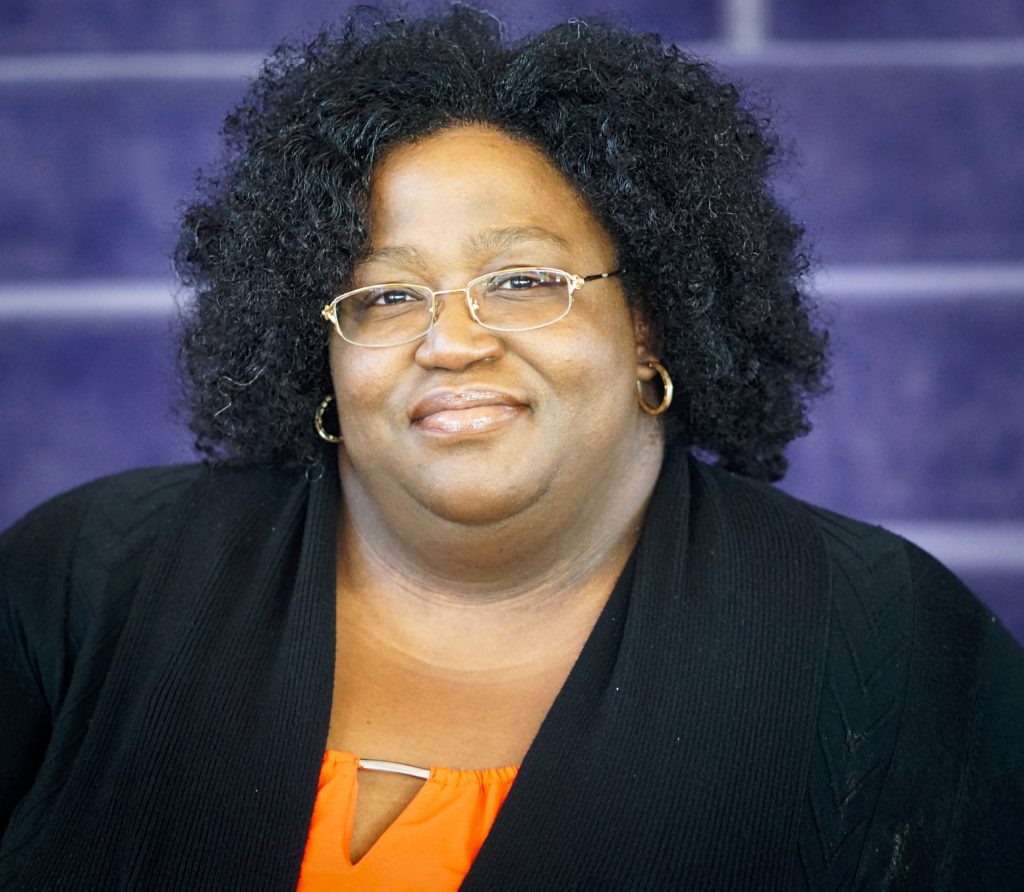
A message from AABJ President Carol Gantt

AABJ President Carol Gantt

Greetings:

We are at the halfway mark of 2019, and we have accomplished so much! First, if you haven’t heard, AABJ’s documentary, “Black & Reporting: The Struggle Behind the Lens,” has been nominated for an Emmy! We are proud and extremely excited about this.  Thanks to AABJ member, Donell Suggs, the documentary is in the June edition of Atlanta Magazine.  If you have not purchased your copy, please do so today.  The monies go toward AABJ’s Xernona Clayton Scholarship Fund.

I want to thank each of you for your support thus far, but we still have more to do this year.  We are planning more workshops, community service projects, and fundraisers we need your help to make work.  We also need volunteers to help with our newsletter, The Byline and our public affairs show, In Contact.  In the coming month, we’ll be sending out a proposed revision of our bylaws.  It’s been over ten years since they’ve last been updated.  We will be voting on adopting them later this year.

Speaking of voting, if you or anyone you know have some interest in leading this organization, now is the time to begin thinking about a leadership role.  Our term will end this year with elections slated to take place in November 2019.  The nomination process will start in September.

Yours in service,

Carol M. Gantt

President  

###

AABJ Online Fundraiser: 43 Years Campaign

AABJ’s $43 for 43 fundraising campaign is still ongoing. In its 43rd year, we are asking members to donate $43 to go towards programming, scholarships, and events throughout the year. Be sure to invite your friends, coworkers and anyone you know that supports our members in print, communications, public relations, radio, broadcast, digital and the many trailblazers in the literary world. Be sure to share our campaign on your social media by using the hashtag  #AABJ43.

You can donate here.

###

AABJ hosts annual Black Male Media Project

By Breanna Durham


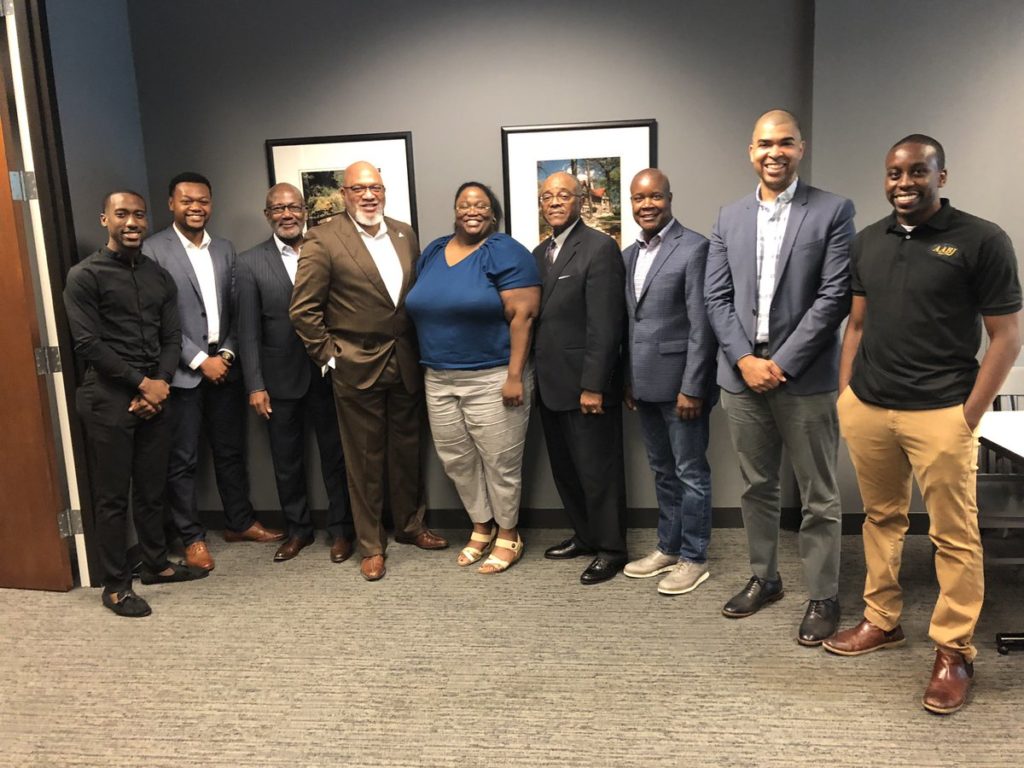
(L-R): AABJ Parliamentarian Wilton Jackson, Glenn Marshall, Eric Ludgood, Drew Dawson, AABJ President Carol Gantt, Collie Burnett, Eric Burns, Tolly Carr and AABJ VP of Print Amir Vera

Kendall “Kenny” Murray walked into a room of six black men working in media, unsure of how to approach them and nervous about how they would react to him.

“Unfortunately, I just automatically assumed that they were going to be standoffish, that they were going to be intimidating to talk to, not necessarily the kindest people,” the junior at Georgia State University said.

That assumption, Murray said, was broken once he sat down with the six men during 10-minute sessions.  

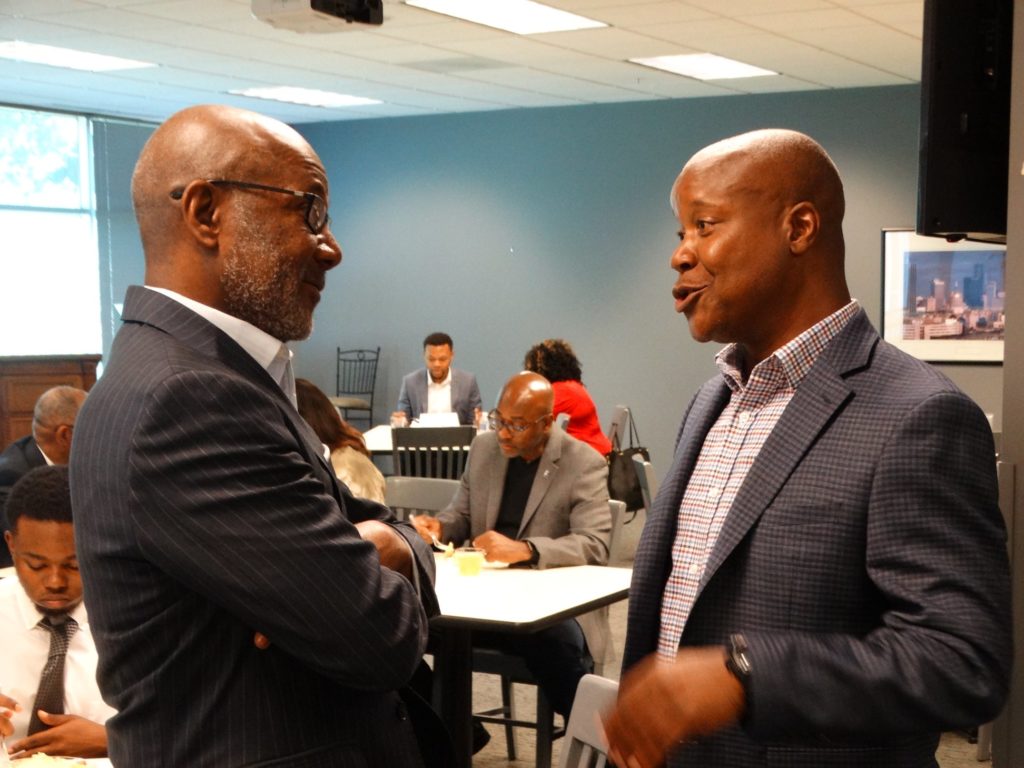
Kendall Murray (left) speaks with Eric Ludgood, assistant news director at WAGA-TV, during the Black Male Media Project June 1, 2019.

Discussions about the representation of black men in the media were all part of the Atlanta Association of Black Journalists’ (AABJ) Black Male Media Project on June 1.

The event  featured six guest speakers who discussed how they earned their management positions where they can make decisions on how black men are represented. It also featured a tour of WSB-TV led by former NABJ President Condace Pressley.

The event was part of a larger project, mandated by the National Association of Black Journalists,  designed to help change the narrative around the lives and images of black men in the news and in society through a series of workshops nationwide.

Drew Dawson, station manager at Georgia Public Broadcasting (GPB) speaks with a guest during the Black Male Media Project on June 1, 2019.

Drew Dawson, one of the guest speakers and station manager for Georgia Public Broadcasting, told Murray that it’s common to see news executives, directors, producers and other people who aren’t black in management approach stories, editing and decision-making from a eurocentric point-of-view. As one pitches stories, he said, the point is to take ownership of stories that are about your community.

“Your job is to position that story in such a way that will appeal to more than a black audience,” Dawson said.

But, Dawson also told Murray that one must watch for the “otherization” of minority groups.

“Sometimes, you’re going to be the only black person in the room, but it’s your job to find a way, before that story gets on the air, to say ‘this is what that looks like,’” Dawson said. “Why are we telling the story this way? Are we trying to demonize someone?”

Eric Ludgood, another one of the guest speakers and assistant news director for Atlanta Fox affiliate WAGA-TV, told Murray he had to be passionate about his work in order to truly succeed.

“I can teach you how to write. I can teach you how to produce. I can teach you how to report. I cannot teach you to care,” Ludgood he said. “But if you care, all that teaching is much easier. Care and want to tell stories about what you care about.”

Murray said it can be scary and hard overall to try to get your foot in the door and understand the information.

“If you talk to 10 different people, you’ll get 10 different stories about how they got where they got to,” said Tolly Carr, one of the guest speakers and a managing partner for HBCU Gameday. “Have you thought about doing anything original just on your own?”

Carr started in TV  and did stories he knew would never be on air.  He wrote them like they were real and gave them to news directors. Over the course of a couple of months, Carr said he wore down the director to accept his work.

“Even though it’s not given to the masses, that’s still experience under your belt,” he said.

Each interaction with the panelists ended with encouragement and connections made. By the end, Murray said he felt like he was talking to his professors and mentors. The conversations he had, which let him peek into different experiences, showed him kindness  and demonstrated success through hard work. It was what he needed, Murray said.

“Everybody here, even though they accomplished so much, they were so approachable,” Murray said.

Ludgood, in particular, had told Murray it was OK to want dreams and that Murray could make them come true.

Murray aspires to write for television.

“Trust yourself,” Ludgood said.

Murray held onto that message.

“He showed me that you can be yourself,” he said.

For those who were unable to make it, take a look at the June 1 event through the gallery below:

Breanna Durham is a free lance writer and staff writer at The McDuffie Progress

###

Member Spotlight: Bradley Gray

Bradley Gray

Current position in AABJ?

I’m a member  of AABJ.

How long have you been a member of AABJ?

2 years

Where did you attend college?

I attended Ball State University.

How long have you lived in Atlanta?

I moved here in May 2016, so just passed the three-year anniversary.

Current Occupation?

Multi-Platform Producer at 11Alive

What do you like most about being a member of AABJ?

I love the community and the mentorship opportunities.

What initially got you interested in the media/communications field?

My church back home runs a summer camp all about multimedia where I was able to get my hands on video and editing software at a young age. I’ve been all about media ever since.

What are your favorite publications/outlets to get your news?

I like to start the day with the daily podcasts from NYT, BBC, and others. I also keep up with AP alerts for breaking news updates. For perspective content, I think NPR does a great job.

Is there anyone in media you look up to? Why?

I looked up to Ed Bradley on “60 Minutes” as a kid. Now I admire my peers that create culturally relevant and informative content; folks like Wesley Lowery and Justin Tinsley.

What’s an interesting fact about you people wouldn’t have otherwise known?

I shortly left the industry to teach at my old high school before I moved to Atlanta.

###

This edition of The Byline was edited by Amir Vera.

THE BYLINE (5/2019)

AABJ to host Black Male Media Project June 1

The narrative of Black men in the media needs to change, in more ways than one.
There are plenty of Black faces in front of the camera. Now is the time to have the discussion about the faces behind the camera. Who are the people making decisions about which stories are being told and how?
AABJ will tackle this subject on June 1, 2019. This year’s focus for the Black Male Media Project is “Becoming a Gatekeeper.” We’ve invited six panelists in different decision-making roles to share how they landed their job, the impact it has caused, and how can we get more Black men involved in decision-making roles.
This project was designed to help change the narrative around the lives and images of Black men in the news and in society, with a series of workshops nationwide to be held on Saturday, June 1, 2019. Participating NABJ chapters will promote the project – which is open to anyone who is passionate about this movement – using the hashtag #InspireBlackMen

After all, who’s best to tell the stories of Black men? Other Black men.
Here’s a look at some of the guest speakers for this year’s event:

Tolly Carr
Managing partner for HBCU Gameday
Eric Ludgood
Assistant News Director for Fox 5
Collie Burnett
President and CEO of AIB Network
Glenn Marshall
Producer for Will Packer’s “PowerStarLive”
Drew Dawson
Station Manager for Georgia Public Broadcasting

Not pictured Eric Burns, vice president of content production and sports at Georgia Public Broadcasting.

Lunch will be provided.

Be sure to spread the word and buy tickets here.

###

AABJ Online Fundraiser: 43 Years Campaign

AABJ’s $43 for 43 fundraising campaign is still ongoing. In its 43rd year, we are asking members to donate $43 to go towards programming, scholarships, and events throughout the year. Be sure to invite your friends, coworkers and anyone you know that supports our members in print, communications, public relations, radio, broadcast, digital and the many trailblazers in the literary world. Be sure to share our campaign on your social media by using the hashtag  #AABJ43.

You can donate here.

###

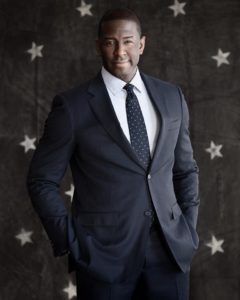
Andrew Gillum, former Florida gubernatorial candidate, to be keynote speaker at CAU commencement

Andrew Gillum

By Camille Taylor

Andrew Gillum, former Florida Democratic gubernatorial candidate, will be the keynote speaker at Clark Atlanta University’s 2019 commencement May 19. Gillum ran a high profile campaign with celebrities and public figures.

“We need a speaker who can reach the students, not only emotionally but mentally,” said Dr. Margaret Spriggs, CAU chair of ceremonials. “This year at our commencement we want the students to know that they have a responsibility to uphold and to leave them with an example of how to lead in the future.”

Most of the time, high profile figures have calendars that needs to be adjusted at least one year in advance, and the committee at Clark was able to confirm Andrew Gillum within weeks of them reaching out.

“Our students are worth a leader who connects with their audience and Andrew Gillum provides that,” Spriggs said.

Last year, Don Lemon gave the keynote address for the class of 2018 and left the students with a message to “be aware of your environment.”

Camille Taylor is a sophomore at Clark Atlanta University

###

Be sure to buy the AABJ documentary “Black and Reporting”

Get your Emmy Award-Nominated copy of AABJ’s Documentary, “Black & Reporting: The Struggle Behind the Lens.”

Proceeds go to AABJ’s Xernona Clayton Scholarship Fund .

Anyone who wants to watch the entire documentary can buy it for $9.95 here.

###

Southern Fried Queer Pride: An Organization Making Space for Queer People in the South

By Breanna Durham

Starting initially as a PRIDE event first held in 2015, Southern Fried Queer Pride (SFQP) expanded into a full  non-profit organization dedicated to showcasing queer and trans art, advocacy, and community building in Atlanta and abroad.

According to The Williams Institute, over 260,000 adults live in Georgia, 37 percent of them are African American. SFQP is one of multiple groups in Georgia working on LGBTQ issues and bringing this community’s stories and skills into the light.

Every month, members of SFQP gather together on the third Sunday to plan events, create programming and brainstorm ideas. The group has no dues, fees or prerequisites to become an organizer to these events.

Besides their two festivals, one in June in Atlanta and one in May in the Durham, North Carolina, the organization holds monthly events. Those events range from workshops and skill-sharing to productions and discussions.  In their Southern Fried Forums (SFF), for example, they hold an open, community discussion around challenging topics like intimate partner violence and racism in the queer community. Their Cinequeer Film Series event features films directed, written and/or starring and centering queer and trans people of color.  In March, they showed “America In Transition,” a documentary about social change from the perspective of trans people of color. They also have a seasonal music and art showcase spotlighting queer and trans people of color(QTPoC) called CLUTCH.

According to their website, the organization expects to open a space to hold events events and art exhibits and to have a resource center, potentially including a coffee shop, by 2020.

Those wishing to get involved in the group or learn more about them can do a few things. You can check out their website at www.southernfriedqueerpride.com and their Facebook and Instagram pages. You can join their mailing list for SFQP updates. Or you can reach them by email at: contact@southernfriedqueerpride.com.

Breanna Durham is a free lance writer and staff writer at The McDuffie Progress

###

Member Spotlight: Cierra Johnson

Current position in AABJ?

Student member

How long have you been a member of AABJ?

Since July of 2017

Where did you attend college?

Clark Atlanta University; Class of 2019; B.A. in Mass Media Arts with a concentration in Journalism

How long have you lived in Atlanta?

Born and raised! 23 years

Current Occupation?

Programming Assistant and Producer at AIB-TV (Atlanta Interfaith Broadcasters)

What do you like most about being a member of AABJ?

I appreciate the mentorship that is provided.  There have been many networking opportunities provided by AABJ and, from my experience, I have met members who have been intentional about remaining in touch with me and guiding me on my career and personal path.  In addition to, I appreciate AABJs dedication to helping students with scholarships. Though I am no longer in college (as of recently), I will never forget when AABJ funded my trip for my first NABJ convention in 2017 and ensured I was given tips on how to have a successful experience at the convention.

What initially got you interested in the media/communications field?

As a child, I watched Monica Kaufman Pearson, a former anchor for WSB-TV, and I was inspired by how confident and well she was able to broadcast news. I knew I wanted to tell great stories and have a strong presence as an African American on camera. I also loved how visually appealing a news story could be, therefore I practiced graphic design, editing and anchoring each chance I could.

What are your favorite publications/outlets to get your news?

Essence magazine, CNN, The New York Times and the AJC

Is there anyone in media you look up to? Why?

Director and screenwriter Ava DuVernay is someone in media I look up to.  Her genius ability to highlight the real-life struggles and triumphs African-Americans face and her compassion for community inspires me to create programming that is true to people’s experience. I also look up to her because she welcomes opportunity for women directors to have a chance to direct her shows – she does not only seek creativity from her own mind.

What’s an interesting fact about you people wouldn’t have otherwise known?

I am a former volleyball player, and I still enjoy playing in my community.  I am a great defense player! (People would not expect, because I have a quiet, reserved personality)

This month’s Byline was edited by Amir Vera