Your cart

THE BYLINE 05/2021

AJC managing editor Leroy Chapman shares how the newsroom handles burnout, remote work  

By: Jamila Wood 

The pandemic affected every aspect of our lives, and journalists have been handed a bigger responsibility. From police brutality to two historic elections in Georgia, journalists have had to cover it all while trying to maintain their mental health, which isn’t an easy task and can lead to burnout especially while doing your job in a remote work environment. 

While trying to meet the deadline of breaking news, personal problems came to the forefront for journalists as newsrooms had to change the work environment to fit a virtual world. 

And The Atlanta Journal-Constitution’s newsroom was no exception.

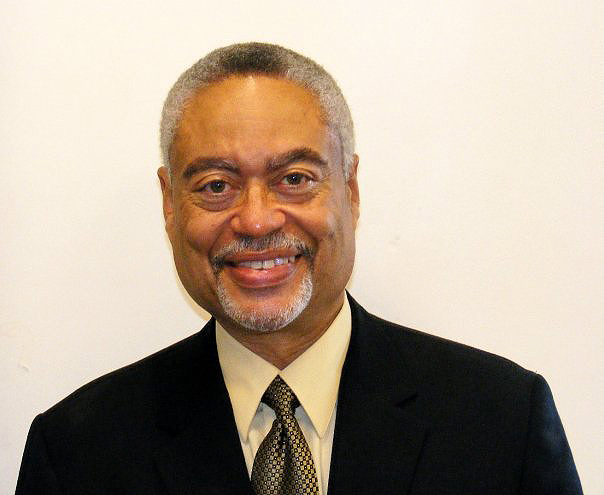
Leroy Chapman. (Chris Hunt/AJC Special)

“We had to be on top of what that [COVID] meant for schools, businesses, government, government services and of course sports was a big thing. It touched every single point,” AJC managing editor Leroy Chapman said. 

Newsroom burnout deals with journalists who faced issues in and out of work. 

“When you talk about the issue of burnout, the pandemic by itself was a huge burn. When you add the other issues, the social justice issues and covering protests in Atlanta and protesting (across the nation) lasted a long time, this city got involved after the death of George Floyd last May,” Chapman said. “Then a week later there was the death of Rayshard Brooks. Because it was right here in Atlanta, we [the AJC] became the center of some of the protests nationally and it was a lot.” 

Chapman said staff had to immediately adjust to working virtually from home. He added he saw a glimpse of their lives outside of work. 

“We have people who have families. They had to work under different conditions whether they were at home,” Chapman said. “Many of them have young children, which is another complicated factor. Another thing, we had a good amount of people on staff who lived alone. We had people who worked in isolation.”

But in some cases, working virtually formed a more personable relationship with other employees. Chapman said employees would take time out of the week to connect with each other outside of work, adding the AJC gave benefits packages to employees, which included 10 free therapy sessions. 

“What happens in the newsroom is that we tend to lean on each other. Unlike many workplaces, we rally and we stand in the middle of the room sometimes and give pep talks. It was tough to do that remotely, but we did some very intentional things,” Chapman said. 

“One is that we met every week with a select group of people and we went around the room and decided we were going to talk about everything but the newsroom. These sharing sessions became really cathartic for a lot of people because they were able to tell things they haven’t told other people,” he continued. 

Adjusting to working virtually had its difficulties and was also a learning experience for AJC staff. 

“We have a lot of folks who are taking care of their kids and parents. The ones who were taking care of their parents had great difficulty. You have a demanding job and have parents who need help,” Chapman said. “We had to think about ways to lighten the load for some folks to make sure they have what they need in order to take care of both children and parents. Also, we had a rash of deaths of family members in the newsroom.”

Chapman knows at least six people who lost a parent during COVID. “That’s a club nobody wants to belong to. There was difficulty because losing your parents during a pandemic and being able to bury your parents is complicated with COVID,” he said.  “Also, giving space for people to do it during a time where your job is demanding you to work even harder than you normally work. There were things we understood we had to do. You had to get involved with the lives of people, maybe a little bit more than you do in a normal circumstance.” 

But like any newsroom, the AJC is going through changes — some of which are likely to come in the next three to five years. The newspaper of record has moved its office space, which is not accommodating to all employees. Additionally, Chapman said no one has a permanent office and the paper has encouraged working where the news is happening. 

“The AJC is going to move from their old office to another office. 

“We have an opportunity to pivot toward working in a way where we minimize space and ownership of space. We are going to have a more situational hotel setting. We come to work and we work together when we need to. We will work where the news is or work in our home,” Chapman said. “I think what that does is takes away a lot of pressure to be in the office and be present in counting.”

Chapman said the office will be used for specific task-oriented work, adding that the remote work has highlighted that staffers can still be productive at home.   

“It makes the whole thing about health and distance look more manageable. We trust our people. We know they are working,” he said. 

Jamila Wood is a student at Clark Atlanta University. 


CNN Health Reporter Jacqueline Howard and AJC reporter Eric Stirgus talk reporting lessons learned from covering COVID-19

By Tiana Allen

When the COVID-19 pandemic forced residents into their homes over a year ago, Atlanta Journal-Constitution higher education reporter Eric Stirgus and CNN Health reporter Jacqueline Howard were among many journalist thrust into coronavirus coverage.

Last year, the two spoke with the Atlanta Association of Black Journalists about some of the things they learned while covering the pandemic when it was still very new.

As vaccines continue to rollout statewide, Stirgus and Howard speak with AABJ’s The Byline about what they’ve learned this past year and how they try to maintain self care while covering the yearlong pandemic.

Tiana Allen: Looking back from 2020, what have further findings about the pandemic taught you both?

Jacqueline Howard: A lot has changed and as time went on we saw the pandemic becoming more politicized [with masks, shut downs, and reopenings]. What I’ve learned from this is how important it is that our health officials are transparent about how COVID is spread. Regarding COVID-19 and the racial disparities, if we look to the past, we all kind of saw this coming. If we look back at the H1N1 influenza outbreak, and the studies that were done during that outbreak it showed racial disparities stating that the Black and Hispanic communities had increased numbers with H1N1. Now, if we look back to last year with COVID-19, we could have predicted the politicization of the same disparities we ran into with H1N1, the impact on public health, the need for transparency and how the public needed more of that. Moreover, we already saw the beginning signs of all the three areas that were mentioned.
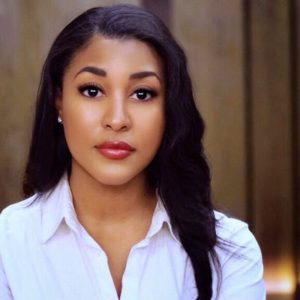
Jacqueline Howard, CNN Health reporter

Eric Stirgus: This pandemic has definitely exposed some of the issues surrounding access to care and disparities in the Black and brown communities. I was at a vaccine clinic in the Mexican Consulate in Atlanta with Morehouse School of Medicine, and the organizers were talking about some of the challenges with bridging access to care. There was literature and brochures regarding COVID-19, however most of it was not in Spanish. There weren’t mobile units going out to underserved communities or senior high-rises to get everyone tested.

These were some of the issues we faced in the beginning. This is why we saw Georgia at the bottom compared to other states when it came to testing rates. We saw Georgia and many other states were not accurately reporting data on who was getting tested and it took us weeks to figure out that Black and brown people were not even getting tested at the same rates as the general population. I looked on the [Georgia] Department of Public Health’s website, and it showed that Black residents in Georgia who’ve gotten at least one shot were at 25% as opposed to White residents who were at 33%, Asians at 58% and finally Hispanics who were at 21%. So, what I’m saying is, you’ve seen these disparities and access issues throughout this pandemic.

TA: COVID-19 has changed the way the media reports on most every topic. Jacqueline, as a health reporter, how has this affected your focus on covering other health related topics? 

JH: Since we are in a public health emergency, our entire focus is on the pandemic. But before the pandemic we were covering infectious diseases, cancer, maternal health and everything in medicine. I will say that during the pandemic we’ve seen a decline in cancer screenings and an increase of severe heart conditions, which could have been prevented sooner if people would have been accessing care during the pandemic.

The pandemic has led to people being hesitant to go to the hospital or doctor’s office for regular checkups as needed. Because of this, we have seen an increase of more severe disease overall. I’ve also noticed a decline in childhood vaccinations like MMR, and parents not keeping up with their children’s pediatric appointments. Another serious decline I’ve noticed is the occurrence in flu cases and other types of respiratory illnesses. It makes sense if you look at it. We are all socially distancing and wearing masks which prevents this. It’s all very interesting to know.

TA: Eric, how has the pandemic changed your focus from covering higher education topics?

ES: Well, I’ve been juggling higher education and the pandemic, but most times the topics have intersected. If you look at when the students had to leave campus and were trying to figure out remote learning, some campuses were settling to do a pass/fail option as opposed to giving out letter grades, which brought on a lot of criticism from public universities. There were some smaller schools that required students to be on campus but they had to wear masks indoors versus the larger universities who had student housing where the COVID-19 cases went through the roof nationally. I mean, there was a big deal with online learning versus in-person learning and now there is an issue whether all students should be vaccinated before coming back to class for this fall semester.

Schools in Georgia like Clark Atlanta University, Morehouse School of Medicine, Morehouse College, and Emory University have all required students to be vaccinated, whereas public universities have decided not to have the vaccine requirements. Overall, COVID-19 has become so much a part of everything we’ve been reporting now. I’m working on a story now about how Georgia was awarded 11 million dollars to use toward providing remote mental health services to college students. There are some challenges with this as well.

Eric Stirgus, AJC reporter

Basically, COVID-19 has been a part of everything I’ve reported on in higher education from finances, with healthcare and even with educational outcomes. I’ve reported on the fact that student enrollment has declined during the pandemic. It’s all encompassing.

TA: We’re more than a year into the pandemic. Have you seen anything different in the numbers regarding communities of color, specifically the Black community, with regards to COVID-19 testing or vaccination?

ES: The numbers have increased but there is still a strong number of Black people who have questions about the vaccine. I have some personal friends who still ask questions. The number one inquiry is about how quickly these vaccines were developed and how were they able to develop it so quickly. I’m even hearing that people are starting to change the word “questioning” to “hesitancy” because if they question it, it might bring a negative connotation to some folks. There are a ton of other problems in access to care from getting the vaccine to the elderly to those who have trouble with learning technology and those who are not able to get a ride to the testing or vaccination facilities.

Moreover, there are outstanding questions about the vaccination process itself, and for many Black people this includes conversations around the Tuskegee Experiment or Henrietta Lacks, which brings a lot of distrust. Secondly, there hasn’t been enough doses given to primary care physicians. The numbers overall have improved with Black people but still well below white Georgians. However, there’s been a huge campaign with celebrities touting getting the vaccine. Even Morehouse School of Medicine had several civil rights leaders come to get the vaccine. There’s been a push to get the Black community onboard. This has helped somewhat but there are still some logistical barriers. 

JH: As Eric stated, we’ve seen an increase in the data regarding the Black community receiving the vaccine, but there still is a gap. With that, there will be a push to get vaccines into primary care physicians offices because studies suggest that if your own doctor recommends and can administer the vaccine, then there is a greater trust with who receives the vaccine.

I also think we have to realize that the disparities in getting the vaccines are layered. Access is one thing, but also there are those who can’t take off work and make time to go get the vaccine, even further taking the time to get two doses. As you see, there are a lot of factors to this.

Yes, vaccine questioning exists, it also needs to be addressed, and there are health officials and those in public health who are addressing it. However, the disparity in vaccinations is a bigger issue in the communities that need them the most. We’ve seen some cases in NY where people of wealthier communities were traveling to Queens in order to get the vaccine. This was taking away from the people in that community who needed it the most. This is a part of the greater discussion.

TA: As the CDC releases new pandemic guidelines, how often do they conflict with some state requirements. 

JH: The CDC did state that if you’ve received both doses of the vaccine and it’s been two weeks since completion, you no longer have to wear a mask outdoors. This guideline was put in place in order to show people that if you’ve followed the precautions, your risk of contraction has now decreased and so the more stringent previous precautions are now a little more lax. This was also to showcase a reason to get the vaccine.

There has also been data showing that the vaccine has been working and we’ve seen a decline in COVID-19 deaths as well as hospitalizations among people who have received the vaccine. However there has been some questioning regarding this guidance. Comedian and host of The Daily Show Trevor Noah asked in one of his commentaries, if you are fully vaccinated then why can’t you go everywhere without a mask? Health officials replied that not enough people are vaccinated yet. Even if you are vaccinated and someone else isn’t, there is still a risk of it spreading indoors. We really can’t go back to “normal” until more people get the vaccine. We have to encourage people to get it.

ES: It goes back to the political divide again. There are some states that are conservative, but you also have sports teams that they are filling all seats at their games, and colleges allowed full capacity at commencement ceremonies. So, I think there is this eagerness to get back to the world we were in before COVID-19, and the criticism surrounding the mask mandates are still working to be resolved. The data is that the vaccines have been effective.

TA: What are you doing as journalists to make sure the information you are reporting is correct, and how are you fact checking information with new data frequently released?  

Eric: I’m lucky to have been working with many reporters that follow these stories. I’ve had many offerings to read articles from my editor and other team members that are also covering the pandemic. So, we’ve all been holding each other accountable. It’s also important to have many different sources.

Universities are always a good source to have because they have experts to talk to about the vaccine. Sometimes I even look at Jacqueline’s work and see what she’s put out. Also, the federal government, particularly the Biden Administration has been a lot more aggressive with providing updates to the media by briefing us three times per week to answer some of the questions we may have. I think that’s been beneficial as well.

JH: I want to agree with Eric, as we’ve seen an increase in briefings from the White House and Biden administration is helpful. As far as getting the right side of the story out, I see it as being no different from any other news story in journalism. It’s the basics, having those sources, checking in with them weekly about any new findings, that’s what we do for any topic. With this pandemic, we all had to return to the basics in order to make sure we get good journalism out there.

On my end at CNN, there has been a lot more collaboration between teams, task forces and beats who have made extra effort to work together to cover pandemic related stories with care and accuracy, not only this but with humanity. There is extra focus on getting the story right, but we can’t forget that this is something that is impacting human lives. We need more empathy in covering this. It’s just as important to keep ethics in mind as well.

ES: That’s a great point about empathy and telling the human side of this pandemic. Yes, this is a story about science but most importantly, it’s a story about people.

TA: Speaking of empathy, how hard has it been to keep your opinion out of the story if you are triggered or emotionally overwhelmed?

ES: I’d say, it’s important to stick to the facts as with all journalism. I’ve had family members and friends who tested positive for COVID-19 or have even died, as well as former colleagues. It is difficult on a personal level to some degree, but you have to be a professional. Our newsroom has been really great about taking time for us to talk about some of the things we’ve been dealing with and to take some time off.

It’s hard, but I take personal time off when I can. We also have group Zoom calls with colleagues. Not for anything in particular, but the opportunity for all of us to just see each other and interact from time to time. These things are helpful to have that type of normalcy again. It also helps us tell our stories better without being as stressed.

JH: We have to approach each story with objectivity and fairness. On the humanity aspect, sometimes there is a need to have a moral compass. For instance, we saw a rise of racism in the pandemic. There are no two sides to that, you can’t give a racist viewpoint to the story because there is only one side to report which is hate.

It’s also important to think about as journalists, we all have a moral compass. You also have to be careful when you are talking about telling two sides when you’re trying to be objective. There is only right and wrong, and hate is hate. The same applies when covering the pandemic. As with many other topics, you keep your personal views out of it. When you see a moral issue or misinformation, or even addressing conspiracy theories, it’s our job as journalists to say, “No. Here are the facts.” No, you cannot kill the coronavirus by drinking bleach or alcohol.

It’s important to correct these myths. Yes, keep your personal viewpoint out of it, but also don’t shy away from debunking misinformation and issues you see come up such as hate or racism. It’s our job as journalists to address this for the public and let them know what’s really happening.

TA: Journalists are providing so much information on a regular basis. How do you make room for self-care?

Jacqueline: One way is collaborating with your team, and two is taking time off for self-care. There has been a huge focus at CNN regarding mental health. I’m grateful for this effort because it impacts how we do our work. My colleagues and I have been talking about how the rise in police violence has taken a toll on journalists of color.

One personal hurdle I’ve had to overcome is what I remember hearing from my childhood: “You always have to work twice as hard to get the same as what everyone else is getting.” Because I heard that growing up, I found it hard to take time off. I hope this new focus on mental health and self-care helps to take us out of that mindset because I had to do it. I have to remind myself that no one’s going to look at me a certain way if I take time off. It’s OK to do this. Journalists of color can really benefit from focusing on self-care.

ES: In general, you can’t do your work at your best if you are stressed out or exhausted. Sometimes you do need to take time to relax and spend time with your family or friends. When you can do that, then you can work much better. I’m glad to see NABJ raising awareness about mental health in journalism and the workshops they’ve had surrounding self-care in addition to the fact that they continue to advocate for us in news rooms to make sure that we are taken care of.

I’ve covered some protests, and I remember being out there having to wear masks in the heat in addition to covering the pandemic while being emotional and having to cover all this. I’m hoping that newsrooms will continue to be aware of mental health and provide more resources where we can have these moments to have self-care.

Tiana Allen is a behavioral therapist and writer for The Byline. This is her first article with the publication.


This issue of The Byline was edited by Tianna Faulkner and Raisa Habersham.

THE BYLINE 07/2020


Atlanta reporter recounts covering the first night of protests in the wake of George Floyd’s death

By Raisa Habersham

I woke up early May 29 to see CNN reporter Omar Jimenez cuffed and arrested on live TV while covering the protests in Minneapolis, Minnesota, in the wake of George Floyd’s killing by a white police officer.

The tears streamed down my face as the network replayed Omar’s encounter with law enforcement. That moment reminded me of the many times my mother begged me not to cover protests.

“I don’t want anything to happen to you,” she’d say.

Raisa Habersham, reporter

As the footage played on seemed like a loop, I confided in my husband about what many Black journalists were dealing with while covering protests — well before the media uprisings in newsrooms across the nation. Not long after, I gathered myself and braced for the call — the one I knew my editor would make to me, asking if I’d cover a protest later that day.

I said yes. I’m always eager to cover a protest, it’s the language of the oppressed and essential to knowing what challenges communities are facing. I’d covered several Black Lives Matter protests before then, starting in 2016, when Atlanta had a five-day stretch of them in the wake of Alton Sterling and Philando Castile’s deaths and reports a hanged Black man was found in Piedmont Park.

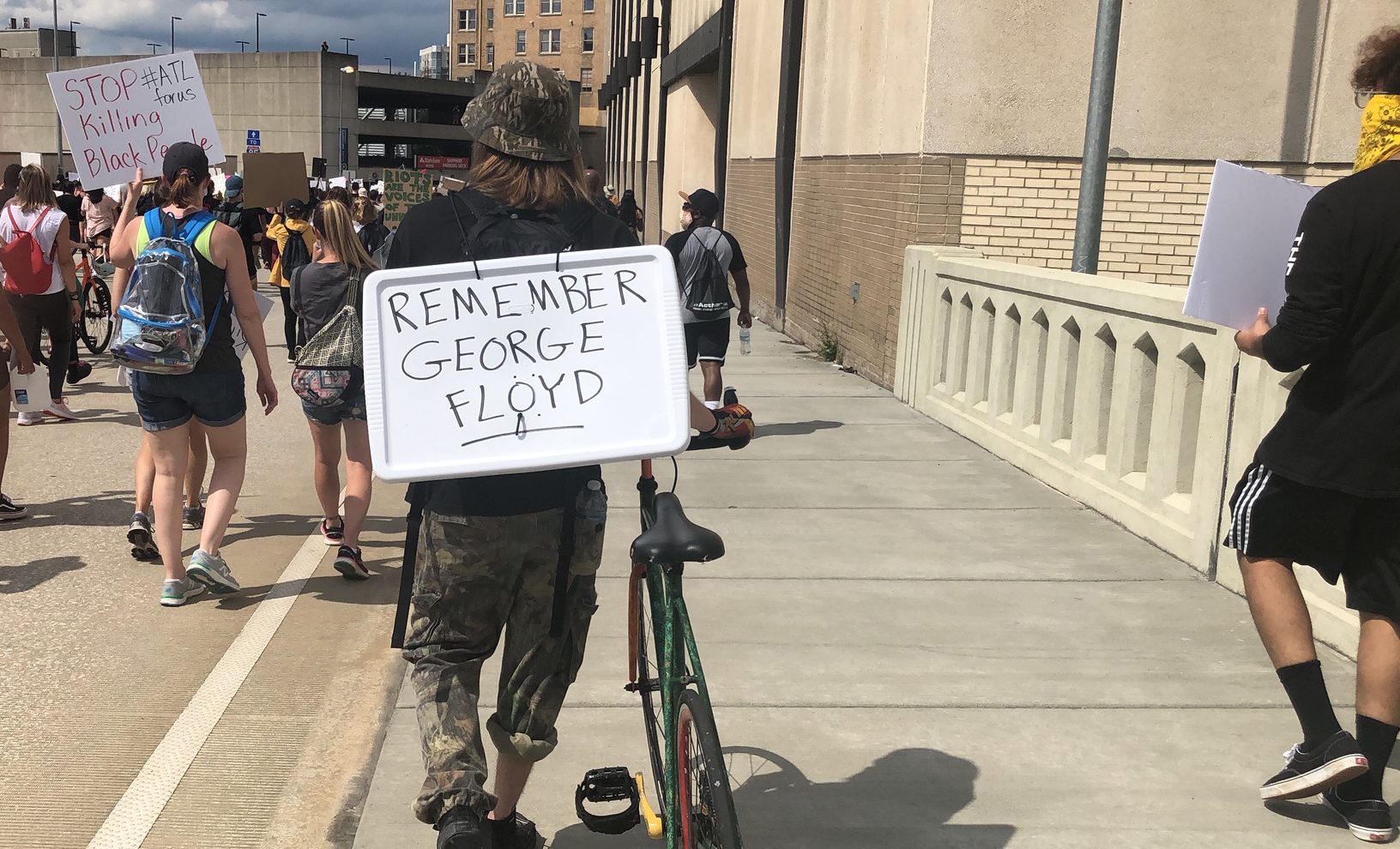
A protester carries a sign honoring George Floyd, the Minneapolis man killed after an officer held his knee to Floyd’s neck. (Credit: Raisa Habersham)

But on May 29, the spirit of my late grandmother, Theolanders J. Veal, ran through me. A 911 operator from Macon, Georgia, she was one of the few Black women working in her call center. She took her job seriously and had little tolerance for racism — to put it as politely as possible.

I felt her spirit watch over me as I packed my backpack — two laptops, two water bottles, plenty of snacks, a portable charger, masks to avoid COVID-19, extra iPhone charging cords, a sweatshirt in case it got cold and an umbrella. The protest was expected to be two hours long, but given what how protests turned in other cities, it was better to be safe than sorry.

By 3 p.m., I’d made it to Centennial Olympic Park where thousands of people gathered to march to the Georgia Capitol, for a brief sit-in. The trek led marchers along Marietta Street, where I spoke to a teary-eyed, native Atlantan, outside a nearby business about the protests. By the time we got to the capitol, I spoke with another protester, originally from New York, who said she’d been protesting since Eric Garner’s killing, which spawned a new statement in the movement: “I can’t breathe.” They were also George Floyd’s final words.

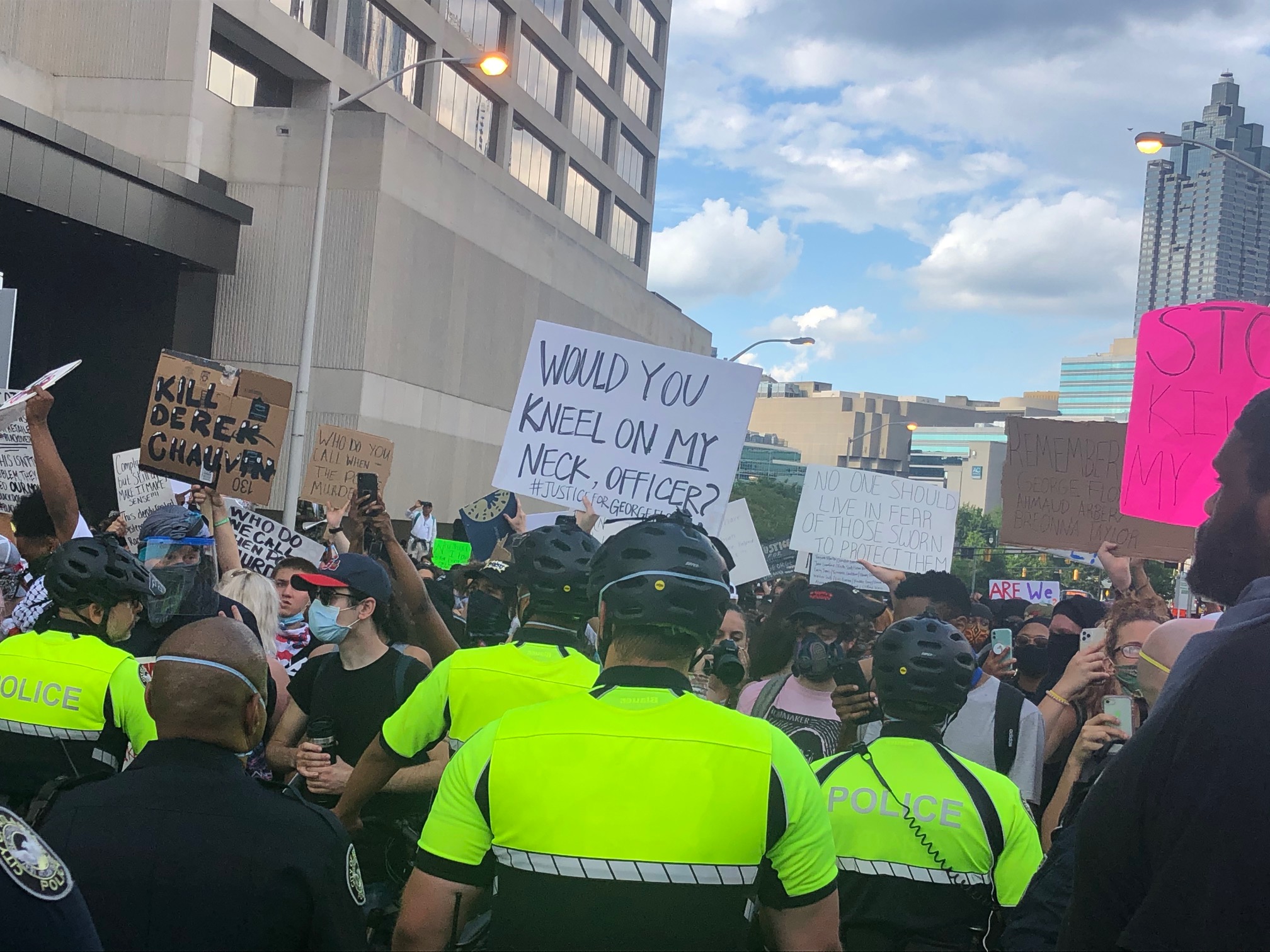
Atlanta police and protesters face off in front of the CNN Center. (Credit: Raisa Habersham)

But that tidbit didn’t make the AJC’s digital file. Right as I was about to send an updated feed for our live blog, I got word that the now dispersed crowd was in front of the CNN Center. I ran that way and saw protesters face off with Atlanta police. With each passing minute, the crowd grew angrier, throwing water bottles and glass bottles at officers. At one point, a lieutenant announced the group was violating an ordinance by standing in the middle of the street and would be arrested if they didn’t move. On top of that, Atlanta police brought out their SWAT team.

It didn’t dawn on me that I would be in for a long night until the famous CNN Center sign was vandalized and soon after the actual building. In the background, a car blared Tupac songs as officers moved to stand in front of the building to prevent people from entering.

And while all this was going on, I was avoiding the text message from my mom asking if I was covering the protests. I didn’t want to worry her. I didn’t respond to her until about 2 a.m., when I finally got home.

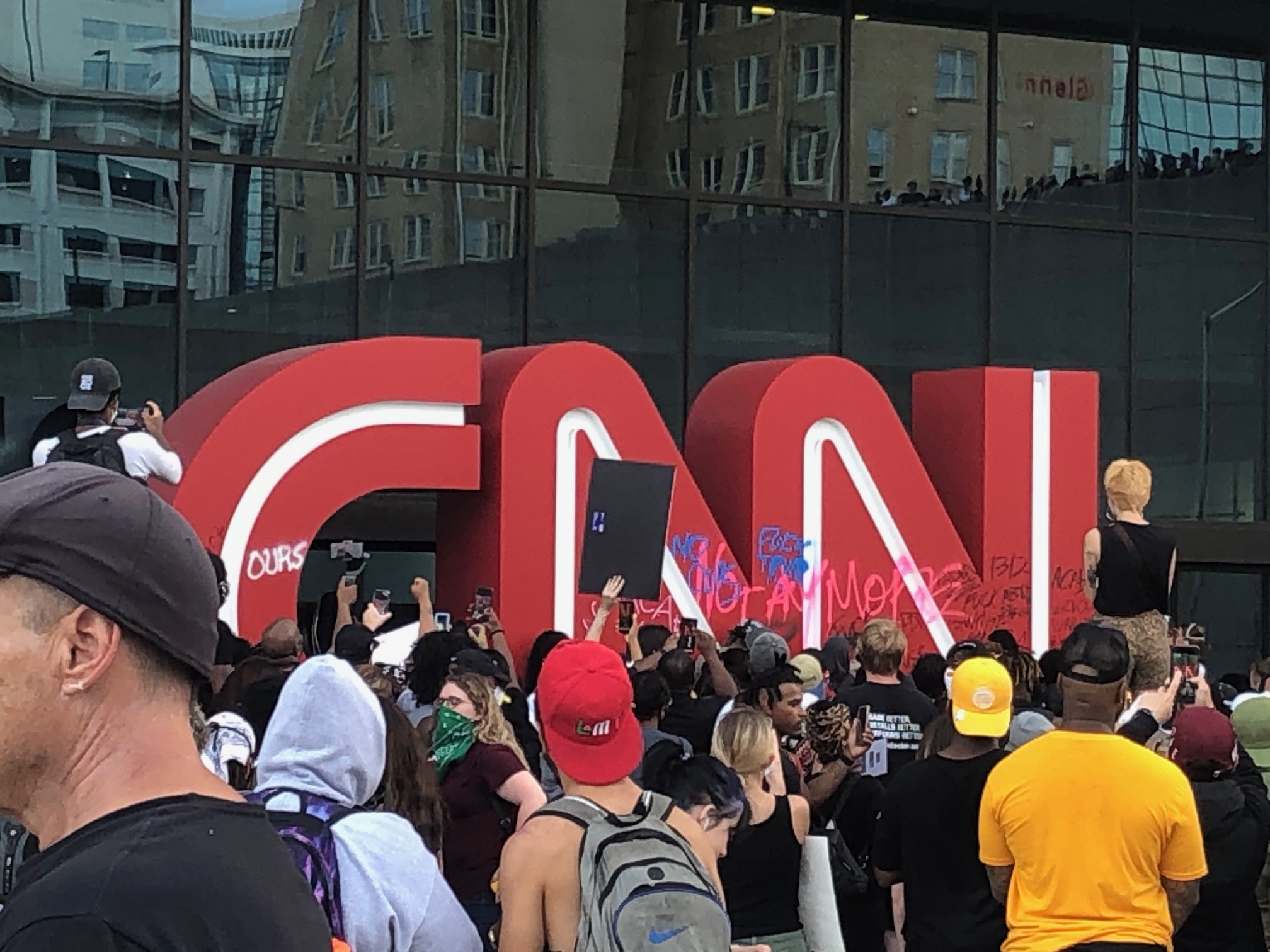
People deface the CNN sign outside the CNN Center on Marietta Street in downtown Atlanta.

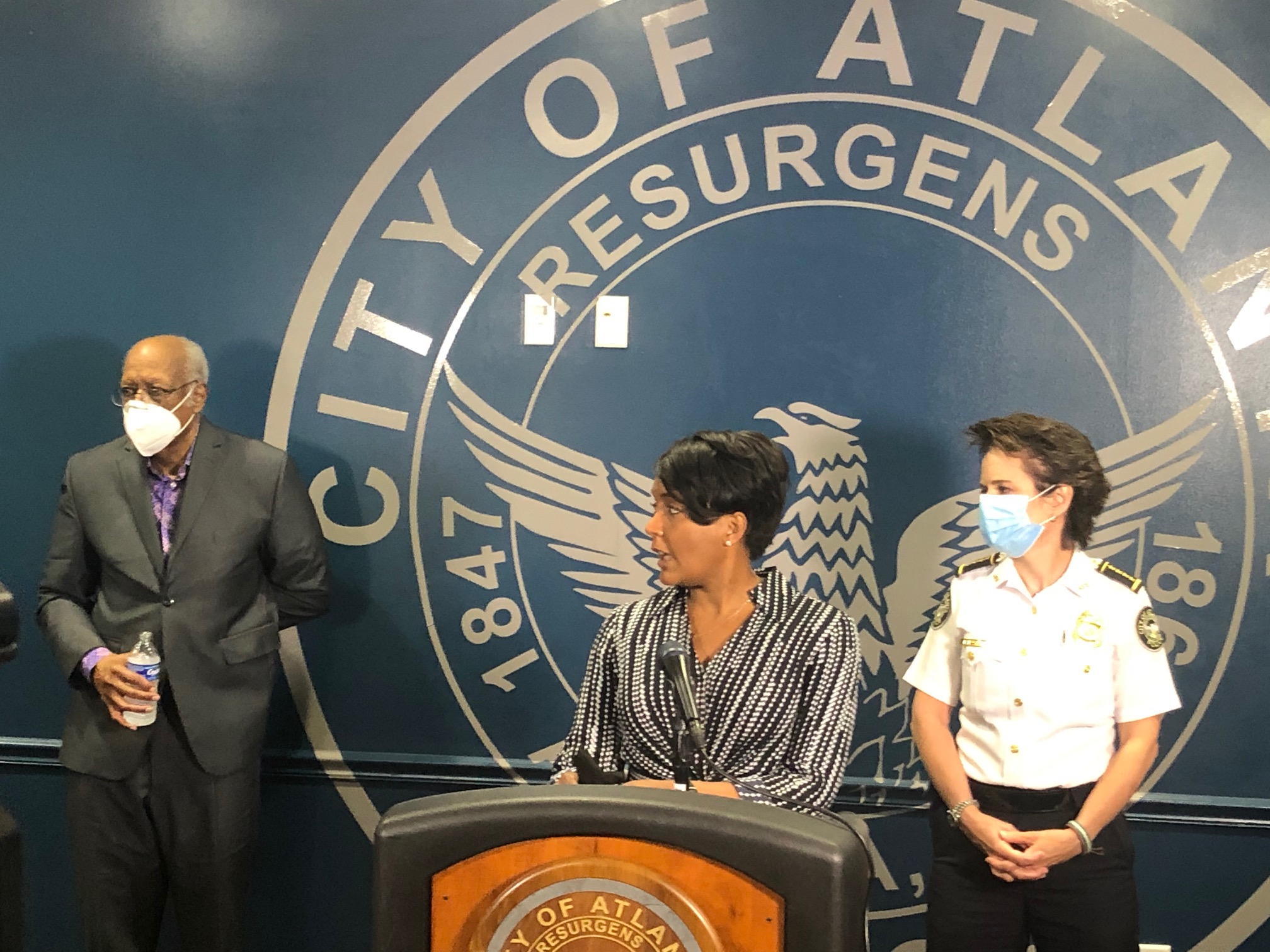
In the middle of it all, I got a call from Atlanta Mayor Keisha Lance Bottoms’ spokesman alerting me to a joint press conference with her and then Atlanta Police Chief Erika Shields. As I ran to the presser, a mob of people ran my direction; I hid behind a light pole to protect myself from a potential stampede. It wasn’t until later when I realized tear gas was fired and eventually a police car was set on fire.

As I raced to the press conference, the scene throughout other parts of downtown Atlanta was serene. People were chilling at a hookah lounge, other were grabbing a bite to eat. Apart from me, one other person had on a mask. It was as if COVID-19 didn’t exist.

At the presser, there was a different reality: Vandalism ran rampant in downtown Atlanta and rumors of crowds heading to Buckhead to commit property damage. Mayor Bottoms was not pleased. I’d covered press conferences with the mayor before and have interviewed her on occasion. I’ve never seen her react the way she did to the scene she saw that night. The caring mother in her was visible, and she didn’t mince words: “Go home because I can’t protect you.” It was an emphatic display of emotion from an otherwise composed Atlanta mayor who’d spent the past months urging residents to stay safe amid COVID-19.

Atlanta Mayor Keisha Lance Bottoms tells protesters to “go home” during a joint press conference with former Atlanta Police Chief Erika Shields, Bernice King, and rappers T.I and Killer Mike. (Credit: Raisa Habersham)

After the presser, a colleague was supposed to relieve me of my duties. I’d been out there for about six hours at that point and I’d contributed to other stories during the day. I’d essentially worked a 12-hour shift. He was to drive me to my car and I head home, except my car was stuck in the CNN parking deck where the bulk of the action remained.

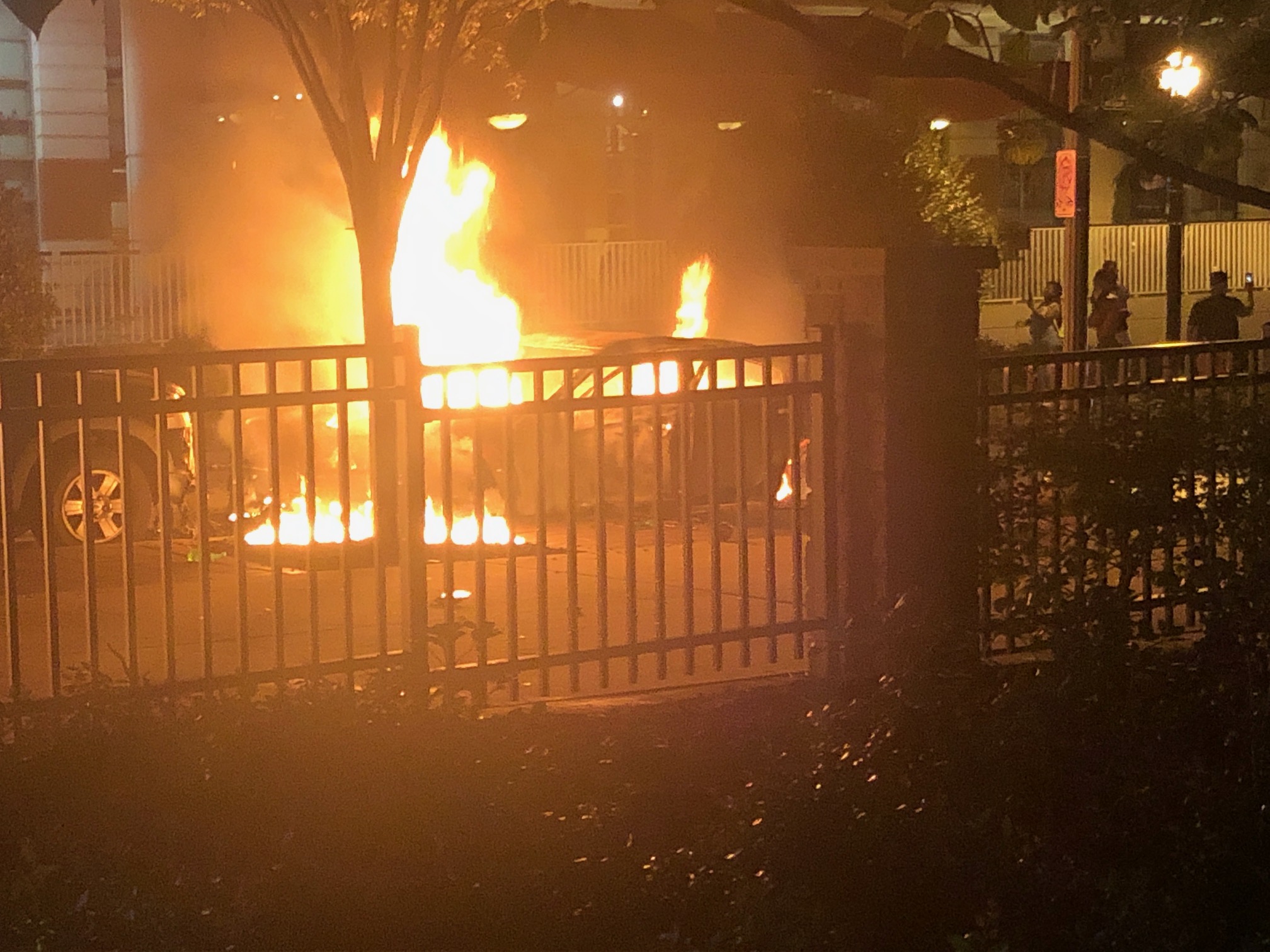
We spend the night riding around Atlanta, observing the scene and gathering color for the live blog. In downtown Atlanta, we saw burned police cars, a vandalized College Football Hall of Fame building, and shattered glasses outside a nearby Starbucks and the McCormick and Schmidt’s. Perhaps, ironically, local businesses were unscathed near Centennial Olympic Park (at least that I saw). The outer edges of the park looked like a warzone you’d see in movies.

A car is on fire outside Centennial Olympic Park, where protesters earlier gathered. (Credit: Raisa Habersham)

After about an hour downtown, my colleague and I drove to Buckhead where hordes of people were already at Lenox Mall, hoping to vandalize the building. Atlanta police had already set up camp at the mall. So, protesters headed to other parts of the neighborhood. Vandals threw objects at the Target, shattering the glass; across the street at small strip mall, vandals damaged a glass window at a FedEx.

The damage didn’t end there. The Corner Bakery and the Maggiano’s Little Italy on Peachtree Road were vandalized and there were reports of a fire in the area. At one point, officers threw tear gas at protesters. The stench got in my eyes briefly, reminding me of the stories my dad told me and my brother about being a Marine.

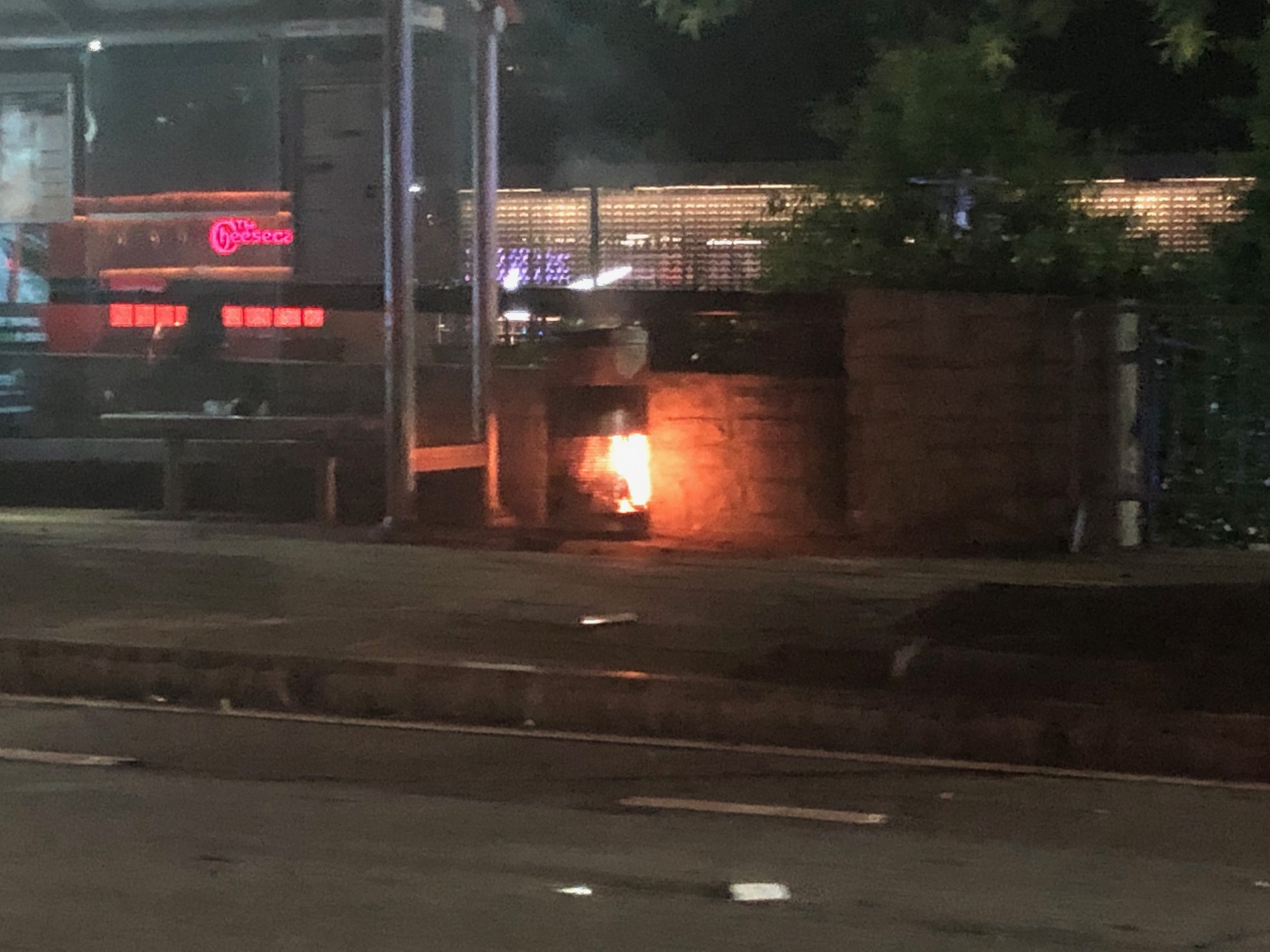
A small trash can is on fire at a MARTA bus stop near Lenox Square mall. (Credit: Raisa Habersham)

As the night raged on, my colleague and I headed south to take me home. A warm bath, Popeyes and a massage were waiting on me. I finally texted my mom. It was 2 a.m. In the days covering COVID-19, things had been a blur. But that day, May 29, I’ll always remember.

Raisa Habersham is an Atlanta-based freelancer reporter, whose work has appeared in The Atlanta Journal-Constitution and The Daily Beast. She is also AABJ’s Vice President of Print.


AJC, WSB reporters offer tips for covering protests

By Elisheva Wimberly 

The recent killings of Black people at the hands of police officers have sparked protests nationwide, including in Atlanta, which garnered national attention following the fatal shooting of Rayshard Brooks. Recent peaceful protests gave way to rioters who burned, looted, and destroyed buildings around the city and two reporters — The Atlanta Journal-Constitution reporter Eric Stirgus and WSB reporter Matt Johnson— were in the middle of it during the first night of protests in May, days after George Floyd was killed after a white police officer knelt on his neck for over eight minutes. The two spoke to The Byline on how to cover protests, especially when they become high risk.   

Stirgus said he saw the protest on WSB that evening and asked if his colleagues needed help.

Eric Stirgus, AJC reporter

“My original orders were to relieve another reporter but he didn’t want to leave, by the time I got there it was nightfall, a couple of minutes later I saw people throwing objects at police and breaking the glass to the CNN on Marietta Street,” Stirgus said. “Once nightfall hit, things had the potential to become violent.”

Johnson said the first night of protests was “unexpected.”

“About an hour or two before everything blew up there was a peaceful protest through downtown Atlanta. Then before we knew it the (Atlanta police) car caught on fire,” Johnson said. “Above all, we weren’t really prepared for a riot. We were psychologically not prepared, we had no security. Our job was still to paint the picture and to stay as composed as possible. It was probably one of the biggest challenges in my career.” 

Peaceful protests aren’t always prone to turn violent. Critics criticized the media for showing profuse attention to the riots rather than the peaceful protest that occurred in Centennial Olympic Park earlier during the day. Johnson said reporters’ response to criticism shouldn’t ever censor their content.

“It’s such a complex issue. As a reporter, you’re caught in the middle of all the sides. You can’t get caught up in too much of the criticism. If you’re at a riot and you focus on only peaceful protest you can be accused of whitewashing a situation,” Johnson said. “When it first started you could see the distinction between the peaceful presentation at Centennial Park whereas across the street was the rioting and looting. You can give the proper perspective while giving accurate information of what is happening in front of you.”

Stirgus recommended reporters arrive at protests early and speak with organizers. “If you’re listening to what the main organizers have to say and you’re being observant you may see things that may interest you as a reporter.”

Matt Johnson, WSB reporter

Stirgus also suggested keeping your smartphone with you as a trusty tool to help cover protests, wearing comfortable shoes, and bringing goggles in case you’re sprayed with tear gas “One of my coworkers brought a helmet with ‘Press’ written across the top,” he said.

Before Johnson steps close to a protest he’s covering, he makes sure his press badge is on him and visible.

“I’m always with a camera guy so I’m more identifiable than a print reporter. You want to have your press pass visible if your legitimacy is ever questioned,” he said. “You have to bring an open mind, perspective, and the ability to do your job in the scariest circumstances.”

Johnson made it clear journalists need to have situational awareness; understanding when a protest is about to take a turn is crucial for your safety. When things seem like they’re about to take a turn, Johnson said communicate with your news station.

“There have been journalists who have been shot at and physically assaulted, so don’t lose track of your safety,” he said.

But while focusing on your safety is crucial, Johnson said ensuring your caring for your mental health is equally important when covering ongoing protests. 

“You can get flashbacks and feel like it’s still happening. When it’s over, just take a break,” Johnson said. “Take care of your mental health. You’re experiencing more than the average person is experiencing.” 

By Elisheva Wimberly is a rising senior at Georgia State University.


How to become a freelance journalist: A Q&A with Atlanta-based reporter Jewel Wicker 

By Greer Wilson

With many journalists losing jobs due to the coronavirus pandemic or looking for a new start following the racial inequity fallout in mainstream newsrooms, some may be considering freelance reporting. And as newsrooms begin adapting to their work-from-home policies due to COVID-19, many publications and outlets are looking for freelance writers to help with the steady news cycle. 

But making that move can be difficult if you’re accustomed to the hustle and bustle of daily news reporting. 

Jewel Wicker,  an Atlanta entertainment and culture writer, made the transition to freelance reporting in 2017, after a year with The Atlanta Journal-Constitution’s features team. Wicker, whose byline has appeared in Atlanta Magazine, Billboard and Creative Loafing, spoke with The Byline on her freelance career and provided tips on what others can do to have a smooth transition out of the newsroom and into freelance reporting.

Jewel Wicker

How did you get your start and what was the first publication you wrote for?

Jewel Wicker: As a freelancer, I got my start three years ago this month. The first publication I wrote for was Creative Loafing. One of the things that I did when I first went to freelancing was reaching out to the publications here in Atlanta that I had previously worked for. When I was in college, I wrote a freelance article for Creative Loafing. Right after I graduated college, I interned with Atlanta Magazine, and I worked on staff with the AJC before going freelance. So I reached back out to Atlanta Magazine and Creative Loafing to let them know that I was now a freelancer, and I could write entertainment and culture if they were looking for someone to do so. I had a column for a year with Creative Loafing for about once a week and also did some work with Atlanta Magazine. About three months into going freelance, I had taken a class on how to pitch and I co-pitched Billboard. I started writing for them, and that was the beginning of writing for a national publication. 

For someone starting out, what would you recommend for them to develop a writing routine?

JW: For me it differs. I found that if I schedule off time on my calendar to write that’s more effective because sometimes I get flogged down with interviews. If I have a story coming up, I’ll put a few hours on my calendar to write a draft. On the day I need to write, I schedule it and it will show the writing block for this story. So, I know not to schedule interviews or any other tasks during that time. A lot of times, I write better when I first get up or start doing other tasks and get into the groove. I might struggle to get into the writing grooves later in the day. But sometimes I wake up in the morning and can’t find the words. Sometimes I don’t write until nighttime. It really just depends. 

What advice would you give on making pitches?

JW: So, one of the things I did when I first started freelancing, I realized I wasn’t that good at pitching because I was used to being a staff reporter. So, co-pitching wasn’t something I had to do. I took a class on how to pitch as a freelance reporter. I highly recommend it if you can find an online class that caters to pitching as a freelance reporter. I understand that can be cost-prohibitive; the alternative suggestion is searching pitching as a journalist or similar keywords on Twitter. A lot of sample pitches will come up. (There are) a lot of writers and editors for major publications who make Twitter threads, and post on social media sharing the best way to format a pitch, the information that could be in a pitch, and how much reporting that should be in a pitch. They just give a lot of the best tips and tricks as well as some things you don’t do. That’s a free and easy way to get a look at the best practices from the leading editors and reporters in the industry. 

Do publications have their writing styles? Would you advise people to practice their writing styles before pitching?

JW: I would say practice for pitching, but I would also say it’s really important to read what that publication writes about. You could pitch the same story to different publications, but the angle and the tone might slightly change based on who you are pitching to. So I would say, if you’re going to pitch a publication, be very well versed in the type of writing and reporting they do. That’s going to help formulate the pitch to them and that increases your chances of getting your pitch accepted. Publications can tell if you don’t read them because your pitch is far beyond their scope. 

How would you advise freelancers starting out on how to protect themselves from stories being stolen if rejected?

JW: Unfortunately, that is a risk that a lot of freelancers fear. I always advocate for not sending complete stories. Send just enough information to give the publication confidence that you are the perfect person for this story. 

How would a freelancer try to pitch to publications if there is a job board?

JW: One of the newsletters I follow is @studyhallxyz. They publish a weekly job board for full-time positions, fellowships and grants but also for freelance submissions. They scour the internet because a lot of editors will tweet and say “I’m looking for this topic, this is what I’m paying, please email me at this email address to pitch me.” They will combine all of those pitches and put them all in one place so you don’t have to follow all of these editors to see. I highly recommend following them. I think I pay $10 to $11 a month (to subscribe to the newsletter). But as a person of color, if that is cost-prohibitive to you, I believe you can get access to the job board for as little as $1 a month.

Greer Wilson is a recent Spelman College graduate. 


This issue of The Byline was edited by Raisa Habersham.

THE BYLINE 06/2020

AABJ President talks Black Twitter’s reaction to his Verzuz battle story 

By Amir Vera

We’ve all seen what happens when you cross Black Twitter. 

When someone who isn’t in tune with the culture gets relentlessly attacked for being anti-black, clueless or simply having a controversial opinion. Black Twitter can and will fry you without mercy. 

I knew that and yet had no idea I would be the next victim between the night of April 18 and stretching all the way until the evening of April 20.

It all started with a simple story idea. Like many R&B fans, I had been anticipating the Verzuz Instagram Live battle between singer-producers Kenneth “Babyface” Edmonds and Teddy Riley. But things didn’t go according to plan because of technical issues, specifically on Teddy Riley’s end. 

As a viewer, I thought it was funny, but as a journalist, this immediately looked like a story for CNN. So I wrote the story with the headline “Instagram Live battle between Babyface and Teddy Riley was a complete fail.” The headline wasn’t inaccurate. The two artists attempted to do something and it didn’t happen. Thus, it was a fail. 

There were also no issues with the reporting; everything I had written was either based on social media feedback of the failed live or posts from the artists themselves. 

Black Twitter’s main criticisms were the “harsh” headline and many thought it unfair I wrote about the failed Verzuz as opposed to writing about the other successful battles. 

It is true, I hadn’t written about the other Verzuz battles, but nothing newsworthy took place during them as far as I know. Another CNN entertainment reporter, however, did write about the two producers, Swizz Beatz and Timbaland, who were behind  Verzuz and why they created it.

And so began the barrage of comments, including calling me an Uncle Tom and a token and chastising me for “telling the family business” on what many see as a mostly white platform. 

I was unfazed by the comments; as a journalist, I know my work will be critiqued. However, I was baffled by comments saying CNN had no right to cover the event, and instead preferred the event be covered by Black cultural websites Vibe, Complex, or BET.com. 

Part of the reasoning is some view CNN as a platform that doesn’t cover cultural events like the Verzuz battles, but instead focuses on hard news and politics. The deeper issue wasn’t with me or the headline. It was the fact people felt CNN had invaded a black space and used a token (me) to invade that space. 

I can tell you that’s simply not true. 

While some would feel pigeon-holed by being the “black reporter” — which often happens in newsrooms — I believe it is my mission to report those stories that otherwise wouldn’t be reported at CNN. 

That means being an ambassador for, not an invader of, black issues, events, and cultural phenomena. Sometimes that means I will have to alert editors about rappers dying, entertainers and their raunchy live videos and cultural sports stories.

It doesn’t mean I am or feel pigeon-holed because as that ambassador I also bring attention to stories about HBCUs, viral moments that put us in a positive spotlight, and criminal justice.  

I later wrote a follow-up to the Riley and Babyface battle, but not because of the lashing I took on Twitter. The world needed to see what happens when two legends (successfully) go head-to-head. I’ve also reported on the other Verzuz battles since then because if I didn’t write them, who would?

Amir Vera is president of the Atlanta Association of Black Journalists. 


Outgoing NABJ VP-Print on his advocacy for Black print journalists 

By Marlon A. Walker

NABJ doesn’t care about print journalists.

That could easily be rephrased to be put in a better light, but many members of the largest advocacy organization for journalists of color feel that way, often cast aside for their more visible broadcast counterparts.

That doesn’t mean the work stops.

The job of a print journalism advocate within the confines of the National Association of Black Journalists can be best reflected through the main conflict many black journalists face in mainstream newsrooms across the country as they seek to tell stories from black communities. That people outside the black community have to be convinced there is, indeed, relevance in issues those outside do not see or understand.

Marlon Walker, NABJ Vice President of Print.

Black journalists get it. Black print journalists also fall victim to the same ideologies, being forced to convince others outside print newsrooms of the relevance to their concerns.

“There’s something to the premise that you’ve got to be a part of something to understand it,” the late Roosevelt Wilson told me several years ago as I sought to better understand my role as NABJ’s vice president of print.

Wilson was a retired professor in Tallahassee, Fla., at Florida A&M University’s School of Journalism and Graphic Communication and a long-time journalist who spent 18 years as publisher of the Capital Outlook, the city’s black newspaper. He had been my teacher at the school, my boss at the paper.

“Diversity for diversity’s sake – I can’t make a case for that. It’s like having a plain cake but putting the layers in various colors. It’s the same cake. That doesn’t mean it tastes any differently. If you want a rainbow cake, you get a chocolate layer, a strawberry layer, and so on.

“That’s where I think there’s miscommunication.”

Again, that doesn’t mean the work stops.

Through conversations with mentors, former professors, newsroom leaders, and reporters across the country, I developed programming outside of the annual convention that would speak to the deficiencies seen in professional development offerings. NABJ’s current model for success includes an annual conference heavy on digital resources and a career fair many convention attendees see as the main reason for their attendance.

NABJ Presents: The Basics Bootcamp is a training ground to not only make sure members know what they need to know to get jobs but puts them in small classroom environments with hiring managers who accept the invitation knowing they could find their next police reporter or social media manager.

Through that program, about half the participants have taken jobs, internships, fellowships, and freelance opportunities as well as finding mentors and guides as they work their way through the industry.

I’ve spent countless hours with newsroom managers pitching them black journalists who they would not have found through their traditional networks – college friends, other recruiters, even job boards – because our members are more often matriculating through programs that don’t have journalism resources, or lack in-house professionals with the network to spread their name and work ethic. 

We do it because in 1978 when the American Society of News Editors set a goal to push newsrooms to have the same diversity as the communities they covered, just 4 percent of newsroom employees were people of color. People of color make up less than 20 percent in newsrooms across the country today, while people of color are nearly 40 percent of the country’s population.

I do it because of people like Pearl Stewart, the first black woman to lead a major daily newsroom, who was a professor of mine. Her network helped in major ways.

I want my network to do the same for somebody else.

Marlon A. Walker is Vice President of Print for the National Association of Black Journalists.


Black male journalists discuss challenges breaking into the field

By Anfernee Patterson 

The Black Man Lab hosted their weekly meeting June 1 in conjunction with the Atlanta Association of Black Journalists as part of the journalist group’s Black Male Media Project The event featured The Atlanta Journal-Constitution’s deputy managing editor Leroy Chapman and opinions editor Andre Jackson, and Dennis Byron, editor-in-chief of Hip Hop Enquirer Magazine.

In the wake of the massive number of protests across the country and worldwide in response to George Floyd’s death at the hands of the Minneapolis Police, the meeting touched on black journalists’ role within the media, the panelists’ journalism careers, and police brutality.

As the meeting began, Chapman and Jackson discussed how their journalism careers began and demonstrated why it is important that black voices be heard in the media.

Leroy Chapman. (Chris Hunt/AJC Special)

“Once I got in, I had the right kind of mentors who said you should think about being a leader,” Chapman said. “We need African-American men who lead in journalism because in these big corporate entities our voices are needed. We need to express issues in our community and open our door to be a connection to the community who do not know how to connect with the media.”

“I came to Atlanta to segway to the opinion side of the business,” Jackson said. “Journalists aren’t paid to have an opinion, we are paid to keep our opinion out of what we do. Newspaper opinion sections are the one place where you can have an opinion.”

As their journalism careers began and they started working, both men said they realized quickly how different of a world they were in, but also the importance of their position.

“I was a business reporter and I was covering banks,” Chapman said. “I go to a bank and they have all their regional vice presidents in there, I was the only black person there not serving food. Being a journalist is a passport to being in rooms that you never thought you would be in. When you are there as an observer, you’re able to have a real understanding of where power rests.”

Chapman also added how different he saw things during his time as a sports reporter. “I was a sports writer for a while. On the field, we are everywhere. In the administration and front office, we are not there.”

Jackson said his experience taught him much more about himself as he learned from other people.

Andre Jackson, AJC Opinions Editor

“I grew up in an all-black school and neighborhood. You move from that environment to a university that is more diverse,” Jackson said. “You gain experience with people who didn’t grow up in the same background and same ethnicity as you and you have to get comfortable with that 

“You quickly have to get comfortable with yourself and who you are. You quickly learn that some of the things that are said about yourself as a representative of a group are not necessarily true. In my youth, in the newsrooms I worked in, I was labeled the office militant because I was quick to call things out about things that could have been better. Sometimes you want to be listened to more than heard.”

Black journalists have fought hard for years to help change the number of people of color covering issues and how the Black community is portrayed. For these journalists, they are fighting hard during these times to make sure African-Americans not only are depicted in positive light but that the full truth is told.

“The biggest thing I see is how the mainstream media covers us and how we are depicted in a manner that is not true,” Byron said. “I have covered several court cases and if I was not in the courtroom, your clients may have had a different story. It was important for me to be in those courtrooms.”

Dennis Byron, Editor-in-Chief of Hip Hop Enquirer Magazine

How black men are depicted in the media is of high importance now with several protests going on in multiple cities, including Atlanta. Chapman reiterated the importance of reporting during times like this.

“What we want to do is provide the fullest picture possible. The thing we want to do is tell the whole story,” he said. “We have been on the street, we have had African-American journalists there and we are asking, ‘Why are you here?’ (when referring to the protests). We are always doing our best to get behind the whys. 

“The why is a lot of things, it is the routines of having black men who are victims of police violence and that is the heart of the why. We have to be able to understand the context; many of the people are not old enough to have been on the streets of Ferguson, some of these kids are 18 and 19. They’re under a lot of trauma and stress and it is up to us to explain a lot of that. The story is not looting, it is all the facts. It is about socioeconomic, education, having a seat at the table and having safety.”

Jackson added social media has changed the way African-Americans are represented and how hard it is for journalists to do their jobs.

“Social media has had a big influence because people can create their own realities,” he said. “Now anyone with a cell phone and a voice can do that. They can present things that are factual and it takes a lot of discernment from the audience to dissect the truth of what is being put out.”

Anfernee Patterson is a recent graduate of Georgia State University. 


This issue of The Byline was edited by Raisa Habersham and Tianna Faulkner.


THE BYLINE – 05/2020

Health reporters talk coronavirus and media coverage  

By Elisheva Wimberly

The Atlanta Association of Black Journalists (AABJ) hosted a webinar April 25 featuring CNN health reporter Jacqueline Howard and The Atlanta Journal-Constitution’s higher education reporter Eric Stirgus, who shared how the coronavirus has impacted their professional and personal lives. 

Hosted by AABJ President Amir Vera and AABJ Vice President of Print Raisa Habersham, the webinar provided insight into journalists’ coverage of the coronavirus pandemic  and how the shelter-in-place orders have affected their work. It also touched on challenges Howard and Stirgus face covering the virus and how they have navigated them.

Jacqueline Howard

Howard said she was excited about the way journalists are seen as the prime source of relative and factual information for the world. 

“When it comes to journalism, one thing that has emerged in this pandemic is that we are becoming the ones that connect the dots for people,” Howard said. “I’m really proud of journalists for doing this. It’s our responsibility to connect the dots now that we have this kind of data. It’s more important now than ever.” 

“The biggest challenge for me has been keeping up to date with all the information coming out,” Howard says, “Every day there’s a new press conference across the country. Sometimes it can be difficult to juggle, but you just say ‘hey, this is what I plan to tackle today and I’ll do the others tomorrow.’” 

The idea of a pandemic spreading has always been a major concern to health experts and scientists, especially with pre-existing scientific theories now coming true by certain scientists. Eric Stirgus says we need to listen to our fellow scientists. 

“One thing I’ve seen in the science industry in recent years is they explain things in the simplest terms”, Stirgus said.“Keeping up with science updates helps with your research and asking the question of how important or serious is this.”

Eric Stirgus

Since the pandemic began, many journalists are confined to their homes and have less access to newsrooms. “Covering it from home and not having the screens I would typically use has been challenging,” Howard said.  “It’s kinda crazy how it’s the biggest story of the decade and we’re doing it all from home.”

Before the pandemic, Stigus would bounce story ideas off colleagues, but that’s been difficult to do since they aren’t working in the office. 

“One challenge, since we’re not in the newsroom, is not interacting and conversing with different reporters,” Stirgus said. “We have a messaging app we use, sometimes it’s helpful and sometimes it’s time-consuming. It’s helpful technology-wise to have those tools but I’m also missing the human interaction.”

Keeping track of updated information is challenging, especially with constant information flooding news stations and websites, Howard and Stirgus said.

“One thing I started doing which is helpful is to constantly switch from different news outlets. I always monitor who’s doing what in different networks right now,” Howard said. “This is a local, national, and global story. Instead of keeping an eye on what’s going on in the global news, I’ve been focusing more on what’s going on in the international news. Coming out of the (United Kingdom) and Australia. That’s actually been a great way to find stories as well.” 

Stirgus made it a point to reach out to his interviewees in an effort not to misinform the public. 

“I’m not an expert in these topics, so I also follow up with them,” he said. “I’ll say, here’s what I have from an interview: Is this correct? Sometimes they’ll share additional information or correct me. Getting that additional information really does help me.”

Journalists from around the globe are challenged with informing the public from a distance. Jacqueline Howard and Eric Stirgus reminded everyone watching this webinar that they are not alone in this process and to remain confident in your work.

Elisheva Wimberly is a rising senior at Georgia State University. 


COVID-19: How the virus has affected AABJ members

COVID-19 has affected journalists across the nation, resulting in lost jobs, income and opportunity. We asked AABJ members how they’ve been affected by the pandemic. Here is what you said:

Greg Morrison: Taking in the news has been difficult

I have been working from home for five years, but I find myself in need of a hug from my grandchildren. I have stayed at home only going out for medical appointments. My daughter has been doing our grocery shopping. At first, we experienced food shortages in some stores, but things have

Greg Morrison

calmed down a bit. My capacity to absorb tragic news both locally and hearing about friends and people I know in other cities is being tested. I take the attitude that this too shall pass and we will emerge with a new respect for simple things. (To maintain work-life balance,) I work a few hours, take a walk, enjoy some music, work a few hours, and read for pleasure. Additionally, I walk a 3-mile route through the neighborhood a few times a week and reduce food portions at mealtime.

Greg Morrison, NABJ Treasurer and Executive Producer, Griotworks LLC. Dba Bumper2Bumpertv

Allison Joyner: Dealing with my mental health is now a priority

As a freelance writer, I am concerned about my niche, HBCUs, and how it

Allison Joyner

will affect the schools from an enrollment and fundraising standpoint. Dealing with my mental health has now become my priority, and it has caused me to only work a few hours a day. Having Zoom and FaceTime meetings with friends, family, and colleagues has helped, but I miss seeing them in person.

Allison Joyner, Freelance Writer

Joy Woodson: I’ve been working around the clock to get everything done

I am busier now than I was before the pandemic. And, I’m not sure why that is. Some of the increase in work is related to the shutdown, but some of it is not. My biggest concern isn’t even getting sick from COVID-19, it’s the stress that a situation like this creates all the way around. I like working from home, but when you’re basically stuck inside, it’s not the same: It’s confinement. And, that’s not good for sanity or productivity over the long term.

Joy Woodson

In addition to work and all the new procedures just to get groceries, I was an MBA student in my last semester. One of my professors did very little to change our assignments and deadlines, despite classes being canceled for a spate. I ended up working around the clock to get everything done in my life, school, and job. I try to run two to three times a week to help with the stress of it all, and I turned off notifications on my phone. I know things are due for work, but I can’t have my phone going off a million times a day for every meeting or group chat notification.

(To relax), I’ve been running, listening to podcasts, and talking to friends and family. I hadn’t listened to podcasts before all this, and I find them very helpful now when I need to tune out the news.

Joy L. Woodson, GALILEO Assistant Director, Marketing Communications

Ila Wilborn: I live with an essential worker

I’m doing well. My biggest concern is the well-being of everyone around me.

I have an essential worker in my household and I worry about their health, as well as mine since we are around each other daily. Working from home has been a bit of a challenge. My job is a bit more difficult than it would be

Ila Wilborn

if I were in the newsroom. However, I’m coping the best I can by continuing to work through the tough days, asking for help when I need it, and planning in advance. I try to debrief every day from work by talking to family and friends. Additionally, I work out daily and I’ve made it a priority to eat healthy foods. It’s more difficult to eat out now so that helps!

Ila Wilborn, Production Assistant, CNN Newssource

The vignettes were edited for length and clarity. They were complied by AABJ VP of Print Raisa Habersham.


Christine Swanson directed “The Clark Sisters: First Ladies of Gospel.” (Credit: Lifetime)

‘Clark Sisters’ director, magazine editor discuss representation in the film industry

By Greer Wilson

As many around the world discussed COVID-19, Clark Atlanta University Mass Media Arts Alumni Society treated students to a virtual lunch and learn session last month.  

The society in conjunction with the school’s mass media arts program hosted “For the Culture: The Rise of Black Culture In Television & Film” with “The Clark Sisters: First Ladies of Gospel” filmmaker Christine Swanson and Stephanie Eugene, managing editor of Cinema Noir, a website dedicated to celebrating the African diaspora in Hollywood.

Christine Swanson

The women discussed the importance of networking and representation in media. Swanson said building a network as a student is vital because the same students you are working with now are the same people you will work with in the next 10 to 20 years. 

“Create relationships and working relationships that are mutually beneficial and functional for where you are,” she said. “Understand that you are not just going to school. This industry is not based on talent or grades. It is relationship-based.”

Swanson said in many cases, people get film jobs based on word of mouth. “Lay the groundwork and build the relationship in an organic way,” she said. 

Eugene and Swanson also touched on the difficulties of selling and telling your stories as black people and getting others to see your vision. Eugene said part of the problem is people haven’t been exposed to a different point of view. 

“I think as far as our stories being told, we’re not a monolith, there are nuances in the Black experience,” Eugene said. “Over time, we see more and more of that in the mainstream media but I do think there is room for more.” 

Swanson said telling the Clark Sisters’ story on screen meant a lot to her because she wanted to create something people can connect to.

Stephanie Eugene

“I love normalizing gospel singers from Detroit … to me they were always larger than life,” she said.  “Just because the world didn’t know them in the way that we see them does not negate the need or the capacity to show them in that light. That’s not the goal. The goal is to humanize these women in such a way that other people can connect and relate to.” 

Eugene said branding is also important when it comes to the film industry, emphasizing that authenticity is key when developing your personal brand. 

“I think it’s really important, it’s so easy to fall into the trap of copying what you see,” she said. “You may not understand what someone else’s angle is or process, or target demographic. You may not understand what goes behind a brand. I really just caution you to not take any shortcuts because it really does come down to authenticity at the end of the day.”

Greer Wilson is a recent Spelman College graduate who writes for Around The Rings, a website covering the Olympics.


This issue of The Byline was edited by Raisa Habersham and Tianna Faulkner.

THE BYLINE 03/2020

Former CNN producer reflects on her career and being theonly Black woman in newsrooms

By Tenisha Taylor

As a young girl, I always wanted to own my own radio station, WTNT –

Dynamite. I always had something to say, and with the initials, TNT (Tenisha Nicole Taylor), I figured whatever I decided to do in life had to be dynamite.

Tenisha Bell.

While the dream of owning WTNT radio never came to fruition, the reality of working in media did. At 16, I dipped my toes in the industry when I became a typesetter for The Chicago Citizen, one of Chicago’s two Black newspapers at the time. After being immersed in black newsroom culture for a summer, I was hooked on media. I followed publisher Bill Garth to meetings, luncheons and business functions, taking copious notes. I shadowed managing editor Lisa Ely ad nauseum, learning everything I could about reporting and the journalism business. By the time I was a high school senior, I was writing stories for the paper, covering stories affecting Black communities. Working for the Black press carried a sense of pride; it was a badge of honor. 

Unfortunately, in my naivety, I thought that every newsroom cared about Black voices and stories. After college and starting my first job, I quickly realized the world was different.  At The Citizen, everyone was Black and championed Black culture. In my new world, I was often the only Black woman in the newsroom — and the only one who cared about our stories. I eventually became the woman who only pitched Black stories. The comfortable, supportive Citizen newsroom wasn’t representative of what I would experience. While I am grateful it solidified my presence as a Black woman journalist, I had to readjust my thinking if I wanted to survive as an African-American woman in this industry. 

As my career progressed, I often carried the burden of being the lone Black person and pitching our stories without being pigeonholed. It was, and is, a delicate balance. Once I transitioned into management, I was careful not to show favoritism. But with time, I learned favoritism was how some races ensured their friends succeeded. Black women in media must play by a different set of rules; there needs to be a class taught about them. A Black woman can’t be too passionate about a story, or she’ll be labeled aggressive. On top of that, black women work twice as hard to earn half the respect. 

Many Black women journalists carry the weight of representing their race and culture to the highest standard. How you dress, how you rock your hair, what you say, how early you arrive, how late you stay, who you support and promote — these all factor into how you are viewed in a newsroom. And with all that pressure, Black women are still not paid their worth. Black women make .61 cents for every $1 white men make.

Despite the challenges, I found that being true to myself was important. Yes, it cost me some battles but it didn’t cost me my inner peace. I vowed to fight on behalf of Black people who needed an advocate in the newsroom. I vowed to push for stories that were important to Black people and to treat people with dignity and respect. 

After 16 years in newsrooms, I am pleased with myself and the work I accomplished. When I reflect on my newsroom career, I am confident the little girl who wanted to own WTNT radio, not only had something to say but used her voice to help other Black people in journalism. 

Tenisha Taylor is a PR consultant, former CNN producer and served as AABJ President from 2010 to 2014.


Books You Should Read by Black Women Journalists

By Alexis Grace

In honor of Women’s History Month, AABJ is highlighting Black women journalists who have had an impact on the industry. One way to honor them is to read books written by some of these incredible women. Here are just a few books you should check out if you’re looking for some inspiration:

More Than Enough: Claiming Space for Who You Are (No Matter What They Say) by Elaine Welteroth 

Credit: Penguin Random House

In 2017, Elaine Welteroth made history when she became the first black editor-in-chief of Teen Vogue. A year after leaving the monthly magazine, Welteroth became a New York Times Bestselling author with her book, “More Than Enough,” – a memoir for anyone who has ever felt “othered, overlooked, underestimated, undervalued, and still chooses greatness.” In the book, Welteroth discusses life lessons and breaking barriers while being the only black woman in the room. Readers are reminded they are more than enough despite their challenges. The book will help you face inner conflicts and build confidence.

The Light of Truth: Writings of an Anti-Lynching Crusader by Ida B. Wells

Credit: Penguin Classics

Journalism pioneer Ida B. Wells once said: “The way to right wrongs is to turn the light of truth upon them.” For Wells, that meant exposing the horrors of lynching. “The Light of Truth,” includes a broad assortment of Wells’ articles and discusses her journalism career and experiences while traveling abroad. Wells’ book also addresses her anti-lynching reporting. Her impact has made a  lasting impression, with the creation of the Ida B. Wells Society, an organization dedicated to training investigative journalists of color. The National Association of Black Journalists also gives an annual, prestigious award in her honor. 

Note to Self: Inspiring Words From Inspiring People by Gayle King 

Credit: Penguin Random House

TV personality and CBS This Morning co-host Gayle King gathered her favorite letters of inspiration from a popular CBS This Morning segment and put them all in one place. Her book, “Note to Self,” includes encouraging messages and advice to the author’s younger self. The book provides a sense of appreciation for who the authors once were and who they are today. The New York Times bestseller includes essays from well-known figures like entrepreneur and former television talk show host Oprah Winfrey and the late, esteemed poet Maya Angelou. King’s book is excellent for anyone struggling with growing pains and can be uplifting for those who need a quick boost to their day. These tender words are also great for self-reflection.

Alexis Grace is a senior at Clark Atlanta University. She is also president of the school’s NABJ-CAU chapter


FEATURE STORY: Errin Haines talks new online news nonprofit The 19th

By Darriea Clark

Errin Haines. Credit: The 19th

Errin Haines colored her journalism career with discussions and reports of race and ethnicity. The former Associated Press newswoman, got her bearings at Atlanta Daily Word, a black newspaper in the city. Haines, a former National Association of Black Journalists Vice President of Print, credits the newspaper for helping her realize she wanted to cover black communities. Now, the proud Atlanta native serves at editor-at-large for The 19th, a national news nonprofit focused on women issues. Haines spoke with Byline reporter Darriea Clark about the latest venture, NABJ and what readers can expect.

DC: How did you get involved in journalism and how did segue into political journalism?

EH: I got involved with journalism when I was a sophomore in college. My school paper wasn’t that great. I didn’t really see that as being a stepping stone to making a career out of [journalism]. I was looking through Creative Loafing, saw an ad for an AABJ meeting. So, I went, introduced myself and everyone embraced me and was helpful. One of my friends in the student chapter referred me to The Atlanta Daily World. The day I walked in was the day they got me started. They gave me my first article, and I stayed. I eventually worked there for year covering all aspects of black life in Atlanta.

I got into covering politics during the 2008 election during Barack Obama’s historic candidacy and then presidency. Atlanta has a very storied past around issues of race: Martin Luther King Jr. obviously being from here, John Lewis being such a living icon, Andrew Young — they were all her. They were people I talked to about building a legacy from their efforts. The fruition of that embodied this historic presidency. I was drawn to politics for that reason and covering that black electorate out of the South which was pivotal in his nomination and election. From that point, I wanted to get a deeper understanding of politics.

DC: You are the first and only reporter for the 19th news until others are hired. How have your previous positions prepared you for the demand of the role? 

EH: Working at the AP taught me a couple of things. First, metabolism. I was constantly having to think and write about [this topic] for a national audience. My stories have run in The New York Times and The Washington Post. They’ve also run in small newspapers in the middle of the country — places where they may have not had black or brown journalists who were going to write about these issues. That’s one avenue that has led me to where I am now.

My involvement as a member and in leadership with NABJ has prepared me for this role, because I’ve had to think about representation and why that matters in journalism, mainly around issues of race. NABJ is about creating the types of newsrooms that more accurately reflect our society, and we know we’re not there yet. At the 19th, we absolutely want to create a newsroom that is reflective of both the fact that black and brown people are soon to become the majority in this country and that women are already the majority of the electorate population.

Errin Haines. Credit: The 19th

DC: In what ways are the world ready for a platform like the 19th news, and what ways are they not?

EH: [The 19th’s] assertion is that this platform is overdue. We are certainly feeling that sense of urgency as we have been out for the past month. We’re hearing from so many women. On the campaign trail, people are coming up to me and saying how excited they are that we have launched. Like I said before, women are more than half the electorate, yet in politics, women are discussed as a special interest group. I say to people all the time, “All issues are women’s issues.” That’s whether you’re talking about the economy, or education, or healthcare, you name it.

DC: There are a lot of women who feel like their voices aren’t being heard or their stories are being told. How do you plan on approaching those people who may not tap into the traditional news articles? 

EH: Trying to meet women where they are. We’re doing listening tours as part of a soft launch in multiple cities across the country. Going to women, listening to them, asking them: “What are the issues you most care about? What is the coverage that you want to see in the 19th?” It’s something that we want people to take ownership of, it’s a conversation we’re trying to start. We’re not just telling you what it means to be a woman engaged in politics. We want to engage with those women. And so, there will be those listening tours. We are going to do live events, because it’s important to be in conversation with women about the journalism and about these issues that we’re trying to raise through the journalism.

DC: How can newsrooms begin to make a more conscious shift toward diverse journalists?

EH: It has to be deliberate. I believe in our mission and I believe in our mission. I did feel like it was necessary to have the conversations we wanted to start. We had to build something new, but that’s not to say that media organizations should not be doing better in terms of race and gender. Our goal is equity. That is something we get to think about [everyday] and we build this.

DC: How will you define success in this venture? When will you be satisfied with the work and the mission? 

 EH: That’s a good question. Were the women who worked to ratify the 19th amendment satisfied what that amendment was passed? Was Shirley Chisholm satisfied when she ran for president and made history although she didn’t win? I want to continue in my job as a black person and as a woman and push the democracy forward as much as I can in the time that I’m here to do that job. Success to me looks like forward progress every single day. I think about the women and the people of color who came before me who did not necessarily see the victory or the “finish line” in their lifetime but did their efforts got people that much closer to where they need to be. Ida B Wells was certainly successful, even though she was not able to stop lynching in America. Success looks like for me and the 19th for us to do our part to change the conversation as much as we can and to the extent that we can while we are here. In a lot of ways, our being here and our existence tells me that we’ve already won.

DC: The 19th is launching, and then you’re going on a tour in April. What’s next for the nonprofit? 

 EH: A listening tour, the primary election, ramping up our hiring, and then we’re heading into the summer, the convention. We’re having an eventual nominee against our president, and then it’s on to the general election. We are obviously very much invested in honoring, marking the anniversary of the 19th amendment. You can stay tuned on our details to commemorate that. We are definitely growing, fundraising, committing to journalism, and trying to change this conversation every day.

Darriea Clark is an AABJ member and recent graduate of Syracuse University. This article was edited for length and clarity.

THE BYLINE 02/2020

New AABJ president defines organization’s goals for 2020

Amir Vera is the newly inducted president of the Atlanta Association of Black Journalists.

Dear AABJ members,

With the start of a new year and decade, 2020 also brings with it a new era for the Atlanta Association of Black Journalists.

The new Executive Board was sworn in Jan. 11. As President, I can say we’re all excited about this new transition. As many of you have already seen, we’ve hit the ground running with an aggressive social media campaign on Facebook, Instagram, LinkedIn, and Twitter. One of our goals as a Board was to improve communication with members.

As far as our other goals, we also want all members to feel they’re getting the most bang for their buck. That means hosting professional and social events with other journalism organizations and having guest speakers who members can network with, making connections with people they otherwise wouldn’t have created.

A prime example is our recent fireside chat with CNN’s Southeast Region Newsgathering Director Erica Henry, who spoke with members about mentorships and negotiating pay among many topics.

We also plan to provide workshops to members across all levels of professionalism — from entry-level to management — to help them hone their skills.

I can honestly say I’m excited about the future of this organization and I look forward to working with all of you.

If you have any ideas on how AABJ can better serve you, send us an email to aabj.org@gmail.com. Do you need to renew your membership?  You can do so anytime at www.aabj.org.

We thank you for your continued support.

Sincerely,

Amir Vera


AABJ board members sworn in

On Jan. 11, AABJ held its swearing-in ceremony for its new board at WSB headquarters in Midtown. Leading up to the ceremony, the board shared their bios on AABJ’s Instagram page. To read more about the new board members, visit www.instagram.com/aabjorg.

From left to right: VP-Digital Gary Cotton, Secretary Eric Nickens, Treasurer Shelitha Hurd, President Amir Vera, VP-Print Raisa Habersham, Parliamentarian Craig Brown, and VP-Broadcast Karvis Jones.


CNN’s Erica Henry speaks on building a successful journalism career

By Alexis Grace

CNN Director for Southeastern Region Newsgathering speaks to AABJ members about mentorships, negotiating pay and navigating a career in journalism. (Credit: Cam Mitchell)

The Atlanta Association of Black Journalists (AABJ) kicked off Black History Month at their Feb. 10 general body meeting with guest speaker Erica Henry, CNN’s Southeast Newsgathering Director, who spoke on her journalism career.

AABJ President Amir Vera and Henry had an open conversation on a variety of topics including mentoring, business relationships, management, salary negotiation, internships and even paid time off.

Henry originally studied history in college but entered journalism after working at NBC in New York City shortly after graduation.

During the conversation, Henry stressed that building relationships, finding mentors and networking are very important to a successful journalism career.

“It’s very important to maintain your relationships with your mentors because I don’t want to feel that every time I call my mentor I’m calling them because I have a problem,” the Duke University alumna said, adding her relationship with her mentor helped paved the way to a career in management at CNN.

“I have had help along the way. I think when I picked my mentors or when they picked me, it was organic,” Henry said.

Henry also emphasized that mentorship is a two-way street, delving into the story behind her own mentor-mentee Ila Wilborn, who was also at the meeting.

Wilborn, a production assistant for CNN Newsource and an AABJ member, said her mentor-mentee relationship with Henry is special. She credits Henry for her success at CNN.

“It was like she really is somebody that cares about what she does,” Wilborn said. “That was something I saw in her and I wanted that for myself.”

Henry also discussed salary negotiations and urged attendees to do some research instead of taking the first offer. One thing she did was ask friends living in Los Angeles, where she was first offered a position at CNN, if she could live off the salary first offered to her.

The experience taught Henry how to negotiate for things beyond salary: “Negotiation is more than just money, it’s time off,” she said.

Later in the meeting, Vera opened the floor to questions from AABJ Board Members and attendees, including one about the controversy surrounding CBS news anchor Gayle King.

King’s interview with WNBA star Lisa Leslie went viral when a clip surfaced online of the journalist asking whether rape allegations would affect the legacy of Leslie’s late friend and former NBA star Kobe Bryant. A retired Los Angeles Laker, Bryant and eight others died in a plane crash last month.

Some online critics questioned the timing of King’s question so soon after Kobe’s death and others went as far sending King death threats.

“When we signed up to be journalists and to be reporters and correspondents 15 years ago — we had no idea that getting death threats would be a part of your daily life,” Henry said.

Adelin Gasana, a documentary filmmaker and producer, who attended the meeting said Henry gave interesting tips and left him inspired.

“I’m always looking for new ways to grow. The conversation of salary negotiations or paid time off negotiations with an employer that’s offering you a job or an advanced role – that was insightful,” Gasana said

Darriea Clark, a recent Syracuse University graduate, found the conversation very encouraging.

“Erica talked a lot about having confidence in yourself,” Clark said, “and at the end of the day, if you do not have confidence it’s kind of hard to accomplish some stuff.”

Alexis Grace is a senior at Clark Atlanta University. She is also president of the school’s NABJ-CAU chapter


JOBS 

Vox Media, Inc is looking for a *remote* race reporter. Five years of experience required. For more on the position, visit here.

Any fluent Spanish speakers looking for a TV gig? CNN Español is hiring an associate producer to aid line producers and assist with shows. Learn more about the position here.

CNN Digital is looking for a senior news editor to help run their national news desk. At least 6 years of experience required. Fore more on the position, visit here.

For more job announcements, visit AABJ’s Facebook page.


ANNOUNCEMENTS 

AABJ is hosting its first mixer of the year Feb. 20 from 6 to 8 p.m. at 55th & Park, located at 55 Park Place NE. Active AABJ members can attend all social events for free. Entry is $5 for nonmembers. And don’t forget your business cards!

Join AABJ in Nashville, Tennessee for the Region 3 conference April 3 and 4 at the Freedom Forum’s John Seigenthaler First Amendment Center located at 1207 18th Avenue South. The conference will feature a luncheon with ABC news anchor Kenneth Moton, day-long sessions for investigative reporting, mobile storytelling workshops and two Google training sessions. For more information on registration and hotel reservations, visit nabj.org.


Be sure to buy the AABJ documentary “Black and Reporting”

Get your Emmy Award-Nominated copy of AABJ’s Documentary, “Black & Reporting: The Struggle Behind the Lens.”

Proceeds go to AABJ’s Xernona Clayton Scholarship Fund .

Anyone who wants to watch the entire documentary can buy it for $9.95 here.


This edition of The Byline was edited by Raisa Habersham and Tianna Faulkner.

THE BYLINE (12/2019)

Outgoing AABJ president reflects on journey that led to her presidency

By Eric Nickens Jr.

AABJ President Carol Gantt

Ask AABJ President Carol Gantt how she feels about passing the leadership torch to the next president and the quick and blunt reaction you’ll get: “It’s time for me to go.”

However, her Cheshire catlike grin says otherwise.

For this south Alabama native, journalism wasn’t her original calling.

“Going in with intentions of pre-law, I got suckered into TV at the University of Southwest Louisiana (now the University of Louisiana at Lafayette). I graduated with a degree in broadcasting, after I fell in love with breaking news — like a dummy — because I was told that I couldn’t produce.”

After stints in Columbus and Augusta, Georgia, the call from CNN brought Gantt to Atlanta.

“I was in college, but had no clue what NABJ was about. It was only when I came to Atlanta and was working on the scene, I heard about AABJ. So, I went to a meeting.”

Based on that first meeting, Gantt was surprised she charted a path with AABJ, let alone leading its board of directors.

“At my first meeting, I felt like an outsider. I never felt that way before around a group of people who look like me. So, I walked away from it,” she said. “I tried it again when the national convention was here in 2005, only because I wanted to go to the convention for free. Even then, it felt so cliquish to me that I walked away again.”

Carol Gantt speaks during an AABJ Board of Directors candidate forum November 9, 2019.

Ten years later, a life changing “sucker punch,” of sorts changed Gantt’s mindset about life. Her father died in 2015 and up until then, Gantt said she was just “here on earth,” looking for what she could get out of things. It was at her father’s funeral that she realized all the things he did that she never knew about.

 “It wasn’t about what he got out of things, it was what he could do for others,” Gantt said. “It was at that point that I realized that I needed to figure out what I could do to help someone else. Getting back into AABJ at that point allowed me figure out how to give back to an industry that I love.”

Gantt joined the executive board as secretary in 2015. Even then, some people had more in mind.

“Stan Washington, Jaya Franklin and Jennifer Matthews asked me to lunch one day, trying to sell me on running for president. I thought about it a little and convinced myself to go ahead and do it.”

Gantt is proud of the many accomplishments that she guided during her term, including AABJ’s documentary, “Black & Reporting: The Struggle Behind the Lens,” a sold-out Region III conference and raising a significant amount for student scholarships.

Other board members also said they’d miss their AABJ responsibilities.

“Serving in this capacity can be and is very rewarding. It is a commitment, however, that should not be taken lightly,” said Catherine Witherspoon, AABJ secretary.

Quyana Barrow, AABJ vice president of broadcast, said being on the board was an amazing experience.

“(The) Atlanta chapter has accomplished things that no other chapter has and I’m proud to have been a part of it,” Barrow said.

Although Gantt may be leaving the functions that keep AABJ running, she’ll still be around, with greater NABJ responsibilities, as the newly appointed chair of the Student Education Enrichment and Development (SEED) program, primarily overseeing scholarships.

“Passing the AABJ torch will allow me to refocus on being the best at what I need to be personally and professionally,” Gantt said. “AABJ is a great organization. We need to continue the legacy of this organization with people who not only have a passion for AABJ or NABJ, but a passion for this industry.”

Eric Nickens, Jr. is the marketing and communications director and district public information officer for the DeKalb County Board of Health in Decatur, Ga.


AABJ Online Fundraiser: 43 Years Campaign

AABJ’s $43 for 43 fundraising campaign is still ongoing. In its 43rd year, we are asking members to donate $43 to go toward programming, scholarships, and events throughout the year. Be sure to invite your friends, coworkers and anyone you know who supports our members in print, communications, public relations, radio, broadcast, digital and the many trailblazers in the literary world. Be sure to share our campaign on your social media by using the hashtag  #AABJ43.

You can donate here.


Atlanta college student jumps starts her career before graduation

By Joi Light

Mia Harden

Imagine trying to run your own business while taking classes.

Tough right?

That’s exactly why everyone can’t do it, but entrepreneur and Atlanta native Mia Harden, 24, is truly an exception to the rule.  

The senior at Georgia Gwinnett College runs Mia Harden Creative Inc., a business revolved around creativity. Majoring in design and production, her business focuses on brand building for other entrepreneurs while using her technological talents such as photography and videography.

Her creative talents include helping others add value to their websites, cleaning up their branding and messaging and creating logos and other professional visuals for their brands. As journalists living in the social media world, it’s critical they establish themselves as a brand and build off it to increase their opportunities. We sat down with Mia in between classes to find out more about her journey.

Hello Mia, tell us a little bit about how you entered the creative world.

“I’ve always been creative! Before digital design, I was a painter and I sold my paintings until my freshman year of college. However, I began designing things around the time of Myspace and Bebo in Microsoft Paint and my passion for digital design grew from there. Fast forward, in high school, I was required to take classes on web design, coding and Adobe programs.

“It wasn’t until my freshman year of college that I decided to get serious about my art. I started off designing on the iMac at my campus job since I didn’t have a computer with the right design software. At the time, I wasn’t necessarily thinking of it as a business. I worked two jobs during my freshman year and saved enough money to purchase a Macbook Pro. In a little less than three months, I had a pretty good amount of clients. The rest is history.”

What’s one of your most recent wins?

“Back in July, I won an opportunity to become a part of the design team for a new vegan restaurant that has taken Atlanta by storm, Slutty Vegan.”

What exactly is Slutty Vegan lol?

“It started as a food truck that turned into a popular restaurant that people from all over the country are coming to pay a visit. They provide quality vegan meals to communities that would otherwise never have these options.”

When you say, “I recently won,” was there some sort of contest?

“Yes! I originally found out about the contest because I follow them on Instagram and a few of my friends forwarded me the post that they were holding a T-shirt contest. I was hesitant because I submitted myself for one of their previous contests and lost. The process of coming up with the design was pretty easy. I played off of the current branding Slutty Vegan currently has to give the shirts a cohesive look to the current branding. The contest was on Instagram and people had to vote on their favorites.”

How did it feel to win based on votes from their 285,000 followers and what did you win exactly?

“Winning for me was a super surprise, but I’ve gained many followers and notoriety. It was worth giving it another try! I was paid in monetary form as well as joined the team as one of their designers.”

Where do you hope to see yourself in the world of digital communications within the next five years?

“I see myself owning a creative agency with other designers, photographers, videographers, etc. If not, I hope to have another business that is not design, but some sort of physical product to sell.”

Joi Light is a full-time digital brand journalist and part-time freelance writer and blogger. 


Be sure to buy the AABJ documentary “Black and Reporting”

Get your Emmy Award-Nominated copy of AABJ’s Documentary, “Black & Reporting: The Struggle Behind the Lens.”

Proceeds go to AABJ’s Xernona Clayton Scholarship Fund .

Anyone who wants to watch the entire documentary can buy it for $9.95 here.


This edition of The Byline was edited by Amir Vera and Raisa Habersham.
THE BYLINE (5/2019)

AABJ to host Black Male Media Project June 1

The narrative of Black men in the media needs to change, in more ways than one.
There are plenty of Black faces in front of the camera. Now is the time to have the discussion about the faces behind the camera. Who are the people making decisions about which stories are being told and how?
AABJ will tackle this subject on June 1, 2019. This year’s focus for the Black Male Media Project is “Becoming a Gatekeeper.” We’ve invited six panelists in different decision-making roles to share how they landed their job, the impact it has caused, and how can we get more Black men involved in decision-making roles.
This project was designed to help change the narrative around the lives and images of Black men in the news and in society, with a series of workshops nationwide to be held on Saturday, June 1, 2019. Participating NABJ chapters will promote the project – which is open to anyone who is passionate about this movement – using the hashtag #InspireBlackMen

After all, who’s best to tell the stories of Black men? Other Black men.
Here’s a look at some of the guest speakers for this year’s event:

Tolly Carr
Managing partner for HBCU Gameday
Eric Ludgood
Assistant News Director for Fox 5
Collie Burnett
President and CEO of AIB Network
Glenn Marshall
Producer for Will Packer’s “PowerStarLive”
Drew Dawson
Station Manager for Georgia Public Broadcasting

Not pictured Eric Burns, vice president of content production and sports at Georgia Public Broadcasting.

Lunch will be provided.

Be sure to spread the word and buy tickets here.

###

AABJ Online Fundraiser: 43 Years Campaign

AABJ’s $43 for 43 fundraising campaign is still ongoing. In its 43rd year, we are asking members to donate $43 to go towards programming, scholarships, and events throughout the year. Be sure to invite your friends, coworkers and anyone you know that supports our members in print, communications, public relations, radio, broadcast, digital and the many trailblazers in the literary world. Be sure to share our campaign on your social media by using the hashtag  #AABJ43.

You can donate here.

###

Andrew Gillum, former Florida gubernatorial candidate, to be keynote speaker at CAU commencement

Andrew Gillum

By Camille Taylor

Andrew Gillum, former Florida Democratic gubernatorial candidate, will be the keynote speaker at Clark Atlanta University’s 2019 commencement May 19. Gillum ran a high profile campaign with celebrities and public figures.

“We need a speaker who can reach the students, not only emotionally but mentally,” said Dr. Margaret Spriggs, CAU chair of ceremonials. “This year at our commencement we want the students to know that they have a responsibility to uphold and to leave them with an example of how to lead in the future.”

Most of the time, high profile figures have calendars that needs to be adjusted at least one year in advance, and the committee at Clark was able to confirm Andrew Gillum within weeks of them reaching out.

“Our students are worth a leader who connects with their audience and Andrew Gillum provides that,” Spriggs said.

Last year, Don Lemon gave the keynote address for the class of 2018 and left the students with a message to “be aware of your environment.”

Camille Taylor is a sophomore at Clark Atlanta University

###

Be sure to buy the AABJ documentary “Black and Reporting”

Get your Emmy Award-Nominated copy of AABJ’s Documentary, “Black & Reporting: The Struggle Behind the Lens.”

Proceeds go to AABJ’s Xernona Clayton Scholarship Fund .

Anyone who wants to watch the entire documentary can buy it for $9.95 here.

###

Southern Fried Queer Pride: An Organization Making Space for Queer People in the South

By Breanna Durham

Starting initially as a PRIDE event first held in 2015, Southern Fried Queer Pride (SFQP) expanded into a full  non-profit organization dedicated to showcasing queer and trans art, advocacy, and community building in Atlanta and abroad.

According to The Williams Institute, over 260,000 adults live in Georgia, 37 percent of them are African American. SFQP is one of multiple groups in Georgia working on LGBTQ issues and bringing this community’s stories and skills into the light.

Every month, members of SFQP gather together on the third Sunday to plan events, create programming and brainstorm ideas. The group has no dues, fees or prerequisites to become an organizer to these events.

Besides their two festivals, one in June in Atlanta and one in May in the Durham, North Carolina, the organization holds monthly events. Those events range from workshops and skill-sharing to productions and discussions.  In their Southern Fried Forums (SFF), for example, they hold an open, community discussion around challenging topics like intimate partner violence and racism in the queer community. Their Cinequeer Film Series event features films directed, written and/or starring and centering queer and trans people of color.  In March, they showed “America In Transition,” a documentary about social change from the perspective of trans people of color. They also have a seasonal music and art showcase spotlighting queer and trans people of color(QTPoC) called CLUTCH.

According to their website, the organization expects to open a space to hold events events and art exhibits and to have a resource center, potentially including a coffee shop, by 2020.

Those wishing to get involved in the group or learn more about them can do a few things. You can check out their website at www.southernfriedqueerpride.com and their Facebook and Instagram pages. You can join their mailing list for SFQP updates. Or you can reach them by email at: contact@southernfriedqueerpride.com.

Breanna Durham is a free lance writer and staff writer at The McDuffie Progress

###

Member Spotlight: Cierra Johnson

Current position in AABJ?

Student member

How long have you been a member of AABJ?

Since July of 2017

Where did you attend college?

Clark Atlanta University; Class of 2019; B.A. in Mass Media Arts with a concentration in Journalism

How long have you lived in Atlanta?

Born and raised! 23 years

Current Occupation?

Programming Assistant and Producer at AIB-TV (Atlanta Interfaith Broadcasters)

What do you like most about being a member of AABJ?

I appreciate the mentorship that is provided.  There have been many networking opportunities provided by AABJ and, from my experience, I have met members who have been intentional about remaining in touch with me and guiding me on my career and personal path.  In addition to, I appreciate AABJs dedication to helping students with scholarships. Though I am no longer in college (as of recently), I will never forget when AABJ funded my trip for my first NABJ convention in 2017 and ensured I was given tips on how to have a successful experience at the convention.

What initially got you interested in the media/communications field?

As a child, I watched Monica Kaufman Pearson, a former anchor for WSB-TV, and I was inspired by how confident and well she was able to broadcast news. I knew I wanted to tell great stories and have a strong presence as an African American on camera. I also loved how visually appealing a news story could be, therefore I practiced graphic design, editing and anchoring each chance I could.

What are your favorite publications/outlets to get your news?

Essence magazine, CNN, The New York Times and the AJC

Is there anyone in media you look up to? Why?

Director and screenwriter Ava DuVernay is someone in media I look up to.  Her genius ability to highlight the real-life struggles and triumphs African-Americans face and her compassion for community inspires me to create programming that is true to people’s experience. I also look up to her because she welcomes opportunity for women directors to have a chance to direct her shows – she does not only seek creativity from her own mind.

What’s an interesting fact about you people wouldn’t have otherwise known?

I am a former volleyball player, and I still enjoy playing in my community.  I am a great defense player! (People would not expect, because I have a quiet, reserved personality)

This month’s Byline was edited by Amir Vera

THE BYLINE (4/2019)

Recap of NABJ Region III Conference

This year’s conference for Region III took place in Birmingham, Alabama, April 5-6. AABJ President Carol Gantt attended the conference, as did many AABJ members including Fox 5 anchor/reporter Kerry Charles and CNN digital trending news writer Doug Criss. Here’s a look back at the conference in historic Birmingham.
Learning to serve while being great

By Louis Deas


Eldredge Washington

“Everybody can be great because everybody can serve,” Dr. Martin Luther King Jr. once said.

But how many of us can serve while being great?

We’re all striving to be great. However, Atlanta resident Eldredge Washington, 29, has proven that in the midst of striving for personal greatness, there’s still time to give back to others through volunteerism, activism, and service.

As the founder of a non-profit Motivated Adults Developing Excellence (M.A.D.E) and co-founder of the startup tech company Spendefy, Washington has navigated multiple layers of the social sphere. Despite his accomplishments he’s as humble as he is charismatic and constantly thinks of others before he thinks about himself. A man of character and integrity, he has unwittingly positioned himself as a role model for everyone seeking to serve while being great.

A native of Monroe, Georgia, Washington has become a part of the fabric and inner-workings of Atlanta’s entrepreneurial and social good communities. Launching his youth empowerment organization, M.A.D.E, when he was only 17 years old, he sought to transform the lives of others by actively promoting cross-generational interaction and dialogue between adults and youth through mentorship.

“Just seeing the everyday impact of sitting down and talking with students, letting them know you care and that you’re available gives you that ‘wow’ feeling,” Washington said. “More important than the feeling, though, is seeing their lives change for the better.”

Full of life and bubbling with subdued energy and excitement, Washington has a magnetic draw that attracts people into his orbit and inspires them to serve in their own way on some level.

“People want to give back to their community, but many times don’t have time and don’t know how. I help them see that there’s no shortage of ways and more than enough opportunities to make an impact,” he says.

Years spent as a nonprofit leader has taught Washington that while service is good, the community is best served when good hearted people with decision making and economic power can be counted as true allies. Motivated to become such an ally and have an even greater impact for the African-American community, Washington and his co-founder, Antwon Davis, launched Spendefy — a web based application designed to promote black businesses and to dare its users to “spend different”.

“Spendefy is just an outgrowth of my passion for community and sustainable transformation,” Washington said. “When we strengthen the power of the Black dollar and support each other on the grassroots level, we can begin to see real changes from the bottom up.”


Eldredge Washington

In addition to mentoring students, leading social change in the neighborhoods and building socially minded businesses, Washington is active in his local church and engages with other civically minded groups who share his same vision for community uplift.

“It’s easier to go it alone to get all of the glory, but we have a greater chance of success and can touch more lives when we pool our resources, talents, and connections to achieve the greater good,” Washington said.

Washington’s daring to put his community first has inspired countless people — young and old alike — to envision greatness for themselves through service and entrepreneurship. His journey is just beginning, but he’s proven to be a true leader dedicated to uplifting his community through mentorship, financial empowerment, and community activism.
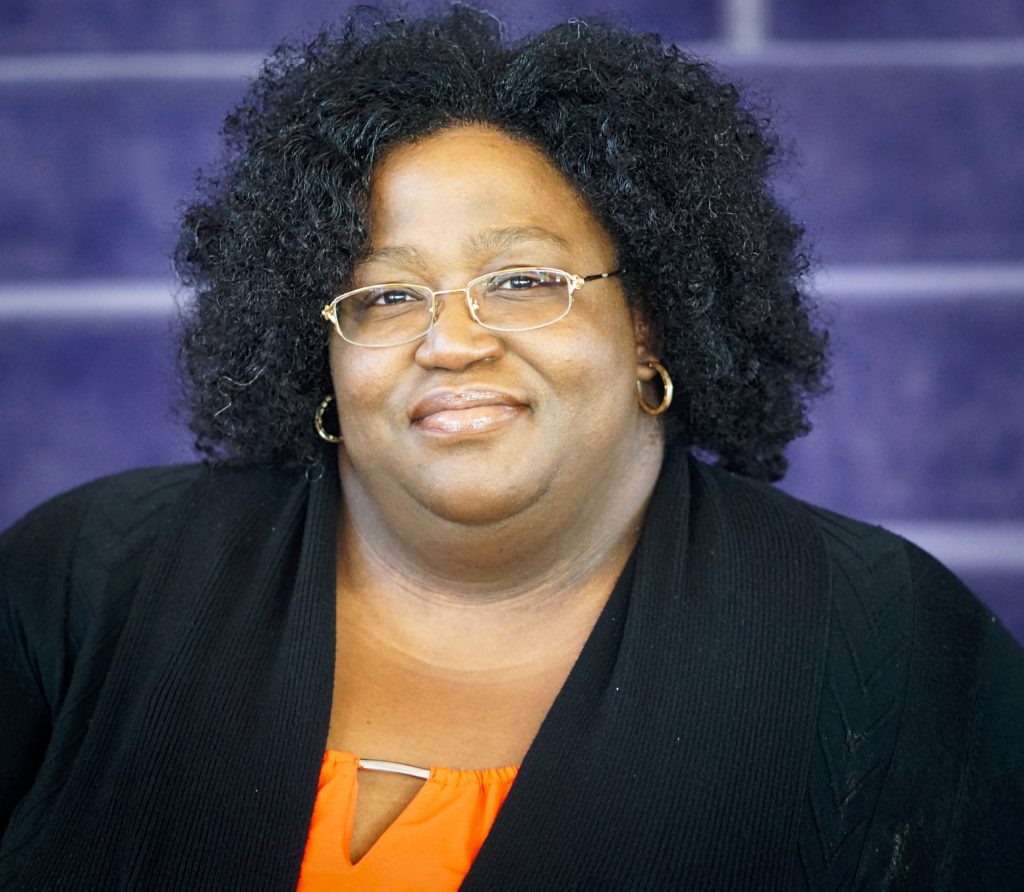
Louis Deas is the founder of Assured Hope

AABJ Online Fundraiser: 43 Years Campaign

AABJ’s $43 for 43 fundraising campaign is still ongoing. In its 43rd year, we are asking members to donate $43 to go towards programming, scholarships, and events throughout the year. Be sure to invite your friends, coworkers and anyone you know that supports our members in print, communications, public relations, radio, broadcast, digital and the many trailblazers in the literary world. Be sure to share our campaign on your social media by using the hashtag  #AABJ43.

You can donate here.

How to prepare for life after college

By Mariah Hill

When it comes to students’ senior year of college, there tends to be a gap between the campus environment and “the real world.” Every student fears whether he or she is prepared for the opportunities that typically won’t fall in their lap when they’re not a student anymore.

There is the also the question whether the institution the students attended prepared them for the “real world.” Some students blame themselves for not taking advantage of opportunities presented to them.

“Clark gives you a glimpse into the real world and doesn’t hold your hand … That’s how the real world is,” said Frank Jefferson, a senior at Clark Atlanta University.

Each institution sometimes held career fairs where students are able to meet professionals for potential internships that could turn into a job in the student’s interested field.

Students could also join organizations that put them in the position to network with professionals or an outside organization where students can get hands-on opportunities.

“My best advice would be to seek out the opportunities yourself, be assertive but not aggressive and follow up with those who you have connected with over the past few years in college,” Nailah Heard a Senior at Clark Atlanta University said.

Ultimately students want to feel fully prepared for life after college. Professionals say “that is when the hard work begins.”

Mariah Hill is a junior at Clark Atlanta University

Member Spotlight: Ray Metoyer, past AABJ president

Ray Metoyer

Current position in AABJ?

Technically I don’t have a current position in AABJ, but I’m a very active member. I am a past AABJ President, who served from 2005-2008. During that time, I was blessed to be the President when AABJ hosted the NABJ convention in 2005 and AABJ/Atlanta did an amazing job.

How long have you been a member of AABJ?

I’ve been a member of AABJ since 1994, right after I relocated here to be an anchor/reporter for WGNX, which is now WGCL. My membership in AABJ is connected to my membership in NABJ, where I served on the NABJ Board from 1989 to 1991. I was a chapter president in Denver and my hometown of Omaha.

Where did you attend college?

I graduated from the University of Nebraska/Lincoln where I majored in journalism.

How long have you lived in Atlanta?

I’ve lived in Atlanta since 1994 and I continue to work as a journalist.

Current Occupation?

Currently I’m the managing editor for Georgia Public Broadcasting’s “Lawmakers” program, covering the legislature when it’s in session. The rest of the year I work on freelance projects. I started my career in broadcasting in Omaha before moving to Denver, Little Rock, Houston, Dallas and Atlanta, both in front of and behind the camera.

What do you like most about being a member of AABJ?

Being a member of AABJ is important because our voices need to be heard in Atlanta. The diversity of media people here is the direct result of the push for change by NABJ/AABJ. It is our job to point out issues that need to be corrected, including how our communities are covered by mainstream media. Questions we have raised locally and nationally have made a difference in changing unfair practices, but we can never let up. Bad habits, lazy reporting and cultural arrogance in coverage have a way of coming back and we have to be there waiting.

What initially got you interested in the media/communications field?

I was always fascinated with television production and storytelling. I got my first introduction to TV while in high school. I joined a Junior Achievement company, run by a local Omaha TV station, WOWT-TV, where we produced our own programs. When I was a sophomore in college, I was hired part time by that station, working summers as a reporter/photographer, before being hired full time after I graduated. Starting as a photographer made me a better storyteller because I learned to see each story through the lens of the camera.

What are your favorite publications/outlets to get your news?

I watch and read media every day, CNN, MSNBC, local news, PBS, AJC, and the NY Times to name a few. I’m fascinated by great storytelling and how things are produced and that includes movies, documentaries and special programs.

Is there anyone in media you look up to? Why?

Former CBS 60 Minutes Correspondent Ed Bradley remains one of my biggest heroes because he was such a trailblazer in the industry and he commanded respect. I also respect ABC’s Robin Roberts because of her bravery in fighting cancer, while maintaining a high level of professionalism in her lead role on Good Morning America. She brings great JOY to her work and shares it every day.

What’s an interesting fact about you people wouldn’t have otherwise known?

Most people don’t know I’m a musician; a percussionist since high school. I’ve produced the music and soundtrack for three documentaries. In 2018 I created the music for a new TV program called “Secrets of the Caribbean,” which is currently being distributed on smaller TV networks and online. Creating music and the atmosphere for TV programs and productions is also an important part of storytelling!

This edition of the Byline was edited by Amir Vera and Shalon Bell