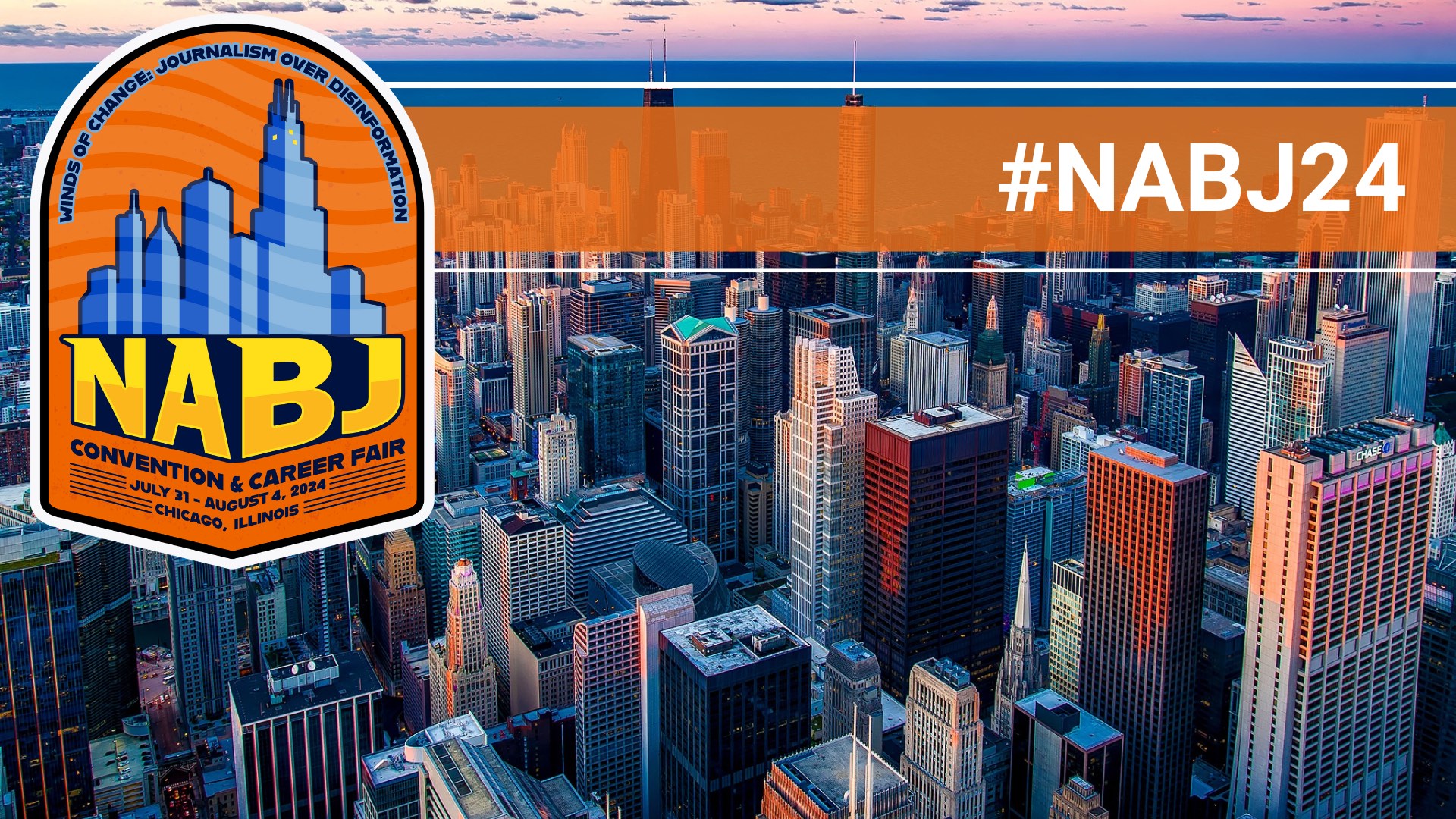
Join us at the NABJ Convention & Career Fair! Hosted in Chicago, IL this year, the convention brings incredible Black journalists from all over to network, inspire and educate us all on the ever-changing world of journalism, media, business and everything in between. From check-ins from the NABJ President, Ken Lemon, to convention preparation meetings, the excitement is pumping as we’ve shared many tips about what to do before, during and after the convention, and we look forward to seeing you there and having a great time!
Stay up to date with the convention & career fair’s itinerary here. Download the EventPilot app to register for and organize the events you’d like to attend. Remember to stay safe and have fun!
Congrats to AABJ’s 2024 NABJ Convention Grant Recipients!
In support of continued professional development opportunities for students, AABJ has provided financial assistance for these students to attend the convention. The recipients are:
Janiya Ansah – Clark Atlanta University
Nilea Cosley – Clark Atlanta University
India Rice – Clark Atlanta University
Aveon Sims – Clark Atlanta University
Marquette “Hollywood” Walker – Georgia State University
Fun Things To Do In Chicago That’ll Have You Saying “Yes, Chef!”
By: Aaleah McConnell
Are you heading to Chicago for the NABJ convention? Here are a few great travel spots in the Windy City inspired by the hit TV-series, “The Bear,” and some other attractions that you don’t want to miss! The National Association of Black Journalists’ Convention and Career Fair is less than a couple of weeks away, and while many of us have been anxiously preparing to rub shoulders with industry leaders and influencers in media, I’ve been watching FX’s “The Bear” a lot.
In case you haven’t heard of this hit dark-comedy drama series, it follows the story of a young chef and his small kitchen staff as they transform a modest, family-owned sandwich shop into a Michelin star-worthy destination. So, if you’re wondering what this particular story about chefs has to do with the upcoming conference, other than both taking place in the Windy City, then let’s take a deeper look!
I think it’s safe to say this show draws viewers each week for its awe-inspiring look into the culinary world, which appeals to the pathos of chefs and foodies equally. But, what attracts many people to the program is its portrayal of the everyday person fighting tirelessly for the actualization of their ambitious dreams. Which many people, especially young professionals, can identify with.
The job hunt can be a mammoth undertaking for even the most seasoned professional. One thing I learned from my hours-long binge of “The Bear” is the importance of taking a deep breath and appreciating the beauty of the world around you. Even in the process of finding your next big break.
So here’s my guide to local landmarks and restaurants featured in the show (and some that are not) that will help you make every second count at this year’s gathering. And don’t worry, this guide isn’t riddled with fine dining spots that’ll leave a dent in your pockets and a hunger in your belly, but if that’s your thing, check these out!
If you’re also a fan of “The Bear,” then you know Chicago is bursting with great food spots. Some are Chi-town staples and have even made cameos on the show like Pequod’s Pizza, well-known for its deep-dish style pie laced with a caramelized crust.
Mr. Beef’s Deli and Margie’s Candies are amongst the historic foodie destinations featured in the show but there are new institutions making waves in the city, like Virtue Restaurant and Bar, a Black-owned eatery serving up fresh culinary ideas.
One of the city’s most attractive features is Lake Michigan, which offers 26 miles of shoreline to explore. You can take in these stunning views via the Chicago Lakefront Trail, which is an 18-mile-long pedestrian walkway connecting nearby beaches, parks and waterfront restaurants along a convenient path where you can walk, bike or rollerskate.
The Bronzeville Arts District is a mecca of Black culture and artists and is home to Gallery Guichard, which boasts a large collection of art representing the African Diaspora. Art lovers visit the Pilsen Neighborhood murals each year to view the work of many Latinx artists. Plus, this stop will earn you a check off of your “The Bear” sight-seeing list.
There’s so much to explore and learn about the Windy City, and this is such an exciting opportunity to experience the culture while networking with other journalists and professionals. See you in Chicago!
Enjoy this fun word search during your travels! You can also download it here.
This issue of The Byline was edited by Mya Grant, Vice President of Print for the Atlanta Association of Black Journalists (AABJ), and Mandisa Johnson, Chair of The Byline.
First, I want to thank you for your continued support and readership.
Raisa Habersham
Second, you may notice this edition of The Byline is a hybrid issue. You’ll read stories focused on men in media and the challenges that led to their triumphs. We’ll also have a quick Q&A with Aviation Queen and The Points Guy senior editor Benet Wilson on preparing for virtual convention. We hope you find this issue insightful and useful as we take a brief publishing break for August.
— Raisa Habersham, Vice President of Print
Metro Atlanta journalist Donnell Suggs on his transition from freelance to full time reporter
By Elisheva Wimberly
When Donnell Suggs first moved to Atlanta in 2006, he started working at The Atlanta Daily World and The Atlanta Voice. According to Suggs, newspapers were more prevalent back then, but it was equally as difficult to get on staff at these papers. Suggs, being new to Atlanta and not knowing anyone in the business, wanted to be involved in journalism and freelance reporting became a window of opportunity.
Publications during that time had budgets for freelance journalists and those freelance stories helped him apply for reporter positions and gain additional experience. Suggs worked at his college newspaper at the New York College of Technology. He also wrote a few sports stories for small print publications in Brooklyn, N.Y.
“I didn’t come to Atlanta with a ton of experience but I had to hustle and I was willing to go and cover that football game for 35 bucks,” Suggs said. ”Papers will always take you on if you’re willing to work cheap.”
Since Suggs was willing to work for low wages, he used freelance writing to break into the industry. Suggs reminisced on his experience when he came to Atlanta and said that was ultimately the best course for him. The need for inexperienced journalists is not the same today as it was when Suggs first came into the industry.
Donnell Suggs, reporter with the Atlanta Business Chronicle. (Courtesy of Donnell Suggs)
“Today, you all have so many options,” he said. “Online existed in 2006, but it wasn’t nearly as strong as it is today. We didn’t have specialty websites like the AJC.”
Before digital media became so popular, Suggs pitched to print publications. His dream was to cover baseball games in the paper as a subsequent love for him and his father’s love for baseball. Suggs said the sports department has always been fully covered by people.
Atlanta, being a big sports market, made Suggs realize he had to make himself available. When Suggs pitched to print publications he understood he had to give them something good, whether that be reporting in the rain, traveling to work, or turning in a story at 11 p.m. Suggs always made himself available to turn in the assignment.
Now, Suggs writes full time for the Atlanta Business Chronicle. “There’s someone that is 35 and 45 dying to get into the business,” he said. “I did not dream of being a real estate reporter in Atlanta.” Suggs’ goal was to get to the AJC or the Atlanta Business Chronicle. As a daily print and online journalist, Suggs says it is important to keep fighting for your spot.
Although Suggs has been covering a wide range of subjects for 15 years, he says taking the traditional route is not necessary in today’s time. Social media platforms such as Facebook, Twitter, TikTok, and even blogs can help inexperienced journalists get hired at major newspaper publications.
Donnell Suggs, reporter.
Suggs told The Byline he applied for the Atlanta Business Chronicle (ABC) five years ago but knew he wasn’t ready to take on the position. Suggs was hired by one of ABC’s recruiters. He reports all of the big real-estate deals happening in the city of Atlanta. Suggs always dreamed of working for the ABC and received one of only 16 jobs on the paper under their real estate reporters.
“I was waiting for this moment and now it’s like we’re here.” Suggs said, adding the Atlanta Business Chronicle serves a specific demographic because it’s a business newspaper. “I haven’t had this much pressure in a while,” Suggs says. “The rest of the staff has been there for over a year, it’s a lot of pressure but I love it.”
With his new position at the ABC, Suggs said he hopes to see more Black representation in the paper. Suggs says most Black representation does not get as much recognition unless they’re a prominent Black figure or it’s a pressing movement happening such as Black Lives Matter. Suggs wants to be a representation for his son, his stepdaughter and his community and is working toward that goal in one of Atlanta’s top prominent papers.
“Seeing these people made it seem like I could be at a major paper publication and still be Black,” Suggs said. “You need to be around your own people, Black or white. There is no better way to do your craft than to be around your own people who do it professionally.”
Suggs’ goal is to one day become an editor. He wants to be able to hire someone like him at the age of 30 with his same drive to get out quality stories. Suggs advised any journalist to not give up or take a year off.
“You will win and you’ll get to where you want to be but you can’t be above the journey.” Suggs says.
Elisheva Wimberly is a student at Georgia State University.
AJC reporter Ernie Suggs talks about his pandemic T-Shirt A Day posts
By Kassidy Jack
COVID-19 has affected our lives in ways that we had never imagined. It forced college students to leave their campuses, left many people unable to work, and required essential workers to put their lives on the line daily.
One main change that COVID-19 also brought along was quarantine in the beginning stages of the pandemic. People were forced to stay indoors unless it was urgent. But Atlanta Journal-Constitution reporter Ernie Suggs came up with a creative way to spend his days in quarantine: Suggs uploaded a daily picture with a different T-shirt onto his social media. And 365 days later, he is still posting them. The Byline spoke with him about his reasoning and the joy it brought onlookers during the pandemic.
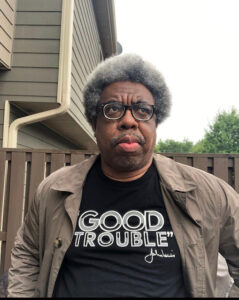
AJC reporter Ernie Suggs wears a “Good Trouble” T-shirt in honor of the late Congressman John Lewis and late Civil Rights pioneer C.T. Vivian. (Ernie Suggs’ Instagram)
Kassidy Jack: What inspired your initial t-shirt post?
Ernie Suggs: Over the years, I’ve worked in a corporate setting as a newspaper reporter, and I go to work every day with a tie or polo shirt. So, over the years, I’ve collected all these t-shirts that I’m never able to wear. During the pandemic, I’ve been working from home. Because of that, I decided these t-shirts would be my work uniform. I started posting them on Facebook, Twitter, and Instagram and it just kind of took off. I think I did about 160 days straight, took a bit of a break during the winter, and I just started back up last week. It was also something fun and brought some levity to the tragedy of this pandemic. I still probably have 100 t-shirts that I still haven’t worn.
KJ: Did you think that a year later, you’d still be posting your t-shirts?
ES: I knew that if we were still in the pandemic and I was still working from home, I would. I have 250 nice new T-shirts. So, until I go back to work, I’m still going to be wearing them. I also knew I’d be posting until I got tired, or people got tired. But people don’t seem tired, and neither am I.
KJ: How do you think your posts affected the lives and spirit of your followers?
ES: I think it gave and still gives people something to look forward to. I believe our timelines are inundated with a lot of negativity, namely surrounding politics. So, my T-shirt posts are just this positive thing. It isn’t controversial, just fun. I’ve even gotten people who send me shirts because they enjoy the posts so much. Throughout this whole process, I think I’ve probably gotten 20 T-shirts. So, it’s been a good thing going on.
KJ: Which t-shirt post has been your favorite?
ES: I love my fraternity ones. I am also a big fan of Prince. I try to have a theme for each week. That helps it become more manageable. Sometimes, I’ll do Prince, the fraternity, foreign or local cities, or even historically black colleges. Choosing the themes are always fun.
KJ: What have people said about your posts? Have you seen anyone take up your challenge? How have people reacted?
ES: When I first started, I had people on Twitter who decided to take on the challenge. They said they had some cool T-shirts and wanted to wear them. They slowly fell off, so I guess I’m the champ! But I think that it’s become kind of like this whole social media event that people are drawn to. Last year, I did a Prince week and got retweets from Wendy & Lisa, who were in Prince’s band. I also try to tag any organizations I’m representing, so it’s also fun when they retweet, comment, or send me something. That happens probably once or twice a week.
KJ: How do the posts make you feel?
ES: I’m no social media maven, but this is a way for me to expose myself and get out there once a day, so people know I’m still here. Yeah, we’re in a pandemic, but I’m doing fine. I just hope that I can put a smile on someone’s face or meet new people throughout this whole process. And as far as motivating me, I mean for one, I have to wear something, right? It has also helped me to develop a routine throughout this pandemic which I think is super important.
Kassidy Jack is a student at Clark Atlanta University.
Atlanta Voice sports reporter Anfernee Patterson reflects on finding his first job in a pandemic
By Anfernee Patterson
It seems March 2020 was yesterday. I was in Macon covering the basketball high school state championships, which featured Atlanta Public School teams Douglass High School girls and Therrell High School boys. It was a fun weekend, as usual, covering sports as one team won their second straight championship. I was there covering it for The Atlanta Voice, but as I drove back to Atlanta, I did not think that it would be my last time covering a sporting event until August 2020.
Last year, when COVID put the nation at a standstill, a lot of things became uncertain. Are sports going to be around? Is the world going to get back to normal? Will I be able to do sports journalism? Will I be able to do my internship? Am I going to make next month’s rent while being out of work?
As these questions swirled in my head, I prioritized completing my classwork and paying my bills. On top of that, I had to ensure my resume, writing and work samples and broadcast reel were ready to post and send to potential employers.
When the sports world began to shut down, my internship was placed on hold. I saw it coming and knew it was out of my control. This particular internship was something I thought would put me in my sports journalism career permanently and open up numerous doors as I graduated. During the summer and preceding months, I wondered if that internship would still be available. I kept in contact with the coordinator, but the opportunity just was not there.
I applied for numerous sports and news jobs at various newspapers and television stations. In some cases, I never heard back; in others, I received rejection letters. I attended the annual NABJ Convention and job fair, but had no luck.
Anfernee Patterson, sports reporter for The Atlanta Voice.
To keep myself busy, I formed a podcast with my friends at The Atlanta Voice, where I interned during the summer; I kept my mind focused and created content. To maintain my skills, I practiced standups (where TV reporters stand in front of a camera and narrate part of a story) or took photos throughout downtown Atlanta. I also updated my equipment so I could have better content and materials for my stories and podcast.
Apart from keeping my skills fresh, I drove around when I could, I exercised, and I tried to get out of the house — I did everything I could to ensure I was prepared for any opportunity and in good mental health. But In the end, I had to move back to my hometown, Manchester, Georgia, which still gets me down to this day. At the time, I did not have a job nor enough money to afford rent during the pandemic.
That was a dark moment. I have a love-hate relationship with my hometown, and it left me feeling stagnant and lost. I eventually became depressed; I went almost two weeks without social media and without speaking to my friends and loved ones. I had hit rock bottom: I just graduated college and had nothing to show for it. I felt everything I did was for nothing, and I had to just figure things out and give myself time.
With the sports season being in question, I wondered about the future of sports journalism. Would it be sustainable? How long will it last? Will it be a one to two year hiatus before they play again? Is it even safe for players to play sports and reporters cover it and do their job efficiently? This and many more questions came to my mind.
As states announced plans to hold in-person or virtual school, some states such as California canceled the football season. In Georgia, it was surprising to learn the Corky Kell Classic and high school football would be played. But that decision would be a blessing in disguise for me. The Atlanta Voice called me to cover as much high school football as I could.
I was taken aback by the call, as it seemed nearly impossible that I would be able to cover sports. But reassuring knowing that my job valued high school sports coverage and the reporting I have done.
Today, I still cover sports for The Atlanta Voice, the first place that gave me an opportunity. I may be a freelancer and I still have to commute to Atlanta from Manchester, but I am glad I get to do what I love. It is also a good feeling knowing that what I’ve worked for has paid off. While I may not be exactly where I want to be, getting this opportunity lets me know that I am on the right track.
Finding work in an ongoing pandemic can be tough. I’m always willing to give advice to anyone entering the journalism field after college. So, here are a few things that I think helped me, and may be of help to you:
Get as much experience while you are in college and save all of your work.
Network. Always be nice and respectful to people and follow up. It may not mean much at the moment but do it because you genuinely care. Always surround yourself with mentors, colleagues and friends who understand you and have your best interests at heart.
Get involved. Join NABJ, AABJ, campus newspapers and television stations that will help you get that experience.
Always ask questions and don’t hesitate to jump at an opportunity. Whether it is to cover a specific event that you enjoy, a potential job opportunity or just a chance to help you in your journalism career, ask to do it. I truly believe that a closed mouth cannot be fed and that no question is a dumb question.
Be true to yourself but never be afraid to grow. Stay true to your values and what makes you special because that is what makes you unique and sets you apart. Don’t try to be something or somebody else. But always figure out ways you can be a better journalist and produce better content. Determine the best way to be a better you.
Find balance. Do things outside of journalism that matter to you and keep your mind fresh. Whether it is exercising, reading a book or traveling, take time for yourself because you earned it and need it.
As I reflect on the pandemic and my professional journey, I am thankful to God that I am blessed to do what I love. I am grateful for my life and for having the sense of mind to keep working and prepare for my opportunity. It is my hope that I continue to elevate as a sports journalist, but also that anybody reading my story who feels that they’re in the same position never stops and keeps pushing.
Anfernee Patterson covers sports for The Atlanta Voice.
Quick tips on navigating NABJ’s virtual convention
By Kassidy Jack
For the second consecutive year, NABJ’s convention will be held virtually. While some are not new to virtual conventions, there may be a few newly graduated students or working professionals who are first timers and need advice on how to navigate a virtual convention. The Byline spoke with Benét Wilson, senior editor at The Points Guy, founder of Aviation Queen, and longtime mentor to Black journalists about preparations and tips for this year’s virtual NABJ Convention.
Kassidy Jack: What are some things you’ve been doing to prepare for the convention?
Benét Wilson: Well, to start with, I’ve been checking my internet connection frequently. That was an issue I ran into a lot last year. I’ve also looked at the schedule and created calendar reminders for every session I want to attend, whether it’s a panel or a plenary session.
KJ: What is something that last year’s convention taught you, and how will you use it this year?
BW: It definitely taught me to watch the time because many of the sessions would immediately follow one another. By using the calendar, I’ll see the notification pop up and move on to my next event.
Benet Wilson, senior editor for The Points Guy and longtime NABJ mentor.
KJ: How do you recommend networking in a virtual setting?
BW: Social media, LinkedIn, and Google are your best friends. If there are specific people that you know you want to speak with, names you recognize, or even titles you’re interested in, find them on social media. You can simply say, “I would love to get in touch with you either before, during, or after the convention.”
KJ: What are some resume and cover letter tips?
BW: Well, I’d be the perfect person for that question. I’ve reviewed more than 400 resumes and cover letters for NABJ members since 2009. As far as resumes, the first tip I suggest is always keeping them updated. Once you’ve done that, have someone review it for a new set of eyes. Ideally, you want a professional. Lastly, for resumes, always customize them for the job you want. Review the qualifications and skill sets, and be sure you are representing those on your resume. You can’t use a generic resume for every job.
As for cover letters, you want to tell a story. One of the best cover letters I read was done by a student getting her journalism degree, but she was also on her college’s women’s basketball team. She talked about her experience on the basketball team and how those experiences applied to her work ethic for journalism. It was brilliant, and it told the employer, “This is why you want to hire me.”
KJ: What advice would you give to people about the type of clothing and background type they should use for virtual meetings?
BW: You don’t have to wear a ball gown. You don’t have to wear a suit. Look presentable. Wear a nice shirt. Bottoms and shoes don’t matter because no one can see those, honestly. If you have a virtual background, you can put it up as long as it isn’t too busy. You can even blur your background. One thing I will tell people is not to use Zoom makeup. Finally, just because you’re behind a screen doesn’t mean you shouldn’t give any effort to how you are presenting yourself, especially in a professional setting.
Kassidy Jack is a senior at Clark Atlanta University.
This issue of The Byline was edited by Tianna Faulkner and Raisa Habersham. The Byline is taking a hiatus for the month of August.