Your cart

THE BYLINE – MAY 2024 ISSUE

Congrats Class of 2024! We wish all of our recent graduates the best in their future endeavors as they embark on new adventures. In this issue of The Byline, we featured three incredible student journalists who are making great strides early on in their careers. Education doesn’t necessarily end at the graduation ceremony, it just grows with you. So, remember to always be hungry for more, be teachable and keep striving for the best version of you that you can possibly be.

May Membership Meeting Recap

Special thanks to NABJ President, Ken Lemon, and First Lady, Kortni Lemon, for coming by and sitting in our monthly meeting. President Lemon shared some great information about the upcoming NABJ Convention, new things to come from the national organization and his positive remarks towards the chapter. We truly enjoyed having you Mr. President!

Vice President of Digital, Tyrik Wynn, hosted a very informational social media workshop for our members. From professional tips to content ideas, Wynn dropped tons of gems on how to be more social media savvy – and make some money from it, too!

Announcements:

  • The Byline continues its search for more writers. Please contact our VP of Print, Mya Grant, at myagrant3716@gmail.com for more information.
  • The 1st episode of “iN Contact” for 2024 is live! Watch it here.
  • July 31st – Aug 4th: NABJ National Convention, Chicago, IL

For more up-to-date information and access to future events, join AABJ today!


21-year-old Marquette “Hollywood” Walker Creates New Opportunities in Atlanta

Pictured: Marquette “Hollywood” Walker

By: Craig Allen Brown and Dijon Milow-Russell

Marquette “Hollywood” Walker has a tenacity for sports journalism that is exceptionally rare for someone his age. At just 21 years old, he has already garnered millions of views of his content with big name players in the sports industry. Currently serving as a sideline reporter for ESPN, Walker has demonstrated a relentless attitude that is sure to catapult him to the top of the sports broadcasting arena. 

Originally from South Memphis, Tennessee, Walker credits his hometown with helping instill drive and a strong work ethic within him but increasing crime and violence caused him to consider a new place for his mother and him to reside. They collectively chose to move to Atlanta, as the Walker’s perception of the city was the new, Black media hub of the South. He didn’t know anyone in Atlanta but was confident that he could create a meaningful existence here. 

Enrolling at Georgia State University was the first step. His initial interest in journalism was sparked by one of his high school teachers who also happened to be Memphis’ most renowned radio DJ’s, Stan “The Man” Bell. Bell would take Walker and other students to the local radio station every day during the school week to give students the opportunity to develop professionally. He even shared professional contacts with the students to promote future success in the areas that they chose to explore. 

Walker believes his most impactful opportunity occurred at the 50th anniversary of Rev. Dr. Martin Luther King, Jr.’s assassination at Memphis’ National Civil Rights Museum. He commemorated Dr. King in front of thousands and left the stage feeling supremely confident in his ability to communicate effectively. 

Once it became clear to Walker that a career in journalism was the answer for him, he didn’t waste any time. Instead of trying to align with a professional news organization, he used Linkedin and Instagram to directly connect with established sports stars. As a result, Walker has had the opportunity to interview NFL receiver and current podcaster, Brandon Marshall, NBA championship winner, Stephon Jackson, former NBA player, Darius Miles, and NFL Hall of Famer and current head football coach of the University of Colorado, Deion Sanders. His interview with Sanders went viral, accumulating over three million views. 

As Walker began looking for more opportunities, he joined AABJ, was awarded the Olisteen Miles Scholarship, and contributes to the “iN Contact” broadcast team. He’s frequented several professional development opportunities, including the NABJ annual convention and the Black Sports Business Symposium. He’s also surrounded himself with others who push him to not only become a better journalist but a better person. 

Walker credits his success to his devout faith. While many people his age are consumed with girls and “likes” on social media, Walker has achieved many successes that are much more meaningful. His ultimate goal is to become the “male Oprah Winfrey” as he continues to conduct viral interviews and tell impactful stories. 


Perfecting Her Craft with Grace

Pictured: Grace Barlow

By: Radhiya Alston

As she finishes her first year at Spelman College, Grace Barlow reflects on her incredible accomplishments and role in journalism. Pursuing broadcast journalism, Barlow knows what it takes to continue her growth and knowledge in her college and professional career. 

Native to Philadelphia, Pennsylvania, Barlow has been recognized for her extensive resume. During the summer of 2022, she produced a video with Philadelphia-based radio station, WHYY. 

“I produced a video on gentrification and displacement from the University City Townhomes which impacted low-income families,” said Barlow. “They were only offering five hundred dollars for a single home occupancy to several Black families with five children.”

After producing this project with her team in 2023, Barlow earned her first Emmy award as a student journalist; the following fall, she chose to attend Spelman. 

“I picked Spelman because I wanted to be surrounded by other Black women doing their thing,” said Barlow. 

Barlow keeps her skills sharpened by writing for her school’s newspaper, The Spelman Blueprint, and anchoring for Morehouse College’s The Maroon Tiger. She enjoys being apart of the editorial staff and around other Black women who are also pursuing journalism, describing her first year as nothing short of a great experience. 

One of the biggest highlights of her college career this year was interviewing Spelman College’s president, Dr. Helene Gayle. During their interview, Dr.Gayle shared with Barlow that being her authentic self is the way to being a true Spelman woman and Barlow lives by those words. 

Another accomplishment of hers is being the only first-year student serving as an anchor for The Maroon Tiger. One of the most recent stories Barlow has worked on for The Maroon Tiger is the Spelman housing crisis, where she interviewed students who protested the lack of available housing on campus. Although these were exciting accomplishments, it did come with a few lessons which she is grateful for because it has helped her become a better journalist. 

“I learned to slow down and trust my gut,” said Barlow. 

She shared this knowledge and more during her appearance at the Taco Bell Foundation Pathways & Perspectives panel discussion earlier this year. Having faith in herself has been a driving force in the way she approaches her career and future and Barlow believes that others should think the same way. 

Progressing towards her sophomore year, Barlow looks forward to perfecting her craft and becoming a better multimedia journalist. A huge congratulations to Barlow, as she’s been promoted to a managing editor position at The Spelman Blueprint. There are also a few summer programs she’s applied to and patiently waiting to hear back from. 

As a fellow writer for The Byline, we wish Barlow nothing but the best as she continues to thrive as a student journalist. To follow Barlow’s journey, stay up to date with her LinkedIn page. 

Freddrell R. Green, III’s Beginning of a Long-Lasting Legacy

Pictured: Freddrell R. Green, III

By: Mya Grant

College is the foundation of every aspect of our adult lives. We grow not only as students of our crafts but as individuals walking towards our greater purpose. Student journalist Freddrell R. Green, III is taking advantage of the opportunities available to him and molding them to help him leave a long-lasting legacy doing what he loves. 

Green’s first interaction with journalism was when he was invited to a journalism camp through the Athens-Clark County High School Completion Initiative during the summer of sophomore year at Cedar Shoals High School. There he learned introductory information about journalism and met Richard Dunn, who’d become his mentor after the program ended. Through the program and under the guidance of Dunn, Green knew that journalism was for him. 

“It was just such a very exhilarating experience,” said Green. “Because here’s this man showing me something that I could do with my basic writing skills that I never thought I could transition into.”

Once the program ended, Green took what he learned at the journalism camp and applied it to his student media career. He had the opportunity of hosting interviews with popular locals in his community and work as a broadcast editor at his student publication, Cedar Blueprints. Green believed that this was a great start into his journalism career that would elevate his college experience. 

As a first-year student at Morehouse College, Green admits that this was not his first choice. Green initially had intentions to attend the University of Missouri for their reputable journalism program and the full-ride scholarship they were offering him but after doing more extensive research and understanding what he needed to thrive, he decided that Morehouse was the best choice for him. 

“Even now, I’ve realized that there are so many other opportunities,” said Green. “There’s so much more opportunity here, journalistically, but it’s also a place where I can get just a genuine solid education.”

Green also says that the history and mission of Morehouse is what drew him to the university. He really wanted to be somewhere where he was nurtured in education and as Black man. 

“It builds that solid groundwork of a true education,” said Green. “Not just going out to get a job.”

As one of the founding members of the Morehouse College Association of Black Journalists (MCABJ), Green believes that journalism is truly the study of everything. From gaining knowledge about your topic to understanding how to relay the information to an audience, there is so much to be learned and implemented in the way journalists operate. A well-rounded experience and continuous growth is what student journalists should aim for as they enter their career. 

Through his involvement with MCABJ, Green notices that other student journalists aren’t as ambitious or committed to their craft. They see and go after the end-product but don’t take into consideration the work that goes behind it. Add the current state of journalism in the mix and it’s obvious that there’s some sort of disconnect. Green looks forward to opening those conversations and meeting other students to bridge the gap and elevate each other as the next generation of journalists. 

 As the owner of his media company, Greenlit Media, he wants to share more stories, show people what he can do with the skills he’s gained and contribute to the positive changes we’re seeing in the journalism industry today. Green wants to leave a legacy of leadership, service and action, and is well on his way. Visit his website and LinkedIn page to stay up to date with his work. 

This issue of The Byline was edited by Mya Grant, Vice President of Print for the Atlanta Association of Black Journalists (AABJ), and Mandisa Johnson, Chair of The Byline.


THE BYLINE 03/2021

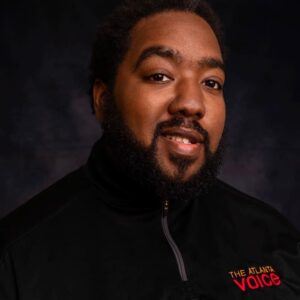
AABJ Mourns the loss of Atlanta Voice editor Marshall Latimore

AABJ Family,

We are mourning the death of Marshall A. Latimore, chief content officer and editor-in-chief of The Atlanta Voice. Latimore was an advocate for Black student journalists, a champion of HBCUs and a great friend.
A graduate of Tennessee State University, Latimore, 36, has served as a page designer for Alabama Media Group, Gatehouse Media and the USA Today Network. He also served as the creative director for duGard Communications and HBCUStories Inc. and publisher and editor-in-chief of STAYONTHGO magazine.

AABJ mourns the death of Marshall Latimore, who served as editor-in-chief of The Atlanta Voice. He was 36.

A champion of the Black press, Latimore spent the last three years at The Atlanta Voice, developing young reporting talent and increasing the newspaper’s digital footprint.

“We at The Atlanta Voice are coming to grips with the sudden and unexpected loss of our Executive Editor and Chief Content Officer, Marshall A. Latimore,” Janis Ware, The Atlanta Voice publisher, said in a statement. “Marshall stood in the epicenter of this Atlanta treasure as we have transformed The Atlanta Voice into a multi-media powerhouse set to grow our legacy for generations to come. His loss is not only ours, his family and loved ones, but also our community’s. His leadership cannot be replaced but his direction will be followed as our mission continues to be a voice for the voiceless. His presence will be missed but his voice will continue on in every aspect of our future. Marshall was loved and cherished by all whom he met.”

Latimore was recently interviewed for the February issue of AABJ’s The Byline on the importance of the Black press and had this to say: “Our purpose is ensuring that the people who have been the most oppressed and disenfranchised have a voice and are able to tell their stories that are based on the truth.”

AABJ extends its deepest condolences to Latimore’s family, friends, colleagues and his Atlanta Voice family.


WSB’s Nicole Carr’s Journey to Investigative Reporting 

By Kassidy Jack

As a child, Nicole Carr was always talkative and curious. She would frequently try to listen to the conversations between her parents, aunts, and uncles. 

At the same time, her heart was always in writing. She still has little books she wrote as a child that she would bind with yarn. But her very first news article would come when she was in the eighth grade when she wrote about Terence Roberts, one of the members of the Little Rock Nine, the first Black students ever to attend classes at Little Rock Central High School in Little Rock, Arkansas. 

Roberts spoke to Carr’s class, and her teacher at the time asked her to write about it. From there, Carr’s interest in journalism piqued: The summer before 10th grade, she studied journalism at Cambridge for a summer prep program. She later attended Winston Salem State, where she served as editor-in-chief of the campus’ paper. Carr then attended Syracuse University, where she obtained her master’s degree in broadcast journalism. Soon after, she began her career as an intern at the Fayetteville Observer in Fayetteville, North Carolina. 

Nicole Carr is an investigative reporter for WSB-TV.

“I liked talking to people. I liked finding things out. And so I think that is what kindled my interest in journalism,” Carr said.

But in between then, Carr’s life was filled with the news, driven in large part by her dad’s Army background. Because Carr grew up in a military family, she traveled to various places and was constantly exposed to essentially history in the making. She remembers TV cameras being around at a homecoming for her father’s unit as they returned from the African countries of Mogadishu and Somalia. 

The movie “Black Hawk Down” was released, based on a mission her father was involved with in Fort Campbell, Kentucky. Carr said that most of her time spent with her father was consumed by them watching CNN, as her father always wanted to remain informed. 

“Growing up, we were always in the middle of historical significance, and it always made me wonder ‘what’s going on?’” Carr said. 

After working in Fayetteville, North Carolina, Carr moved to Wilmington, North Carolina, where she was able to get live reporting experience, such as covering hurricanes. She then moved to Atlanta to be a general assignment reporter for WSB-TV from WVTD in Durham, North Carolina. 

After nearly two years at WSB, Carr was promoted to investigative reporter. Carr said she never specifically decided on becoming an investigative journalist, but decided to take the initiative and time to dive deeper into her stories led her to investigative journalism. 

“I wasn’t looking for a title, but I also knew that standing out and having some deeper reporting in a largely competitive newsroom could show that I could hang with the best of them,” said Carr. 

 Like many of her peers, Carr has faced many challenges as a Black journalist. One of the reoccurring issues she has dealt with is the perception of bias or being tone-deaf because of how she may speak on a particular topic. 

“I think the perception of someone who looks like you handling certain stories might make people uncomfortable, for whatever reason,” Carr said. No matter how professionally she handles a story, there is always an assumption that her stance is somehow subjective. “We address problems by bringing attention to them.”

Carr said one of her proudest stories is of a lady who was billed $10,000 for a DNA test she hadn’t authorized. She was a mental health patient, and her doctor had forged her signature on the test. By the time Carr and the rest of her team had finished the story, the business was under a state investigation and shut down soon after. “I think that’s the power of journalists; we were able to expose something that no one was confronting,” she said.

Carr wants to be remembered as a truth-teller, whether that makes people uncomfortable, whether it helps people, whether there’s a fall out from it, or all three. 

“I think truth is light,” Carr said. “We’ve gotten caught up in the way of both siding parts of our reporting that doesn’t require that. It requires us to plainly tell the truth that’s in front of us.”

When asked about her career goals within the next five to ten years, Carr explained she sees herself doing journalism differently. She wants to go back into the more in-depth storytelling. She aspires to be in a position that will allow her to take more time with her stories and delve into accountability journalism. She wants to write more and eventually work on documentaries. 

To aspiring journalists, Carr says to remember there is no one way to achieve a goal. It is okay to admire people and study the methods used, but you also have to always do what is best for you.

“There was a time when they would teach women in television not to get married or have a family until you’ve gotten into your career,” Carr said. 

While she understood where the advice came from, she acknowledged that wasn’t her path, and she has been able to have it all: a successful career and personal life. “If I stopped today, I’d say good job,” Carr said.

Kassidy Jack is a student at Clark Atlanta University.


Digital marketing specialist Kimeko McCoy explains the digital space 

By: Jamila Wood 

Kimeko McCoy has an astute knowledge of branding and marketing in the digital space. She is a freelance journalist and digital marketer. McCoy has worked with WarnerMedia as a digital marketing specialist and coordinator and at the Atlanta Journal-Constitution as an audience development specialist. Now, she is a marketing reporter for Digiday. She takes the time to elaborate on her experience and the responsibilities of a marketing reporter. 

JW: Can you explain the responsibilities of a digital marketing specialist? 

KM: In my formal role as a digital marketing specialist, I was in that role as a social media marketer strategist and audience development. I spent maybe three or four years in that role at various companies. My experience was an all-hands-on-deck situation. People think that digital marketing is just email marketing and social media. There are so many facets to push people along your marketing funnel. It looks different for everybody. It depends on the service or product. For me personally, television required a lot of legwork. You had to work with teams that were knowledgeable about traditional out-of-home marketing. It is a project management team effort. 

JW: What was the difference between being an audience development specialist and a digital marketing reporter?

Kimeko McCoy is a marketing reporter for Digiday.

KM: As a digital marketing reporter, I look at the marketing landscape. I see where people are investing their ad dollars, what is important to them as far as the marketing funnel and where brands are seeing the most success. As we are in a global pandemic, what’s the best ways businesses have been able to market to their consumers to keep your business thriving. An audience development specialist, I was on the opposite end of that. I used SEO, social media newsletters to make sure I am getting traction to the stories, videos and other digital aspects. 

JW: How do you feel about social media encouraging an industry of marketing specialists? Do you think social media influencers are well-versed to share tips about marketing and passing it off as a way to quit your 9 to 5? 

KM: I think it could be a bit misleading. I think when you have somebody who has success and doesn’t divulge how they got there then it can be harmful for people who are looking to you as an industry leader. If you’re a celebrity and you say “I am going to start selling a book about how to live your best life.” Well if you are not divulging that you have a makeup team, nanny, personal chef. I do think it’s a little misleading to encourage people to buy your product. Especially if you are pitching as a DIY and you are not telling people you had help along the way. It’s the same thing for social media marketing. I think oftentimes it waters down what a social media marketer or digital marketer is because there are unproven, debunked shortcuts that have been introduced. For example, buying followers or using this hashtag strategy and you will be able to gain followers by the morning. There’s nothing wrong with trying and testing different strategies it all depends on what your brand is and what you are trying to do. You have to take it with a grain of salt. Keep in mind that what works for someone else’s brand may not work for yours. 

JW: What is one common theme you find within all social platforms?

KM: There is no common. You have to approach every single platform differently. There are a lot of people that are trying to use the same video on all platforms. What is proven successful on Tik Tok is not going to be proven successful on Reels. You have to approach each platform separately. 

JW: Which social platform gives journalists and digital creators the opportunity to grow organically? 

KM: For journalists, I would say Twitter is a phenomenal help. As a content creator, I think Instagram is still pretty heavy. Tik Tok is kind of storming into that space so we will see. But, I think you are starting to see a rise in Clubhouse. There might be a space for a new type of influencer as social platforms continue to rise. 

JW: What should journalists keep in mind when building their brand? 

KM: The key for me has been just being extremely online. Including yourself in conversations, making sure you are making those connections, and don’t be afraid to talk to people. I don’t know how you are going to be a journalist and be afraid to talk to people. That’s step number one. You can be afraid to slide into someone’s DMs, quote tweet, retweet someone, or engage with them. Not even as a source but get your name out there and make sure you are staying on top of things. I think things happen in a digital space so quickly that if you’re not somebody that utilizes that digital space you will find yourself left out of conversation pretty quickly. 

JW: What advice do you have for individuals wanting to be a digital marketing specialist? 

KM: Put yourself in those spaces and make yourself available. Talk to the people in those spaces and connect with them. A couple weeks before I started this role, I was hosting coffee meetings where I would hop onto a Zoom or Google Hangout and just talk to people and let them pick my brain. It proved to be a very helpful space just talking and getting to know people throughout your career and I think that helps put a name with a face. 

Jamila Wood is a student at Clark Atlanta University. 


This issue of the Byline was edited by Raisa Habersham and Tianna Faulkner.