Your cart

THE BYLINE 04/ 2021

How Clark Atlanta professor balances his freelance career, influences students

By: Jamila Wood 

When he is not teaching Clark Atlanta University journalism students the ins and outs of the business, Christopher Daniel is racking up bylines for the likes of The Daily Beast, The Undefeated, HuffPost, Atlanta Magazine, and  NBC News.

But, the award-winning journalist’s love of words, entertainment and culture began well before he started helping students jumpstart their career in the media industry. 

Daniel found a love for entertainment with his childhood being surrounded by constant music. His mother was a general manager at night clubs and his father a DJ. At nine, Daniel was captivated by Nelson George’s writing style and Ed Bradley’s interview skills. 

“One of the first books that I remember reading was this book called ‘The Death of Rhythm & Blues’ by one of my favorite writers, Nelson George,” Daniel said. “I just noticed that as a nine year old reading this adult book that the way he wrote about was the same way I thought about the music that I heard in my house.”  

The writing passion for Daniel started early and was seen through his constant love for reading magazines at the supermarket and carrying his own notebook. 

“I would literally go to the supermarket and read magazines. I could rundown the bylines of all my favorite writers. I used to walk around with a notebook and write all the time,” he said.

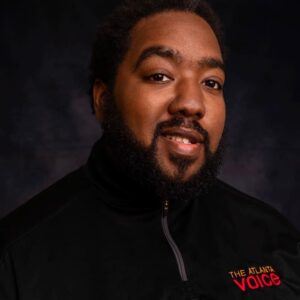
Christopher Daniel

Daniel started his career through his involvement in nonprofits and wanted to cover things that carried purpose. Eventually, his work spoke for itself and opened endless doors of opportunity. 

“At the time there weren’t a lot of people covering it [nonprofit events]. I made it my thing. Every weekend I was at The High Museum, Georgia Aquarium or the Fernbank Museum. I was networking with all these executives and different people. They would see my blog post about who received an accolade at the gala that year,” Daniel said. 

“They would reach out through  LinkedIn or through my email. A lot of it was connecting with communications teams that work with these nonprofits,” he continued. “Naturally, all of these people wanted to invite me to lunch and I started going to events like The Commerce Club. I was just out and talking about things that I did.” 

With Daniel’s immense amount of passion, he went into his career with a strategic mindset that prepared him to handle any difficulty — including maneuvering the challenges of virtual teaching as a professor. 

“As a journalist, it wasn’t hard at all. It was more of a challenge at Clark Atlanta, where I teach. That was because I wasn’t really sure of the content management system or learning management system that we [the school] would have to use to communicate with the students,” Daniel said. “The challenge was trying to figure out how we would transition from the physical setting and deliver it to the virtual setting.” 

Daniel expresses that his strategic networking helped his career and assisted him in gaining more opportunities during the pandemic. 

“I had so many relationships that I built over the years and most of them started by showing up to places and someone referring me because of something they read in a smaller publication. I was just making sure that when I went places I had strategic networking,” he said. 

Now, after making a name for himself, Daniel uses his connections in media to help students at Clark Atlanta University, has dedicated his career to giving more Black writers opportunities, and tries to be a form of representation for his students.

“I knew if there was an assignment I was going to get it. I also knew if they needed students that were good in PR and journalism and would ask for my recommendation,” Daniel said. “That’s why so many students at Clark Atlanta right now are doing well. Why, because they asked questions and followed every move that I was making. It really rubbed off on them by paying attention to the bylines. It really encouraged students to do it because I was doing it.”

But Daniel also cautioned against feeding into misconceptions people have about the entertainment industry whether you’re consuming media or working in the field. 

“You still have to research people and watch tv shows up close and listen to full-length albums and mixtapes. You should be able to read voraciously,” Daniel said. 

As Daniel reflects on his career, he realizes the importance of always executing quality work. Daniel has received endless attention from the entertainment industry and multiple interviews and is thankful to receive the opportunity to share his story with up-and-coming Black journalists. 

Daniel urged rising journalists to “keep your ear to different topics and different things people are talking about. Pay attention to what these editors and producers are doing on social media. 

“A lot of times they put their emails and social media handles out there. They also share the pay and how to pitch,” he said. “It’s one of those things that if you are going to be virtual, you have to utilize the virtual in all possible ways.”

Jamila Wood is a Clark Atlanta University student. 


PR Veteran Carlos Scott talks career, gives insight on the PR industry 

By Da’Zhane Johnson

From crisis management to event planning, publicist Carlos Scott has been able to establish upstanding brands and reputations for celebrities. The marketing extraordinaire is known in the PR industry for his ability to strategically navigate a myriad of matters for his clients.  Scott’s expertise has led him to be seen on CNN in 2016, where he gave professional insight on the scandal surrounding Olympic medalist Ryan Lochte, who fabricated a story about being robbed at gunpoint with three other swimmers. Carlos also spoke on his experiences and his responsibilities at N-Vision Marketing, his Atlanta-based marketing firm. Scott spoke to AABJ’s The Byline about his marketing and PR expertise.

DJ: Tell me how you became interested in the PR industry? Did someone inspire you, or did you discover the industry on your own?

Carlos Scott

CS: It was really my sister who introduced me. After leaving the military, I actually found myself in the music industry as a songwriter. I was able to sign a deal with a record label and started writing for a new artist. I remember sitting in a meeting for about four hours waiting to play the new records we recorded, but that never happened. We spent hours discussing the artist’s image and reputation. We even talked about her dermatologist! That’s when I realized what importance PR, marketing and image had, not only on artists, but on any talent.

DJ: What do you believe is the most difficult part about your job?

CS: I would say the most difficult part can be the clients. You can get clients who are “a problem child.” Another thing is the communication and elitism in the industry. It’s always about respect for me. I can send emails and people do not respond because they see I’m not worthy or they’re not interested. To me, that’s disrespectful. You should treat everyone equally in this industry because you never know who will be your boss.

DJ: As a PR veteran, have you seen any PR trends occur in the past year?

CS: I have definitely seen some trends change. I told a friend of mine earlier this week that the ability to adapt and embrace technology has been the biggest trend. People who couldn’t do those two things probably weren’t able to keep business coming in during COVID-19. In times like this, it’s good to keep your ear to the streets and your mind open.

DJ: Social media has allowed for news to travel across the world easily. It is possible for anyone or anybody to trend on Twitter. Do you believe this has added pressure for publicists when they are managing a crisis situation?

CS: Absolutely. Social media marketing is actually something we specialize in. You just have to learn how to be smart and intentional with every post. We have clients who just don’t need social media because they are so well-known. Some clients just don’t need it for their own good. In those cases, we usually will manage their social media accounts ourselves.  

DJ: What does your typical workday look like? Was it altered at all because of COVID-19?

CS: A typical workday for me doesn’t really exist. Every day can be different depending on the client. Some days I am at my desk emailing pitches. Other days I am helping clients with interviews. The pandemic didn’t hurt business for us actually. The only thing that stopped was traveling. I used to fly from four to five times a month, but that stopped once the world shut down last March.

DJ: What advice do you have for current students who are studying to become a PR expert like yourself?

CS: I would advise any beginner to get an internship first. I say that because it will help you determine if this is the business you really want to be in. I’ve had interns work for me, and say, “You know, Mr.Scott, I’d like to thank you for this opportunity, but this just isn’t for me.” The work is more labor intensive than people think. You need to study the craft in general, get an internship to discover which entity you want to do — whether that be corporate or entertainment — then study this entity. 

Da’Zhane Johnson is a student at Clark Atlanta University. 


This issue of The Byline was edited by Raisa Habersham and Tianna Faulkner. 

THE BYLINE 03/2021

AABJ Mourns the loss of Atlanta Voice editor Marshall Latimore

AABJ Family,

We are mourning the death of Marshall A. Latimore, chief content officer and editor-in-chief of The Atlanta Voice. Latimore was an advocate for Black student journalists, a champion of HBCUs and a great friend.
A graduate of Tennessee State University, Latimore, 36, has served as a page designer for Alabama Media Group, Gatehouse Media and the USA Today Network. He also served as the creative director for duGard Communications and HBCUStories Inc. and publisher and editor-in-chief of STAYONTHGO magazine.

AABJ mourns the death of Marshall Latimore, who served as editor-in-chief of The Atlanta Voice. He was 36.

A champion of the Black press, Latimore spent the last three years at The Atlanta Voice, developing young reporting talent and increasing the newspaper’s digital footprint.

“We at The Atlanta Voice are coming to grips with the sudden and unexpected loss of our Executive Editor and Chief Content Officer, Marshall A. Latimore,” Janis Ware, The Atlanta Voice publisher, said in a statement. “Marshall stood in the epicenter of this Atlanta treasure as we have transformed The Atlanta Voice into a multi-media powerhouse set to grow our legacy for generations to come. His loss is not only ours, his family and loved ones, but also our community’s. His leadership cannot be replaced but his direction will be followed as our mission continues to be a voice for the voiceless. His presence will be missed but his voice will continue on in every aspect of our future. Marshall was loved and cherished by all whom he met.”

Latimore was recently interviewed for the February issue of AABJ’s The Byline on the importance of the Black press and had this to say: “Our purpose is ensuring that the people who have been the most oppressed and disenfranchised have a voice and are able to tell their stories that are based on the truth.”

AABJ extends its deepest condolences to Latimore’s family, friends, colleagues and his Atlanta Voice family.


WSB’s Nicole Carr’s Journey to Investigative Reporting 

By Kassidy Jack

As a child, Nicole Carr was always talkative and curious. She would frequently try to listen to the conversations between her parents, aunts, and uncles. 

At the same time, her heart was always in writing. She still has little books she wrote as a child that she would bind with yarn. But her very first news article would come when she was in the eighth grade when she wrote about Terence Roberts, one of the members of the Little Rock Nine, the first Black students ever to attend classes at Little Rock Central High School in Little Rock, Arkansas. 

Roberts spoke to Carr’s class, and her teacher at the time asked her to write about it. From there, Carr’s interest in journalism piqued: The summer before 10th grade, she studied journalism at Cambridge for a summer prep program. She later attended Winston Salem State, where she served as editor-in-chief of the campus’ paper. Carr then attended Syracuse University, where she obtained her master’s degree in broadcast journalism. Soon after, she began her career as an intern at the Fayetteville Observer in Fayetteville, North Carolina. 

Nicole Carr is an investigative reporter for WSB-TV.

“I liked talking to people. I liked finding things out. And so I think that is what kindled my interest in journalism,” Carr said.

But in between then, Carr’s life was filled with the news, driven in large part by her dad’s Army background. Because Carr grew up in a military family, she traveled to various places and was constantly exposed to essentially history in the making. She remembers TV cameras being around at a homecoming for her father’s unit as they returned from the African countries of Mogadishu and Somalia. 

The movie “Black Hawk Down” was released, based on a mission her father was involved with in Fort Campbell, Kentucky. Carr said that most of her time spent with her father was consumed by them watching CNN, as her father always wanted to remain informed. 

“Growing up, we were always in the middle of historical significance, and it always made me wonder ‘what’s going on?’” Carr said. 

After working in Fayetteville, North Carolina, Carr moved to Wilmington, North Carolina, where she was able to get live reporting experience, such as covering hurricanes. She then moved to Atlanta to be a general assignment reporter for WSB-TV from WVTD in Durham, North Carolina. 

After nearly two years at WSB, Carr was promoted to investigative reporter. Carr said she never specifically decided on becoming an investigative journalist, but decided to take the initiative and time to dive deeper into her stories led her to investigative journalism. 

“I wasn’t looking for a title, but I also knew that standing out and having some deeper reporting in a largely competitive newsroom could show that I could hang with the best of them,” said Carr. 

 Like many of her peers, Carr has faced many challenges as a Black journalist. One of the reoccurring issues she has dealt with is the perception of bias or being tone-deaf because of how she may speak on a particular topic. 

“I think the perception of someone who looks like you handling certain stories might make people uncomfortable, for whatever reason,” Carr said. No matter how professionally she handles a story, there is always an assumption that her stance is somehow subjective. “We address problems by bringing attention to them.”

Carr said one of her proudest stories is of a lady who was billed $10,000 for a DNA test she hadn’t authorized. She was a mental health patient, and her doctor had forged her signature on the test. By the time Carr and the rest of her team had finished the story, the business was under a state investigation and shut down soon after. “I think that’s the power of journalists; we were able to expose something that no one was confronting,” she said.

Carr wants to be remembered as a truth-teller, whether that makes people uncomfortable, whether it helps people, whether there’s a fall out from it, or all three. 

“I think truth is light,” Carr said. “We’ve gotten caught up in the way of both siding parts of our reporting that doesn’t require that. It requires us to plainly tell the truth that’s in front of us.”

When asked about her career goals within the next five to ten years, Carr explained she sees herself doing journalism differently. She wants to go back into the more in-depth storytelling. She aspires to be in a position that will allow her to take more time with her stories and delve into accountability journalism. She wants to write more and eventually work on documentaries. 

To aspiring journalists, Carr says to remember there is no one way to achieve a goal. It is okay to admire people and study the methods used, but you also have to always do what is best for you.

“There was a time when they would teach women in television not to get married or have a family until you’ve gotten into your career,” Carr said. 

While she understood where the advice came from, she acknowledged that wasn’t her path, and she has been able to have it all: a successful career and personal life. “If I stopped today, I’d say good job,” Carr said.

Kassidy Jack is a student at Clark Atlanta University.


Digital marketing specialist Kimeko McCoy explains the digital space 

By: Jamila Wood 

Kimeko McCoy has an astute knowledge of branding and marketing in the digital space. She is a freelance journalist and digital marketer. McCoy has worked with WarnerMedia as a digital marketing specialist and coordinator and at the Atlanta Journal-Constitution as an audience development specialist. Now, she is a marketing reporter for Digiday. She takes the time to elaborate on her experience and the responsibilities of a marketing reporter. 

JW: Can you explain the responsibilities of a digital marketing specialist? 

KM: In my formal role as a digital marketing specialist, I was in that role as a social media marketer strategist and audience development. I spent maybe three or four years in that role at various companies. My experience was an all-hands-on-deck situation. People think that digital marketing is just email marketing and social media. There are so many facets to push people along your marketing funnel. It looks different for everybody. It depends on the service or product. For me personally, television required a lot of legwork. You had to work with teams that were knowledgeable about traditional out-of-home marketing. It is a project management team effort. 

JW: What was the difference between being an audience development specialist and a digital marketing reporter?

Kimeko McCoy is a marketing reporter for Digiday.

KM: As a digital marketing reporter, I look at the marketing landscape. I see where people are investing their ad dollars, what is important to them as far as the marketing funnel and where brands are seeing the most success. As we are in a global pandemic, what’s the best ways businesses have been able to market to their consumers to keep your business thriving. An audience development specialist, I was on the opposite end of that. I used SEO, social media newsletters to make sure I am getting traction to the stories, videos and other digital aspects. 

JW: How do you feel about social media encouraging an industry of marketing specialists? Do you think social media influencers are well-versed to share tips about marketing and passing it off as a way to quit your 9 to 5? 

KM: I think it could be a bit misleading. I think when you have somebody who has success and doesn’t divulge how they got there then it can be harmful for people who are looking to you as an industry leader. If you’re a celebrity and you say “I am going to start selling a book about how to live your best life.” Well if you are not divulging that you have a makeup team, nanny, personal chef. I do think it’s a little misleading to encourage people to buy your product. Especially if you are pitching as a DIY and you are not telling people you had help along the way. It’s the same thing for social media marketing. I think oftentimes it waters down what a social media marketer or digital marketer is because there are unproven, debunked shortcuts that have been introduced. For example, buying followers or using this hashtag strategy and you will be able to gain followers by the morning. There’s nothing wrong with trying and testing different strategies it all depends on what your brand is and what you are trying to do. You have to take it with a grain of salt. Keep in mind that what works for someone else’s brand may not work for yours. 

JW: What is one common theme you find within all social platforms?

KM: There is no common. You have to approach every single platform differently. There are a lot of people that are trying to use the same video on all platforms. What is proven successful on Tik Tok is not going to be proven successful on Reels. You have to approach each platform separately. 

JW: Which social platform gives journalists and digital creators the opportunity to grow organically? 

KM: For journalists, I would say Twitter is a phenomenal help. As a content creator, I think Instagram is still pretty heavy. Tik Tok is kind of storming into that space so we will see. But, I think you are starting to see a rise in Clubhouse. There might be a space for a new type of influencer as social platforms continue to rise. 

JW: What should journalists keep in mind when building their brand? 

KM: The key for me has been just being extremely online. Including yourself in conversations, making sure you are making those connections, and don’t be afraid to talk to people. I don’t know how you are going to be a journalist and be afraid to talk to people. That’s step number one. You can be afraid to slide into someone’s DMs, quote tweet, retweet someone, or engage with them. Not even as a source but get your name out there and make sure you are staying on top of things. I think things happen in a digital space so quickly that if you’re not somebody that utilizes that digital space you will find yourself left out of conversation pretty quickly. 

JW: What advice do you have for individuals wanting to be a digital marketing specialist? 

KM: Put yourself in those spaces and make yourself available. Talk to the people in those spaces and connect with them. A couple weeks before I started this role, I was hosting coffee meetings where I would hop onto a Zoom or Google Hangout and just talk to people and let them pick my brain. It proved to be a very helpful space just talking and getting to know people throughout your career and I think that helps put a name with a face. 

Jamila Wood is a student at Clark Atlanta University. 


This issue of the Byline was edited by Raisa Habersham and Tianna Faulkner.