AABJ volunteers trade experiences with seniors at AG Rhodes Health and Rehab
By Breanna Durham
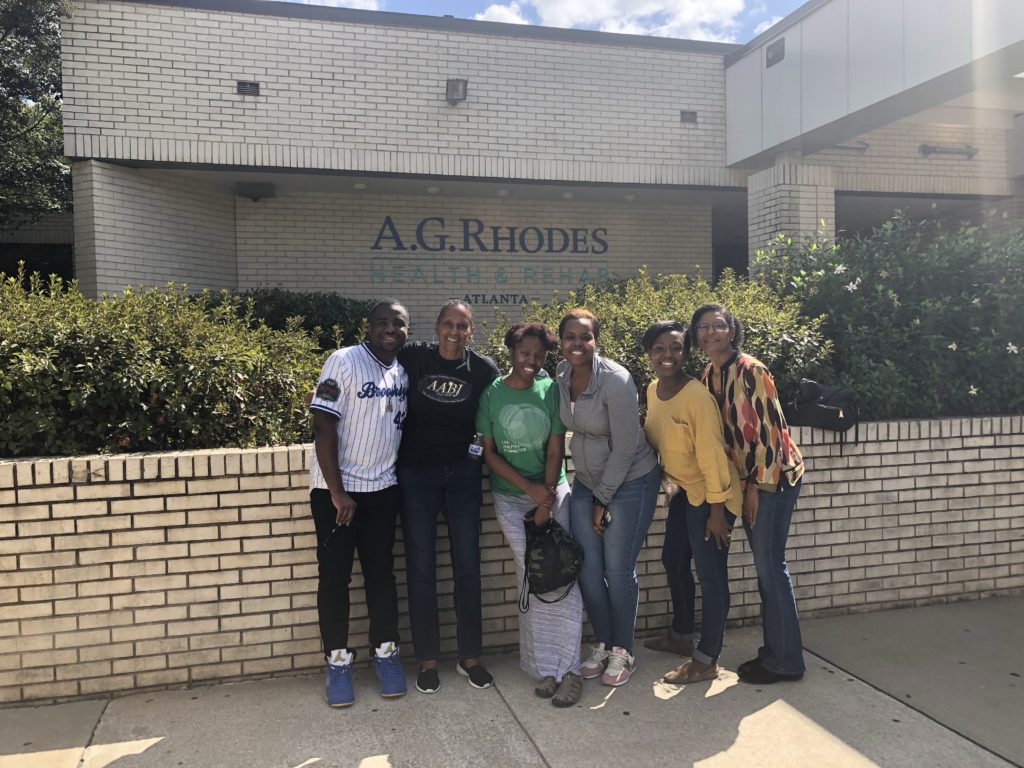
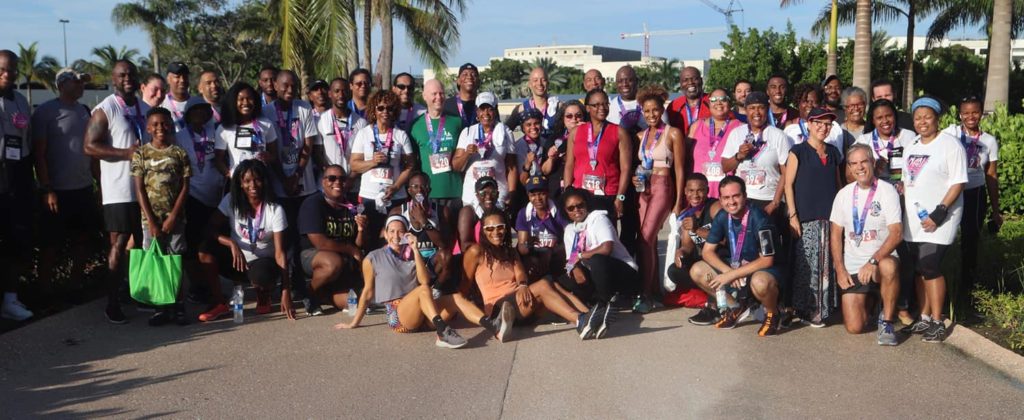
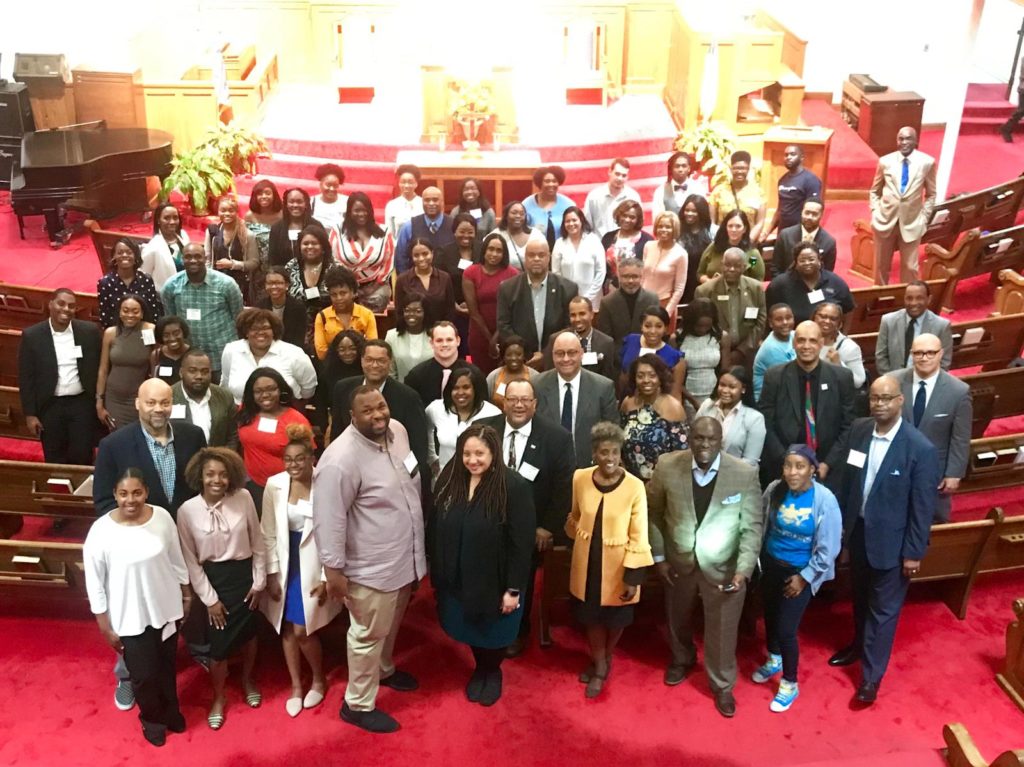
AABJ members pose for a photo outside of the AG Rhodes Health and Rehab on Sept. 21, 2019.
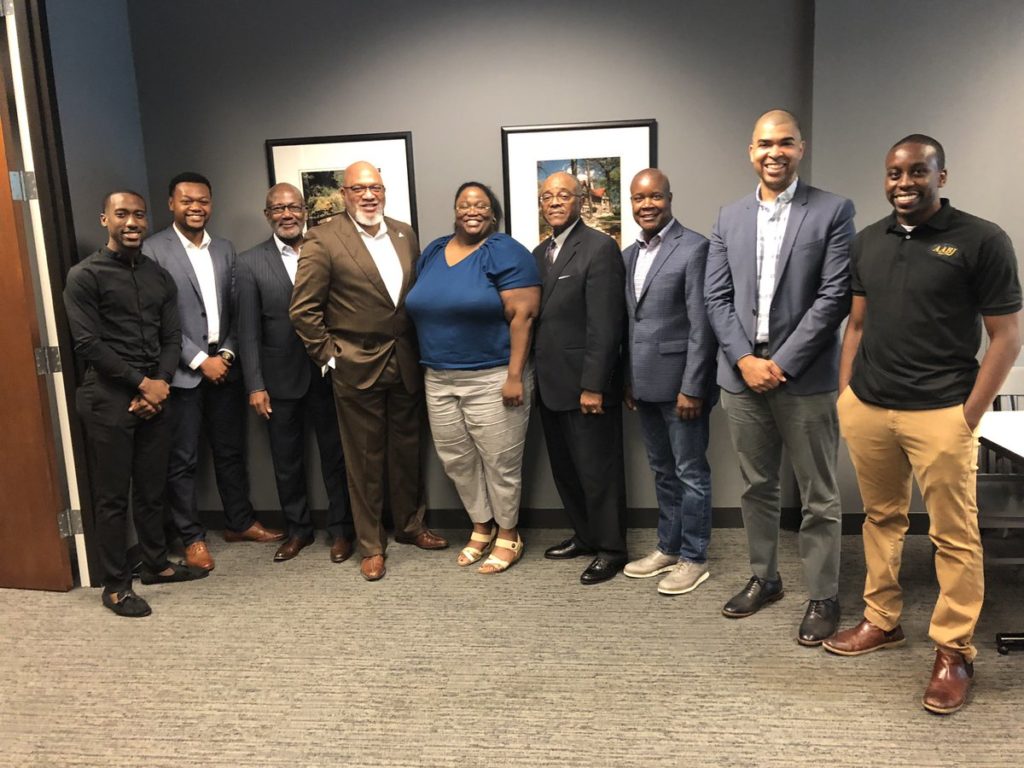
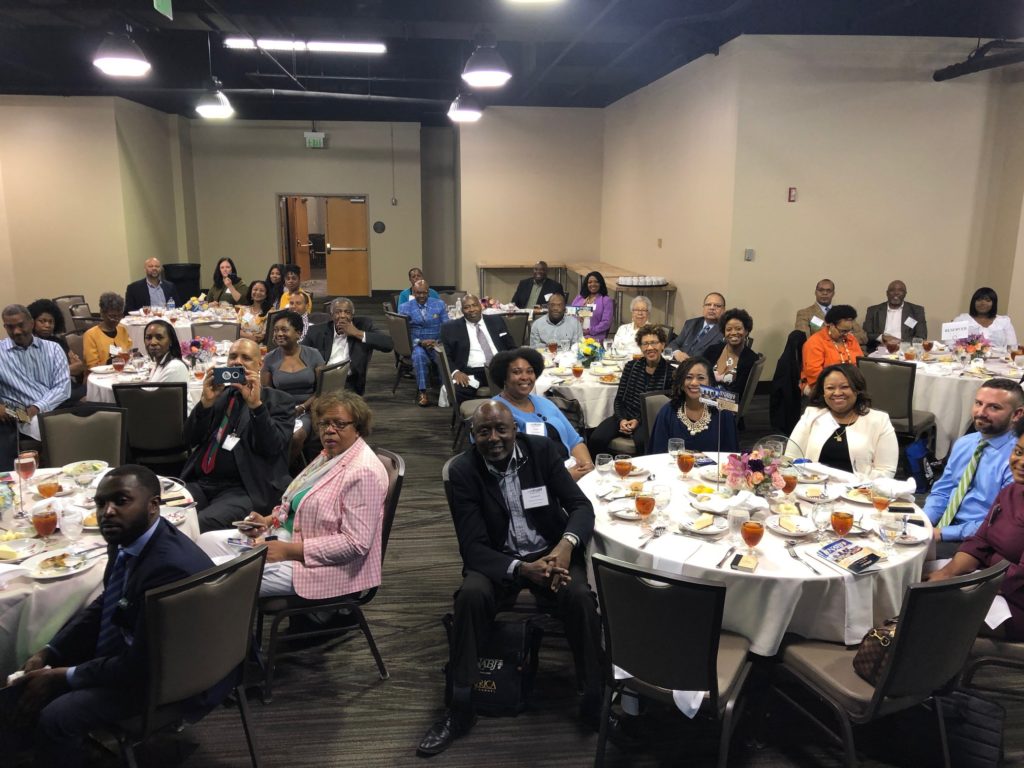
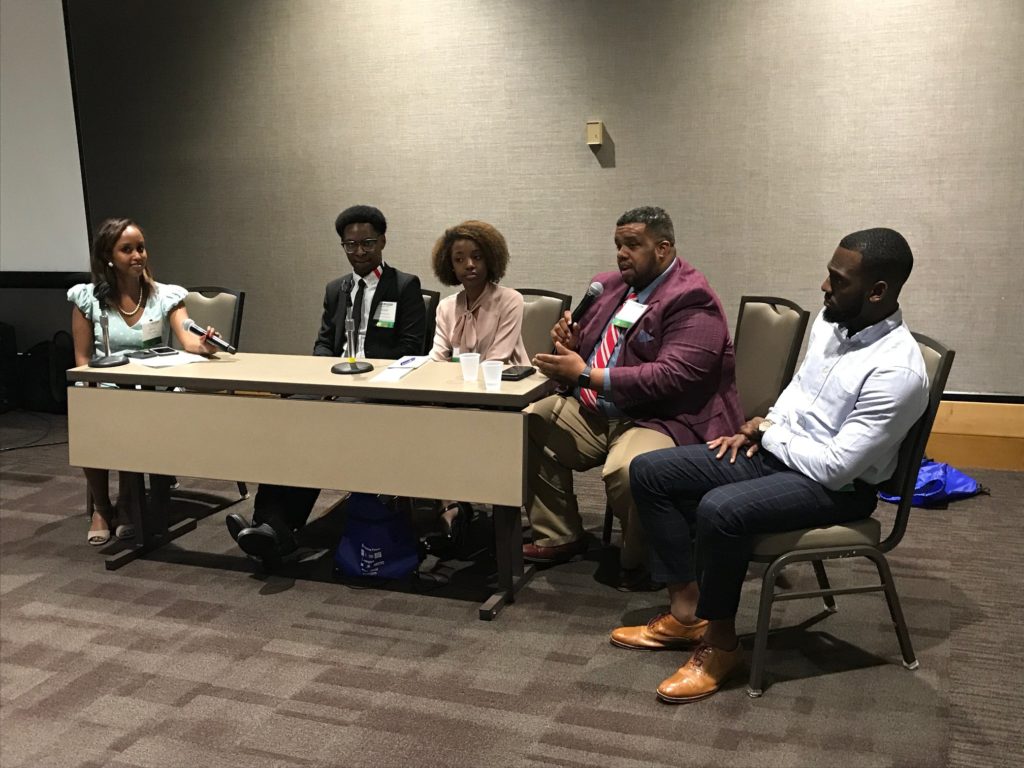
Members of Atlanta Association of Black Journalist (AABJ) gathered to spend time with senior citizens Sept. 21 for a volunteer event at the Atlanta branch of AG Rhodes Health and Rehab, a nursing home.
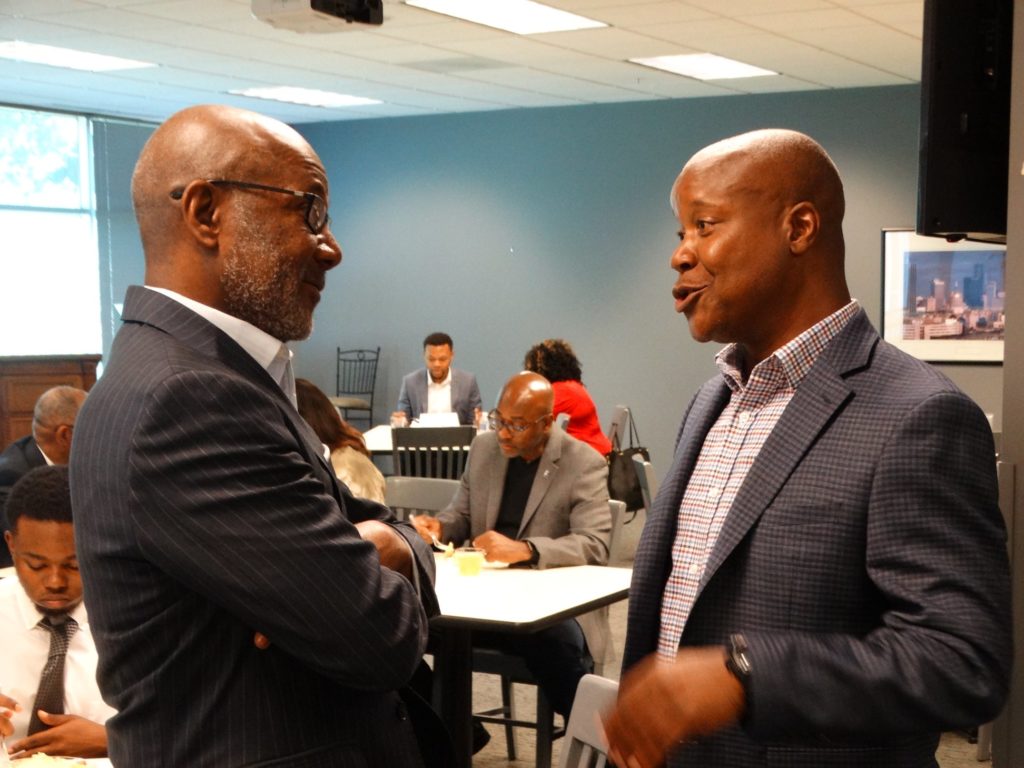
For two hours, the seven volunteers played games and heard about the lives and opinions of the seniors while sharing their own experiences and answering some of the residents’ questions. Typically, AABJ holds four volunteer events per year. After the nursing home visit, the chapter plans to hold one more volunteer event this year.
Barbara McDew, AG’s activities assistant, has worked with senior citizens for the past 30 years and spoke about the impact the seniors had on her and the potential impact they can have on others. Seniors, she said, have experienced life in ways she wouldn’t have ever imagined and hold interesting stories. By working with them, McDew learned things that would equip her for life.
“They taught me how to live and how to be a lady,” she said.
Helene Mills, a 94-year-old resident of the center, told the volunteers about her life and her advocacy. Mills has worked as a community advocate for Atlanta’s Fourth Ward and for senior citizens for years.
“I’m still working as an advocate for senior citizens right here,” she said. “I’m now a (National) Silver Haired Congress person who — when I was able — went to congress to advocate for various items in regards to senior citizens … That’s something I’m proud of.”
Jasimine Murray, who joined AABJ two months ago, said she volunteered due to her past experiences and her love of seniors. Because of her close relationship with her great grandmother, she said she has volunteered at her great grandmother’s senior citizens home.
“Anytime I can do something with the seniors, I do it,” Murray said. “I always think that there’s so many hidden stories here … I think that you can have all the books, but I think the best truths and stories come from people.”
Joy Woodson, the AABJ committee chairperson for community relations, said she chose the center in hopes of exposing the public to reporters.
“We [as AABJ members] thinks it’s important for people to see journalists as people and not just as people you see on the news who are telling a story and the only time they want to know you is when you’re having a bad day,” she said.
In addition, Woodson said she picked the center due to her belief that it’s important for black residents to see reporters that look like them serving the public. A large portion of the residents that came out for the volunteer event were black. Woodson described the group as lively and said she saw a lot of smiles.
“I think part of that is an outside group coming in,” she said. “It’s a help to the community. You’re helping expand the knowledge of whoever you’re helping.”
At this volunteer event, Woodson said that enough people did not come out, but she expressed hope for more to come out for the winter volunteer event. Over the course of a reporter’s career, Woodson pointed out the graciousness people have shown by sharing their stories with reporters and answering their questions. Besides returning that act of grace to the community, Woodson centered service as a pillar of the journalism profession.
“That’s what the core of what journalism should be about,” she said. “It’s a public service.”
Breanna Durham is a free lance writer.
AABJ Online Fundraiser: 43 Years Campaign
AABJ’s $43 for 43 fundraising campaign is still ongoing. In its 43rd year, we are asking members to donate $43 to go towards programming, scholarships, and events throughout the year. Be sure to invite your friends, coworkers and anyone you know who supports our members in print, communications, public relations, radio, broadcast, digital and the many trailblazers in the literary world. Be sure to share our campaign on your social media by using the hashtag #AABJ43.
“My professor encouraged me to run on the state level instead of the federal level because there are a lot of progressive policies and initiatives that must start to happen here in Georgia, and since this is home, take care of home first,” the 33-year-old sophomore at Clark Atlanta University said.
The threat to women’s rights is what prompted Doss-Hunter to run for the state position.
“Men
are controlling women’s rights, and we need more women of color at the table
voicing our rights,” Doss-Hunter said.
“Before I moved to Atlanta I was prepared to enroll in school. I didn’t know where I wanted to go so I was waiting to apply for colleges once I moved here,” Doss-Hunter said. She added that her family worked in film and she started working in film as well.
“I immediately started working in the field I wanted to without a college degree so going back to school seemed unnecessary,” she said.
Doss-Hunter said she was inspired by the teachings of W.E.B. Du Bois, and decided to go back to school to further her education in the fall of 2018.
“I wanted to go back to school to understand policy and legislation thoroughly. What better place to learn politics than at Clark Atlanta University? Georgia is the home of the first black woman state representative, Grace Towns Hamilton. There is no other place I should be,” Doss-Hunter said.
She believes Georgians “deserve transformative
education programs that nurture and guide the excellence of” all children. Doss-Hunter
also said she supports reform that de-criminalizes non-violent minor marijuana
offenses and wants quality healthcare coverage and facilities for everyone.
“No one should be refused quality health care services because they do not have health insurance,” she said.
Students at Clark Atlanta University have shown excitement in seeing their classmate run for state office .
“I believe Amber will represent Clark Atlanta well. I am certain the institution will support her through her campaign journey,” CAU senior Alexis Grace said.
Hunter’s vision for this campaign season is to touch everyone within arm’s reach of her district.
“I
never want to be a person who speaks of the issues and never tries to help
those in need of solutions. I want to help bring the change my community
needs,” Doss-Hunter said.
Union City, Fairburn, Chattahoochee Hills, Douglasville, Palmetto, and South Fulton are all part of District 65.
The primary voting is on May 19, 2020, followed by general elections on November 3, 2020.
Almiya White is a senior at Clark Atlanta University.
Be sure to buy the AABJ documentary “Black and Reporting”
Get your Emmy Award-Nominated copy of AABJ’s Documentary, “Black & Reporting: The Struggle Behind the Lens.”
Proceeds go to AABJ’s Xernona Clayton Scholarship Fund .
Anyone who wants to watch the entire documentary can buy it for $9.95 here.
Member Spotlight: Lisa Cox
Lisa Cox
Current position in AABJ?
Member
How long have you
been a member of AABJ?
5 years
Where did you attend
college?
UC Berkeley-Undergrad
Columbia University Graduate School of Journalism- Graduate
What do you like most
about being a member of AABJ?
The fellowship, networking, making new friends, learning the history and impact of black journos in Atlanta, and being surrounded by fellow black journalists.
What initially got
you interested in the media/communications field?
I grew up in the business so I was naturally attracted to it. My father is a broadcast journalist and professor. He used to be a top local TV news anchor in my hometown of Los Angeles and a former network radio host and correspondent. Plus — I got good grades in English and composition and writing came naturally to me.
What are your
favorite publications/outlets to get your news?
Not really but there are a multitude of people I admire and respect for their accomplishments and acumen (several local news professionals, Carole Simpson, Wolf Blitzer, Byron Pitts, Bernie Shaw among them). I love Whoopi Goldberg. She’s not traditional media but I love her anyways … her spirit and conviction. She keeps it real.
What’s an interesting
fact about you people wouldn’t have otherwise known?
My maternal grandmother was from Guadalajara, Mexico; I’m an
excellent interior decorator; if I could have any job and money was no object
I’d be a masseuse and own an herbal apothecary/fragrance shoppe.
This edition of The Byline was edited by Amir Vera
The Byline staff took a break for the month of August because of the National Association of Black Journalists Convention in Miami.
Two AABJ members won Salute to Excellence Awards (more on that later) and the chapter was nominated — but unfortunately did not win — Chapter of the Year.
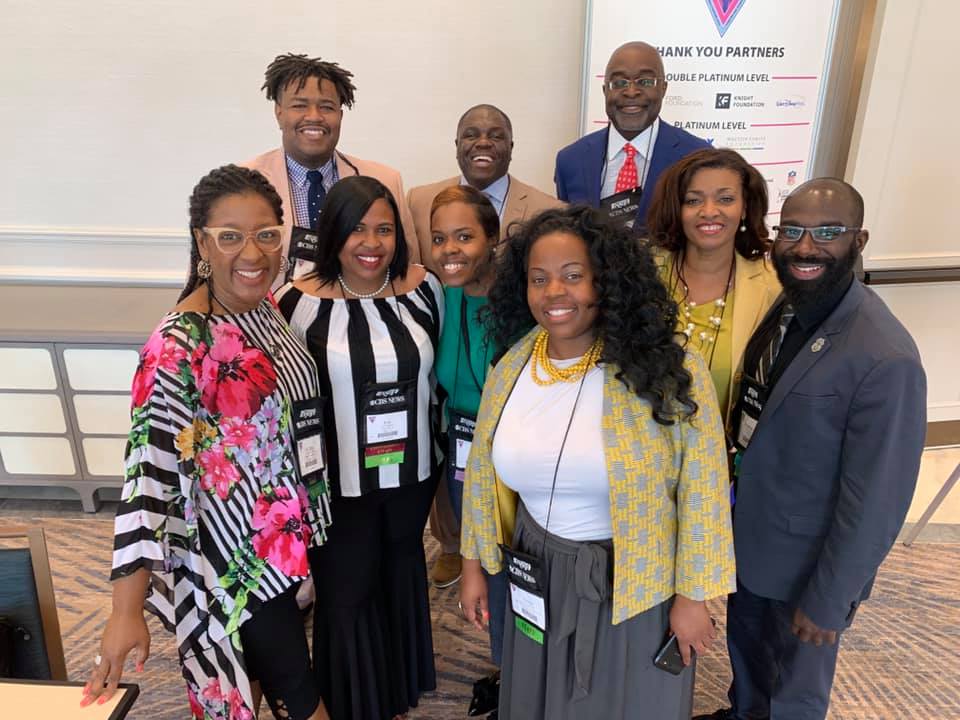
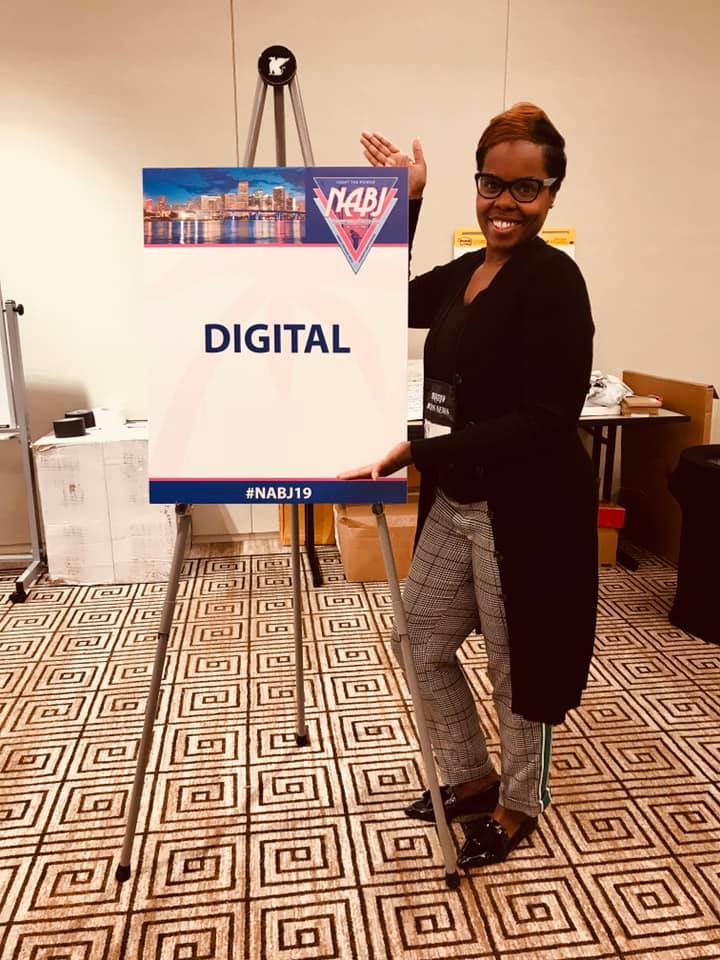
Below are some pictures from the conference provided by various AABJ members.
Fox 5 anchor Marissa Mitchell wins the Salute to Excellence Award
By Craig Allen Brown
Marissa Mitchell holds her NABJ Salute to Excellence Award at the NABJ Conference in Miami, Florida.
Atlanta native and Fox 5 anchor Marissa Mitchell achieved another significant career milestone on Aug. 10 when she won a National Association of Black Journalists (NABJ) Salute to Excellence Award. Mitchell won in the Large Market/Network Radio, Television, Print category for her tribute to soul icon Aretha Franklin.
“When I learned that I
won, I was very honored, and I was humbled,” Mitchell said. “I have been
nominated for Salute to Excellence Awards before, but I had never won.”
“It was very special,” she continued. “I’ve been a member of
NABJ for over a decade now. To have my work recognized by an organization I’ve
supported so much was an esteemed honor.”
Equally important to Mitchell was the recognition received for a memorial on the Queen of Soul. Franklin is considered by many to be one of the world’s greatest singers. She is also hailed as a civil rights and human rights pioneer. Mitchell states that Franklin was more than just an amazing singer, she was an unparalleled embodiment of African-American artistry and humanity.
“[Franklin] was a symbol of pride for so many communities,
particularly the African-American community,” Mitchell said. “To have received
the honor for a piece that I felt honored her was particularly special.”
Upon hearing of Franklin’s passing, Mitchell began conceptualizing what would become the award-winning tribute. She contacted artists who knew Franklin well, such as R&B legend Peabo Bryson and singer Avery Sunshine. These entertainers were able to provide context into what made Franklin such a giant in the worlds of soul, R&B and gospel music. Atlanta-based DJ Frank Ski closed the piece by making an intriguing connection between Franklin’s performances for both civil rights leader Dr. Martin Luther King, Jr. and Barack Obama, as King’s work was certainly influential in Obama becoming the first African-American president.
Mitchell says that the NABJ’s influence on her life and career is
“paramount.” She cites the sense of community within the organization as being
largely responsible for the success that she has had as a professional
journalist.
“NABJ has been my shoulder to lean and cry on throughout the course of my career. This is something I want to be a part of as long as possible.”
Craig Allen Brown is a freelance writer and teacher at Bear Creek Middle School.
AABJ parliamentarian Wilton Jackson wins the Salute to Excellence Award for sports writing
By Breanna Durham
AABJ Parliamentarian Wilton Jackson II
For the second time, Wilton Jackson II has won the Salute to Excellence Award, this time at the National Association of Black Journalists convention in Miami.
Jackson, a six-year member of NABJ and two-year member of the Atlanta chapter, was presented with the award on Aug. 10.
When Jackson was announced as a winner of the award, he admitted he was shocked and quiet, but deep down he was excited. He hadn’t really told anyone he was in the running for the award. Jackson said he hadn’t thought he’d win the award due to hard space he occupied while he was trying to complete his masters at Louisiana State University (LSU).
“Everything that came with that and still trying to do the stories I wanted to, it just happened that that was one of the biggest games in HBCU football … It just meant a lot,” he said. “I’m just grateful and thankful to have won the award.”
In creating a story with context for the battle between the rivals, Jackson went off to gather sources and get closer to his subjects. Jackson said that he went to press conferences and practices, mostly for Jackson State, and spoke to those he knew that attended HBCUs to gather information.
In May, Jackson graduated from LSU and about a month before the convention, he was notified about his NABJ Salute to Excellence nominations.
“I know where I was in my life at that time. It wasn’t the best time in my life because I was frustrated by trying to finish grad school and all the nuances with that, plus trying to do something freelance on the side … That was a great feeling to know somebody read my work,” he said.
Jackson said that he believed that the piece’s combination of feature aspects combined with typical things like stats made the article stand out. Sports reporters at times can get focused on the game alone, Jackson said. He did that when he was younger, but he said that only having the nuts and bolts of things gets boring.
“There’s so many things you can talk about away from the field,” he said. “It’s a culture.You have to include that.”
Jackson won a Salute to Excellence Award for the first time in 2016 for his story, “Tech advances, economy impact trajectory of journalism.” The story covered how technology and the economy was changing the way news was being produced at the time. Jackson said he was a finalist for the Salute to Excellence Award in 2017 as well.
The award is the only U.S. event exclusively honoring exemplary coverage of African and African-American people or issues, according to an NABJ news release. The award showcases stories across a variety of media platforms, having 20 main categories and 120 subcategories.
Breanna Durham is a free lance writer.
AABJ grant winner Amani Patterson explains how the convention changed her life
By Amani Patterson
Amani Patterson poses for a photo at the host hotel for the NABJ conference.
Some say that Disney World is the happiest place on Earth, but many journalists would say it’s actually the annual National Association of Black Journalists convention. Being a part of the NABJ has honestly changed my life. This is the place where your dreams could potentially come true. Thousands come to the ever-changing convention site every year with hopes of networking with the right people and possibly even making life-long friends in the industry. This is also an opportunity to get away from the emotional stress the industry brings and just have fun.
Even though this seems like one big family reunion
every year, it can be quite overwhelming. This was my second year attending,
but the first year after graduating college. Nothing will humble you more than
walking into that career fair. I came with my brand-new portfolio, freshly
printed resumes, and brand-new outfit. I was determined to dominate the career
fair and leave by the end of the week with my first job out of college.
I quickly realized how nervous I was! As a result, I might have self-sabotaged myself just a tiny bit. I found myself downplaying my talents instead of showing recruiters exactly what kind of journalist I am. If I could change anything about my career fair experience, I definitely would have gone in with more confidence. Even though I did not walk away with a job, I definitely networked and made connections with people who work for companies I admire, and of course get my first professional headshot courtesy of Scripps. So in the end, I still consider it a win! Even though this was a trial and error, I now know how to “come correct” next year at the 2020 NABJ Convention in Washington D.C.
Amani Patterson’s headshot
Having fellowship with everyone was my favorite part of the entire experience. I was able to talk with people who had the similar experience and those who were veterans in the industry. I will say that it was kind of weird to be around people that I watch on television. Whether it was at the Tamron Hall luncheon, eating lunch at a table across from Kevin Fraizer, and even taking a picture with Ne-Yo!
I love being a part of something that shows black people in such a great light. We all have faced racism in our lives and have felt like we could not be our full selves. For a week I was able to be unapologetically black and feel comfortable.The convention is not only just business, but at night people were able to let loose and dance all their stresses away. I loved being able to have fun and know that we were all there to have a good time with each other. The mass shootings that happened the week before did make a lot of people in the world uneasy, especially journalists. I personally know a couple of people who decided to skip the convention because of that. It’s a beautiful thing to be able to come together, but more importantly be there for each other. This convention shows how important our work is and that we must continue to report on the things that matter, including tragedies.
Thank you to the Atlanta Association of Black Journalists for believing that I would benefit from receiving their financial assistance grant. Like many of us fresh out of college, it would have been a challenge to scramble the money together to make it to the convention. Knowing that I have a community – both regionally and nationally – that supports me is so comforting. I hope one day I can in return help a student make it to the convention.
Amani Patterson is a recent graduate of Georgia State University.
AABJ grant winner Markayla Brooks wants to take the sports industry by storm
By Markayla Brooks
Markayla Brooks
I can honestly say the National Association of Black Journalists convention changed my life. I am a senior at Clark Atlanta University (CAU) majoring in mass media arts. Prior to the convention I was messaging peers and professionals trying to understand the environment I was about to be immersed in for four days. Everyone spoke highly of the convention and I was excited to get to Aventura, Florida, and network.
It was refreshing to be in a space with people who have similar goals because everyone seemed genuine and eager to offer tips and help in any way.
The workshop I enjoyed the most was “Shooting Your Shot Masterclass” put on by Bleacher Report and Turner Sports. During the workshop there were mini panels about all the careers paths in sports media. My goal is to be in sports media so I really soaked in all the information. Many of the panelists discussed how they started in one place and transitioned to another as they found their passion within the sports realm.
Markayla Brooks and Tyson Beckford
The career fair was overwhelming but exhilarating. I had never been in a space where most of the booths were for me and my career path. There were so many people, so you had to think hard about how to make yourself stand out and ask the right questions. I was always eager to leave my resume and business card with everyone that I spoke with and ask for their business card. Building genuine connections and growing my network was a large goal of mine when I came to the conference. I also appreciate all of the hard work that was put into the career fair. I know for a fact that had it not been for this conference, I would not have gotten an opportunity to speak with some of these companies.
Next year I will do a few things differently, but I am very grateful I was able to attend this amazing conference and see it while I am still a student. While in line for the Sports Task Force party a gentleman shared how happy he was to see me at the conference and how proactive I was because he did not attend his first national NABJ conference until he was in graduate school. My goal in coming to the conference was to build by network and gain self-confidence and get that feeling after the conference that I am ready to go out and take the sports industry by storm.
Markayla Brooks is a senior at Clark Atlanta University.
AABJ extends its condolences to the Edwards family and friends
NABJ and AABJ both extend their condolences, prayers and thoughts to the family, friends and colleagues of Marsha Edwards, Christopher Edwards II and Erin Edwards. Marsha, Christopher and Erin were NABJ members from the Atlanta area. The Atlanta Journal-Constitution reported their deaths in August. The story is available here.
AABJ Online Fundraiser: 43 Years Campaign
AABJ’s $43 for 43 fundraising campaign is still ongoing. In its 43rd year, we are asking members to donate $43 to go towards programming, scholarships, and events throughout the year. Be sure to invite your friends, coworkers and anyone you know that supports our members in print, communications, public relations, radio, broadcast, digital and the many trailblazers in the literary world. Be sure to share our campaign on your social media by using the hashtag #AABJ43.
Instead of the usual newsletter, we asked a student journalist, an early-career journalist and a veteran journalist to write about their experiences at the national convention. Each writer brings a different perspective that we hope not only AABJ members, but all NABJ members can gain guidance from as we all head to Miami in August.
Almiya White heads to NABJ for the first time
Almiya White
I remember walking to class in April when I received an
email alerting me that one of my dreams was becoming reality.
A rush of excitement came over me as I viewed the email. I
worked and prayed for this. “Thankful for this blessing,” were the only words
that came out of my mouth. It’s safe to say the pressure is now on.
I must be honest, I am a little nervous and anxious to work
in a full operating news setting. I’ve heard pros and cons about being a part
of the Student Multimedia Project – the intensity, hardship and reassurance you
receive are like no other. We’ve all
been told nothing in life comes easy, so I want all the pressure.
This year’s convention will also be the first one I’ve ever attended. Sadly, I was unable to attend last year’s convention in Detroit – poor planning on my part.
I remember getting text messages and phone calls from friends and classmates sharing the information, skills and exposure they gained within roughly five days. I also remember stalking NABJ’s social media accounts amazed at the endless opportunities they put together for students and professionals. I might not have been present at the convention, but I like to say I was living vicariously through my friends.
This time around, not only did I want to attend the
convention, but I wanted to be a voice for the convention, so I applied to be a
part of the Student Multimedia Project.
Pursuing a career in broadcast journalism has always been my
No. 1 goal because it allows me to advocate on behalf of underserved
communities and amply unheard voices. I have a duty not only to inform the
public, but to allow audiences to discuss issues that directly affect them.
What I’m looking forward to with the Student Multimedia Project is allowing myself to be vulnerable in a new and uncomfortable setting. As a young journalist, it’s my mission to have the mind and mentality to absorb things freely, whether I’m knowledgeable or not in that area. It’s important that I surround myself with people who can play a pivotal role in my career, go above and beyond and stand out among my counterparts.
Almiya White is a rising senior at Clark Atlanta University.
###
Cierra Johnson provides tips on navigating the national convention
Cierra Johnson at the 2018 NABJ Convention in Detroit, Michigan.
The NABJ convention is considered to be a family reunion for
many journalists. It’s the one time of
year where hundreds of students and professionals travel across the world to
come together to learn how they can be successful in the media and journalism
industry.
During my second NABJ convention last year in Detroit, I participated in a NABJ fellowship called the Student Multimedia Projects. A group of students, including myself, were selected to broadcast daily newscasts for three days. The experience was exciting, intense and fun! I finished the fellowship feeling more knowledgeable of the journalism industry (applications are normally available on the NABJ website in January of each year). It was super inspiring to be surrounded by students who share common passions and mentors who are eager to help you.
Major highlights of the convention included career advice from professionals, a variety of workshops, social events, networking opportunities and the biggest attraction, the career fair. Recruiters offer on-the-spot interviews, internships and jobs. The conventions are super eye-opening and fun!
A memorable tip a panelist said during one of the professional 101 workshops was “it’s not all about the resume, but also about the relationship.”
Take a look at a few tips I learned from previous
conventions:
Be prepared: Be sure to have professional business cards, printed resumes (at least 50), a LinkedIn profile, samples of your work and a 30-second pitch.
Dress appropriately: Wear business attire for the career fair and workshops. Neutral colors are safe. Recruiters are everywhere, and you want your attire to be appropriate at all times.
Clean your social media: Be sure your social media handles and posts are appropriate. Recruiters are looking! If you are not certain your account is appropriate, do not be afraid to reach out to a NABJ member or mentor to ask their opinion.
Network: You will meet a ton of students, professionals and recruiters. Take the initiative to start a conversation and exchange contact information. Remember, building relationships is key.
Be safe and smart: Have accountability partners during the convention. There will be plenty of social events in and outside of the host hotel. Do not travel to places outside of the host hotel without telling someone where you will be and for legal attendees, please be mindful of the amount of alcohol you choose to have.
Follow-up email or thank you card: Follow-up emails or thank you cards are a memorable gesture to the people you meet at the convention. It is highly recommended!
Cierra Johnson is a programming assistant and producer at AIB-TV (Atlanta Interfaith Broadcasters).
###
Craig Brown explains how to prep for interviews
Cierra Jones and Craig Brown at the 2018 NABJ Convention in Detroit, Michigan.
The National Association of Black Journalists convention, from what I’ve seen and what I’ve experienced, can be either an extremely rewarding event, or a very disappointing (and costly) experience.
As I prepare for my third
convention, I find myself reflecting on past experiences, and on ways that I
could have made my time there more gratifying. I’ve realized that proper
preparation is a very important component in making the NABJ convention as
fulfilling as possible. I’d like to share some ideas that may prove helpful as
you prepare for the convention.
Your reel is a
reflection of you
Make your reel look
and sound as professional as possible. The goal is to stand out from the many
others who are trying to secure the same position. Your reel is a reflection of
your abilities as a journalist. If a subject appears too dark, if the sound
fluctuates or if your reel ends abruptly in the middle of a stand-up, this
could affect your chances of being hired.
Be prepared for
anything during an interview
Go beyond the obvious in preparing for interviews. During an interview I had with ESPN the Magazine last year, I was asked the following questions:
Who are your five favorite sports journalists, and why?
Who is your favorite author and/or poet?
What is the most compelling article you’ve read in the last six months?
Those questions were not what I expected, and more
importantly they indicated that I needed to be doing more to stand out in an oversaturated
journalism field. So, in order to separate yourself from the competition, work
on your craft daily. Study your favorite journalists and determine what makes
them so good. Look to add similar qualities to your own skill set.
Make sure you have
all your materials for an interview
Have resumes, business cards and clips of your best work
with you when you’re in front of an interviewer. Ensure that you take notes and
ask questions. If you are able, take a tablet with you so interviewers can
watch your reel immediately. Otherwise, ensure that all of these items are
uploaded to your website.
Know who is doing the
hiring
Connect with hiring managers. Build relationships with those
who actually do the hiring. Contact them prior to the convention, send them a
resume and let them know what you are capable of.
Remember there’s
always someone watching
Be personable, approachable
and professional at all times. At the parties, dance and have a good time, but
I suggest you don’t start “twerking” or “backin’ that thing up.” You can never
be sure of who you might encounter as your career progresses (or regresses).
Be able to take
constructive criticism
Lastly, have thick skin. You are going to be told that you
need more experience. Some journos will not have time to talk or take a selfie.
Do not let that affect your confidence. Trust that while you may not be a good
fit for one organization, you are exactly what another station is looking for.
Hopefully, these tips will aid you in having a fun and
productive time in Miami. I look forward to seeing you there.
Craig Allen Brown is a freelance writer and teacher at Bear Creek Middle School.
###
AABJ documentary nominated for NABJ’s 2019 Salute to Excellence Awards
The AABJ documentary “Black & Reporting: The Struggle Behind the Lens” has been nominated for an NABJ Salute to Excellence Award at this year’s convention.
NABJ’s Salute to Excellence Awards ceremony highlights the work of media organizations and individuals involved in print, broadcast and online journalism, marketing and communications. It is the only event in the U.S. that honors exemplary coverage of African/African-American people or issues exclusively, according to NABJ’s website.
Be sure to get your Emmy Award-Nominated copy of the AABJ.
Proceeds go to AABJ’s Xernona Clayton Scholarship Fund .
Anyone who wants to watch the entire documentary can buy it for $9.95 here.
###
AABJ Online Fundraiser: 43 Years Campaign
AABJ’s $43 for 43 fundraising campaign is still ongoing. In its 43rd year, we are asking members to donate $43 to go towards programming, scholarships, and events throughout the year. Be sure to invite your friends, coworkers and anyone you know that supports our members in print, communications, public relations, radio, broadcast, digital and the many trailblazers in the literary world. Be sure to share our campaign on your social media by using the hashtag #AABJ43.
We are at the halfway mark of 2019, and we have accomplished so much! First, if you haven’t heard, AABJ’s documentary, “Black & Reporting: The Struggle Behind the Lens,” has been nominated for an Emmy! We are proud and extremely excited about this. Thanks to AABJ member, Donell Suggs, the documentary is in the June edition of Atlanta Magazine. If you have not purchased your copy, please do so today. The monies go toward AABJ’s Xernona Clayton Scholarship Fund.
I want to thank each of you for your support thus far, but we still have more to do this year. We are planning more workshops, community service projects, and fundraisers we need your help to make work. We also need volunteers to help with our newsletter, The Byline and our public affairs show, In Contact. In the coming month, we’ll be sending out a proposed revision of our bylaws. It’s been over ten years since they’ve last been updated. We will be voting on adopting them later this year.
Speaking of voting, if you or anyone you know have some interest in leading this organization, now is the time to begin thinking about a leadership role. Our term will end this year with elections slated to take place in November 2019. The nomination process will start in September.
Yours in service,
Carol M. Gantt
President
###
AABJ Online Fundraiser: 43 Years Campaign
AABJ’s $43 for 43 fundraising campaign is still ongoing. In its 43rd year, we are asking members to donate $43 to go towards programming, scholarships, and events throughout the year. Be sure to invite your friends, coworkers and anyone you know that supports our members in print, communications, public relations, radio, broadcast, digital and the many trailblazers in the literary world. Be sure to share our campaign on your social media by using the hashtag #AABJ43.
(L-R): AABJ Parliamentarian Wilton Jackson, Glenn Marshall, Eric Ludgood, Drew Dawson, AABJ President Carol Gantt, Collie Burnett, Eric Burns, Tolly Carr and AABJ VP of Print Amir Vera
Kendall “Kenny” Murray walked into a room of six black men working in media, unsure of how to approach them and nervous about how they would react to him.
“Unfortunately, I just automatically assumed that they were going to be standoffish, that they were going to be intimidating to talk to, not necessarily the kindest people,” the junior at Georgia State University said.
That assumption, Murray said, was broken once he sat down with the six men during 10-minute sessions.
Kendall Murray (left) speaks with Eric Ludgood, assistant news director at WAGA-TV, during the Black Male Media Project June 1, 2019.
Discussions about the representation of black men in the media were all part of the Atlanta Association of Black Journalists’ (AABJ) Black Male Media Project on June 1.
The event featured six guest speakers who discussed how they earned their management positions where they can make decisions on how black men are represented. It also featured a tour of WSB-TV led by former NABJ President Condace Pressley.
The event was part of a larger project, mandated by the National Association of Black Journalists, designed to help change the narrative around the lives and images of black men in the news and in society through a series of workshops nationwide.
Drew Dawson, station manager at Georgia Public Broadcasting (GPB) speaks with a guest during the Black Male Media Project on June 1, 2019.
Drew Dawson, one of the guest speakers and station manager for Georgia Public Broadcasting, told Murray that it’s common to see news executives, directors, producers and other people who aren’t black in management approach stories, editing and decision-making from a eurocentric point-of-view. As one pitches stories, he said, the point is to take ownership of stories that are about your community.
“Your job is to position that story in such a way that will appeal to more than a black audience,” Dawson said.
But, Dawson also told Murray that one must watch for the “otherization” of minority groups.
“Sometimes, you’re going to be the only black person in the room, but it’s your job to find a way, before that story gets on the air, to say ‘this is what that looks like,’” Dawson said. “Why are we telling the story this way? Are we trying to demonize someone?”
Eric Ludgood, another one of the guest speakers and assistant news director for Atlanta Fox affiliate WAGA-TV, told Murray he had to be passionate about his work in order to truly succeed.
“I can teach you how to write. I can teach you how to produce. I can teach you how to report. I cannot teach you to care,” Ludgood he said. “But if you care, all that teaching is much easier. Care and want to tell stories about what you care about.”
Murray said it can be scary and hard overall to try to get your foot in the door and understand the information.
“If you talk to 10 different people, you’ll get 10 different stories about how they got where they got to,” said Tolly Carr, one of the guest speakers and a managing partner for HBCU Gameday. “Have you thought about doing anything original just on your own?”
Carr started in TV and did stories he knew would never be on air. He wrote them like they were real and gave them to news directors. Over the course of a couple of months, Carr said he wore down the director to accept his work.
“Even though it’s not given to the masses, that’s still experience under your belt,” he said.
Each interaction with the panelists ended with encouragement and connections made. By the end, Murray said he felt like he was talking to his professors and mentors. The conversations he had, which let him peek into different experiences, showed him kindness and demonstrated success through hard work. It was what he needed, Murray said.
“Everybody here, even though they accomplished so much, they were so approachable,” Murray said.
Ludgood, in particular, had told Murray it was OK to want dreams and that Murray could make them come true.
Murray aspires to write for television.
“Trust yourself,” Ludgood said.
Murray held onto that message.
“He showed me that you can be yourself,” he said.
For those who were unable to make it, take a look at the June 1 event through the gallery below:
Breanna Durham is a free lance writer and staff writer at The McDuffie Progress
What do you like most about being a member of AABJ?
I love the community and the mentorship opportunities.
What initially got you interested in the media/communications field?
My church back home runs a summer camp all about multimedia where I was able to get my hands on video and editing software at a young age. I’ve been all about media ever since.
What are your favorite publications/outlets to get your news?
I like to start the day with the daily podcasts from NYT, BBC, and others. I also keep up with AP alerts for breaking news updates. For perspective content, I think NPR does a great job.
The narrative of Black men in the media needs to change, in more ways than one. There are plenty of Black faces in front of the camera. Now is the time to have the discussion about the faces behind the camera. Who are the people making decisions about which stories are being told and how? AABJ will tackle this subject on June 1, 2019. This year’s focus for the Black Male Media Project is “Becoming a Gatekeeper.” We’ve invited six panelists in different decision-making roles to share how they landed their job, the impact it has caused, and how can we get more Black men involved in decision-making roles. This project was designed to help change the narrative around the lives and images of Black men in the news and in society, with a series of workshops nationwide to be held on Saturday, June 1, 2019. Participating NABJ chapters will promote the project – which is open to anyone who is passionate about this movement – using the hashtag #InspireBlackMen
After all, who’s best to tell the stories of Black men? Other Black men. Here’s a look at some of the guest speakers for this year’s event:
Tolly Carr Managing partner for HBCU Gameday Eric Ludgood Assistant News Director for Fox 5Collie Burnett President and CEO of AIB Network
Glenn Marshall Producer for Will Packer’s “PowerStarLive”
Drew Dawson Station Manager for Georgia Public Broadcasting
Not pictured Eric Burns, vice president of content production and sports at Georgia Public Broadcasting.
AABJ’s $43 for 43 fundraising campaign is still ongoing. In its 43rd year, we are asking members to donate $43 to go towards programming, scholarships, and events throughout the year. Be sure to invite your friends, coworkers and anyone you know that supports our members in print, communications, public relations, radio, broadcast, digital and the many trailblazers in the literary world. Be sure to share our campaign on your social media by using the hashtag #AABJ43.
Andrew Gillum, former Florida gubernatorial candidate, to be keynote speaker at CAU commencement
Andrew Gillum
By Camille Taylor
Andrew Gillum, former Florida Democratic gubernatorial candidate, will be the keynote speaker at Clark Atlanta University’s 2019 commencement May 19. Gillum ran a high profile campaign with celebrities and public figures.
“We need a speaker who can reach the students, not only emotionally but mentally,” said Dr. Margaret Spriggs, CAU chair of ceremonials. “This year at our commencement we want the students to know that they have a responsibility to uphold and to leave them with an example of how to lead in the future.”
Most of the time, high profile figures have calendars that needs to be adjusted at least one year in advance, and the committee at Clark was able to confirm Andrew Gillum within weeks of them reaching out.
“Our students are worth a leader who connects with their audience and Andrew Gillum provides that,” Spriggs said.
Last year, Don Lemon gave the keynote address for the class of 2018 and left the students with a message to “be aware of your environment.”
Camille Taylor is a sophomore at Clark Atlanta University
###
Be sure to buy the AABJ documentary “Black and Reporting”
Get your Emmy Award-Nominated copy of AABJ’s Documentary, “Black & Reporting: The Struggle Behind the Lens.”
Proceeds go to AABJ’s Xernona Clayton Scholarship Fund .
Anyone who wants to watch the entire documentary can buy it for $9.95 here.
###
Southern Fried Queer Pride: An Organization Making Space for Queer People in the South
By Breanna Durham
Starting initially as a PRIDE event first held in 2015, Southern Fried Queer Pride (SFQP) expanded into a full non-profit organization dedicated to showcasing queer and trans art, advocacy, and community building in Atlanta and abroad.
According to The Williams Institute, over 260,000 adults live in Georgia, 37 percent of them are African American. SFQP is one of multiple groups in Georgia working on LGBTQ issues and bringing this community’s stories and skills into the light.
Every month, members of SFQP gather together on the third Sunday to plan events, create programming and brainstorm ideas. The group has no dues, fees or prerequisites to become an organizer to these events.
Besides their two festivals, one in June in Atlanta and one in May in the Durham, North Carolina, the organization holds monthly events. Those events range from workshops and skill-sharing to productions and discussions. In their Southern Fried Forums (SFF), for example, they hold an open, community discussion around challenging topics like intimate partner violence and racism in the queer community. Their Cinequeer Film Series event features films directed, written and/or starring and centering queer and trans people of color. In March, they showed “America In Transition,” a documentary about social change from the perspective of trans people of color. They also have a seasonal music and art showcase spotlighting queer and trans people of color(QTPoC) called CLUTCH.
According to their website, the organization expects to open a space to hold events events and art exhibits and to have a resource center, potentially including a coffee shop, by 2020.
Breanna Durham is a free lance writer and staff writer at The McDuffie Progress
###
Member Spotlight: Cierra Johnson
Current position in AABJ?
Student member
How long have you been a member of AABJ?
Since July of 2017
Where did you attend college?
Clark Atlanta University; Class of 2019; B.A. in Mass Media Arts with a concentration in Journalism
How long have you lived in Atlanta?
Born and raised! 23 years
Current Occupation?
Programming Assistant and Producer at AIB-TV (Atlanta Interfaith Broadcasters)
What do you like most about being a member of AABJ?
I appreciate the mentorship that is provided. There have been many networking opportunities provided by AABJ and, from my experience, I have met members who have been intentional about remaining in touch with me and guiding me on my career and personal path. In addition to, I appreciate AABJs dedication to helping students with scholarships. Though I am no longer in college (as of recently), I will never forget when AABJ funded my trip for my first NABJ convention in 2017 and ensured I was given tips on how to have a successful experience at the convention.
What initially got you interested in the media/communications field?
As a child, I watched Monica Kaufman Pearson, a former anchor for WSB-TV, and I was inspired by how confident and well she was able to broadcast news. I knew I wanted to tell great stories and have a strong presence as an African American on camera. I also loved how visually appealing a news story could be, therefore I practiced graphic design, editing and anchoring each chance I could.
What are your favorite publications/outlets to get your news?
Director and screenwriter Ava DuVernay is someone in media I look up to. Her genius ability to highlight the real-life struggles and triumphs African-Americans face and her compassion for community inspires me to create programming that is true to people’s experience. I also look up to her because she welcomes opportunity for women directors to have a chance to direct her shows – she does not only seek creativity from her own mind.
What’s an interesting fact about you people wouldn’t have otherwise known?
I am a former volleyball player, and I still enjoy playing in my community. I am a great defense player! (People would not expect, because I have a quiet, reserved personality)
This year’s conference for Region III took place in Birmingham, Alabama, April 5-6. AABJ President Carol Gantt attended the conference, as did many AABJ members including Fox 5 anchor/reporter Kerry Charles and CNN digital trending news writer Doug Criss. Here’s a look back at the conference in historic Birmingham.
Learning to serve while being great
By Louis Deas
Eldredge Washington
“Everybody can be great because everybody can serve,” Dr. Martin Luther King Jr. once said.
But how many of us can serve while being great?
We’re all striving to be great. However, Atlanta resident Eldredge Washington, 29, has proven that in the midst of striving for personal greatness, there’s still time to give back to others through volunteerism, activism, and service.
As the founder of a non-profit Motivated Adults Developing Excellence (M.A.D.E) and co-founder of the startup tech company Spendefy, Washington has navigated multiple layers of the social sphere. Despite his accomplishments he’s as humble as he is charismatic and constantly thinks of others before he thinks about himself. A man of character and integrity, he has unwittingly positioned himself as a role model for everyone seeking to serve while being great.
A native of Monroe, Georgia, Washington has become a part of the fabric and inner-workings of Atlanta’s entrepreneurial and social good communities. Launching his youth empowerment organization, M.A.D.E, when he was only 17 years old, he sought to transform the lives of others by actively promoting cross-generational interaction and dialogue between adults and youth through mentorship.
“Just seeing the everyday impact of sitting down and talking with students, letting them know you care and that you’re available gives you that ‘wow’ feeling,” Washington said. “More important than the feeling, though, is seeing their lives change for the better.”
Full of life and bubbling with subdued energy and excitement, Washington has a magnetic draw that attracts people into his orbit and inspires them to serve in their own way on some level.
“People want to give back to their community, but many times don’t have time and don’t know how. I help them see that there’s no shortage of ways and more than enough opportunities to make an impact,” he says.
Years spent as a nonprofit leader has taught Washington that while service is good, the community is best served when good hearted people with decision making and economic power can be counted as true allies. Motivated to become such an ally and have an even greater impact for the African-American community, Washington and his co-founder, Antwon Davis, launched Spendefy — a web based application designed to promote black businesses and to dare its users to “spend different”.
“Spendefy is just an outgrowth of my passion for community and sustainable transformation,” Washington said. “When we strengthen the power of the Black dollar and support each other on the grassroots level, we can begin to see real changes from the bottom up.”
Eldredge Washington
In addition to mentoring students, leading social change in the neighborhoods and building socially minded businesses, Washington is active in his local church and engages with other civically minded groups who share his same vision for community uplift.
“It’s easier to go it alone to get all of the glory, but we have a greater chance of success and can touch more lives when we pool our resources, talents, and connections to achieve the greater good,” Washington said.
Washington’s daring to put his community first has inspired countless people — young and old alike — to envision greatness for themselves through service and entrepreneurship. His journey is just beginning, but he’s proven to be a true leader dedicated to uplifting his community through mentorship, financial empowerment, and community activism.
Louis Deas is the founder of Assured Hope
AABJ Online Fundraiser: 43 Years Campaign
AABJ’s $43 for 43 fundraising campaign is still ongoing. In its 43rd year, we are asking members to donate $43 to go towards programming, scholarships, and events throughout the year. Be sure to invite your friends, coworkers and anyone you know that supports our members in print, communications, public relations, radio, broadcast, digital and the many trailblazers in the literary world. Be sure to share our campaign on your social media by using the hashtag #AABJ43.
When it comes to students’ senior year of college, there tends to be a gap between the campus environment and “the real world.” Every student fears whether he or she is prepared for the opportunities that typically won’t fall in their lap when they’re not a student anymore.
There is the also the question whether the institution the students attended prepared them for the “real world.” Some students blame themselves for not taking advantage of opportunities presented to them.
“Clark gives you a glimpse into the real world and doesn’t hold your hand … That’s how the real world is,” said Frank Jefferson, a senior at Clark Atlanta University.
Each institution sometimes held career fairs where students are able to meet professionals for potential internships that could turn into a job in the student’s interested field.
Students could also join organizations that put them in the position to network with professionals or an outside organization where students can get hands-on opportunities.
“My best advice would be to seek out the opportunities yourself, be assertive but not aggressive and follow up with those who you have connected with over the past few years in college,” Nailah Heard a Senior at Clark Atlanta University said.
Ultimately students want to feel fully prepared for life after college. Professionals say “that is when the hard work begins.”
Mariah Hill is a junior at Clark Atlanta University
Member Spotlight: Ray Metoyer, past AABJ president
Ray Metoyer
Current position in AABJ?
Technically I don’t have a current position in AABJ, but I’m a very active member. I am a past AABJ President, who served from 2005-2008. During that time, I was blessed to be the President when AABJ hosted the NABJ convention in 2005 and AABJ/Atlanta did an amazing job.
How long have you been a member of AABJ?
I’ve been a member of AABJ since 1994, right after I relocated here to be an anchor/reporter for WGNX, which is now WGCL. My membership in AABJ is connected to my membership in NABJ, where I served on the NABJ Board from 1989 to 1991. I was a chapter president in Denver and my hometown of Omaha.
Where did you attend college?
I graduated from the University of Nebraska/Lincoln where I majored in journalism.
How long have you lived in Atlanta?
I’ve lived in Atlanta since 1994 and I continue to work as a journalist.
Current Occupation?
Currently I’m the managing editor for Georgia Public Broadcasting’s “Lawmakers” program, covering the legislature when it’s in session. The rest of the year I work on freelance projects. I started my career in broadcasting in Omaha before moving to Denver, Little Rock, Houston, Dallas and Atlanta, both in front of and behind the camera.
What do you like most about being a member of AABJ?
Being a member of AABJ is important because our voices need to be heard in Atlanta. The diversity of media people here is the direct result of the push for change by NABJ/AABJ. It is our job to point out issues that need to be corrected, including how our communities are covered by mainstream media. Questions we have raised locally and nationally have made a difference in changing unfair practices, but we can never let up. Bad habits, lazy reporting and cultural arrogance in coverage have a way of coming back and we have to be there waiting.
What initially got you interested in the media/communications field?
I was always fascinated with television production and storytelling. I got my first introduction to TV while in high school. I joined a Junior Achievement company, run by a local Omaha TV station, WOWT-TV, where we produced our own programs. When I was a sophomore in college, I was hired part time by that station, working summers as a reporter/photographer, before being hired full time after I graduated. Starting as a photographer made me a better storyteller because I learned to see each story through the lens of the camera.
What are your favorite publications/outlets to get your news?
I watch and read media every day, CNN, MSNBC, local news, PBS, AJC, and the NY Times to name a few. I’m fascinated by great storytelling and how things are produced and that includes movies, documentaries and special programs.
Is there anyone in media you look up to? Why?
Former CBS 60 Minutes Correspondent Ed Bradley remains one of my biggest heroes because he was such a trailblazer in the industry and he commanded respect. I also respect ABC’s Robin Roberts because of her bravery in fighting cancer, while maintaining a high level of professionalism in her lead role on Good Morning America. She brings great JOY to her work and shares it every day.
What’s an interesting fact about you people wouldn’t have otherwise known?
Most people don’t know I’m a musician; a percussionist since high school. I’ve produced the music and soundtrack for three documentaries. In 2018 I created the music for a new TV program called “Secrets of the Caribbean,” which is currently being distributed on smaller TV networks and online. Creating music and the atmosphere for TV programs and productions is also an important part of storytelling!
This edition of the Byline was edited by Amir Vera and Shalon Bell
AABJ is kicking off our $43 for 43 fundraising campaign. In its 43rd year, we are asking members to donate $43 to go towards programming, scholarships, and events throughout the year. Be sure to invite your friends, coworkers and anyone you know that supports our members in print, communications, public relations, radio, broadcast, digital and the many trailblazers in the literary world. Be sure to share our campaign on your social media by using the hashtag #AABJ43.
AABJ honors Black media trailblazers at film screening
By Amir Vera
Some of the first reporters and anchors in Atlanta pose for a photo on February 9, 2019.
Until late 2018, there hasn’t been an organized record of the first black journalists in Atlanta.
There was no record of the challenges they faced unless it was by word of mouth.
The Atlanta Association of Black Journalists changed all that. In the span of two years, a lot of volunteer hours and countless interviews, members of AABJ organized all of that history to create a film dedicated to these stories.
“Black & Reporting: The Struggle Behind the Lens” is a firsthand account that charts the paths of 10 Atlanta broadcast pioneers. The organization held a screening in December during its annual scholarship reception and then again on February 9.
The February event featured eight of the 10 pioneers for a post-screening discussion on their experiences, the current state of journalism, it’s future and tips for young journalists.
“It took AABJ to tell the stories of the first black journalists,” said Collie Burnett, a former reporter at WSB Radio and one of the panelists, adding that major and local networks are just covering rappers, athletes and business leaders.
“Only when you control the means of distribution do have the capacity to tell the stories that need to be told and make a difference.”
AABJ Vice President of Print Amir Vera interviews Lorenzo “Lo” Jelks, the first black reporter in Atlanta, after a screening of “Black & Reporting: The Struggle Behind the Lens” on February 9, 2019.
Lorenzo “Lo” Jelks, the first black reporter in Atlanta, came to WSB in the late 1960s. He said he enjoyed the documentary screening and couldn’t wait to see the finished product. He also said he hopes viewers really understand not only the experiences of the trailblazers, but also “the pride associated with African Americans in the media.”
Jocelyn Dorsey, another trailblazer and former anchor/reporter at WSB-TV, spoke to that pride saying her fellow reporters helped her learn about the city. She even described some of the other trailblazers as brothers and sisters.
“There was a community movement, a civil rights movement that got us on the air,” Dorsey said. “We knew if we screwed up, it’d be difficult for another black person to take our place.”
Kerry Charles, a reporter and anchor at WAGA Fox 5, said watching the “more than 300 years of experience in the panel” was inspiring.
“They opened the door for me to have a voice in my newsroom and in the community.”
Cierra Johnson, a senior at Clark Atlanta University, was almost brought to tears during the panel.
“I tried not to cry because I really appreciate journalists that came before me,” she said. “Just watching them take the time to give their wisdom so I can excel, it made me feel no matter what I face in this industry I can get through it because they’re still here.”
Anyone who wants to watch the entire documentary can buy it for $9.95 here.
Amir Vera is AABJ’s vice president of print.
Editor’s Note: The Atlanta Association of Black Journalists would like to pass their condolences to the family of Civil Rights leader Lonnie King Jr., who died Tuesday at the age of 82.
###
AABJ member reflects on volunteering for Super Bowl LIII
By Almiya White
AABJ member Karvis Jones volunteered during Super Bowl LIII.
With a passion for service, FOX Sports South’s very own production assistant Karvis Jones found time to give back to the city that once welcomed him with open arms.
When Jones found out Super Bowl LIII was coming to Atlanta, he didn’t hesitate to sign up as a volunteer and demonstrate his southern hospitality.
“I think the biggest incentive of being a volunteer is to help raise Atlanta’s
profile as a city that continues to show the world that it can host some of the world’s biggest sporting events, as well as show the nation how diversity continues to make Atlanta a special place,” Jones said.
According WXIA-TV, more than 30,000 people applied and interviewed to be volunteers with the Atlanta Super Bowl host committee and only 10,000 were chosen.
“I found out that I was selected as a volunteer via e-mail. I was really excited when I got the news that I got selected because with the record number of applicants who applied to be volunteers, I knew I had a one-third shot of making the cut.,” Jones said, adding that the first person he told was his wife, Carrisa Jones.
“Volunteers spent two hours in training leading up to the Super Bowl where they learned the area around the Super Bowl campus, how to greet fans and how to report suspicious activities. The Super Bowl host committee spoke heavily on the topic of sex trafficking being that Atlanta is a hub for sex trafficking nationwide,” Jones said.
Jones was selected to serve on the street team where he said he welcomed visitors and gave directions to all of the must-see places in Atlanta. Jones said he worked three days out of the 10 days surrounding the Super Bowl.
“The culture of the Street Team was very friendly. The Street Team gave fans materials on how to get to the NFL Experience at the Georgia World Congress
Center, as well as Super Bowl LIVE at Centennial Olympic Park. The Street Team also helped fans find hotels, restaurants, the closest MARTA rail station and places around downtown Atlanta such as the King Center, the Sky View, the World of Coke and the National Center for Civil & Human Rights.” Jones said.
Volunteering for the Super Bowl didn’t guarantee tickets inside the game. However, volunteers were able to experience any and everything else by being in the heart of the action with events like Super Bowl Live and anywhere the game left its footprint. It was all to assist the 250,000 guests, WXIA-TV reported, who came to the city without even having an actual ticket to the game.
Not only were volunteers able to give back to the community, but they were able to do it in style. According to The Atlanta Journal-Constitution, the Super Bowl Host Committee provided 10,000 volunteers with uniforms from The Icebox, an Atlanta apparel and merchandise agency. Jones said the uniforms consisted of six cool swag components that included a jacket, a beanie cap/baseball cap, gloves, a polo shirt, scarf and a book bag.
According to The AJC, more than 500,000 people came to Atlanta, including 150,000 out-of-state visitors to experience Super Bowl LIII and the numerous events.
With two Super Bowls already in Atlanta, Jones said “we’re the city to show the world what we have to offer. We made history hosting Super Bowl LIII in Atlanta.”
Not only that, but Jones said volunteering for the Super Bowl was his way of giving back to the community that welcomed him with open arms when he moved to the city in 2006.
“I love serving people around the community and I believe when you serve others, it makes the world a better place to live as global citizens,” Jones said.
Almiya White is a junior at Clark Atlanta University.
###
Women’s History Month: Inventions by Black Women
By Ashlea Brown
Women’s History Month takes place every March. According to the United Nations’ website, the first National Woman’s Day was February 28, 1909, in the United States. From there it grew internationally in 1910 during a meeting in Copenhagen, Denmark, for a conference with over 100 women in attendance who decided there should be a Women’s Day to honor the movement for women’s rights and support for women’s suffrage, the UN website states. In 1913, the International Women’s Day website states it was established that March 8 would remain the global date for International Women’s Day. In 1981, Congress passed a resolution that authorized Women’s History Week that began on March 7. However, after much petitioning by the National Women’s History Project in 1987 the Women’s Week turned into Women’s History Month that is celebrated in March, according to the federal Women’s History Month website.
Women have made major contributions throughout history by being actresses, writers, activists and inventors. Every day, people encounter inventions made by black women that they may overlook.
Here is a list of women who have invented items you may have not known.
Patricia Bath
Patricia Bath was the first African American to complete residency in ophthalmology in 1973 according to biography.com. She invented the Laserphaco Probe for cataract treatment in 1986. This device is used to remove the cataracts, or cloudy blemishes formed over the lens of a person’s eye. She was able to restore the vision of several people who were unable to see prior to her invention.
The blue print of the closed-circuit television system that was used for home monitoring.
When people think about their modern home security, people can thank Marie Van Brittan Brown. She invented an early closed-circuit television system that was used for home monitoring and filed for patent for the invention in 1966 according to the history website America Comes Alive. Brown was influenced to create this security system, the website states, because of concern for crime and slow response from police. She was also influenced to create this security system so that she could identify those surrounding her home, America Comes Alive states.
Annie Malone
Annie Malone was a chemist and entrepreneur who became one of the country’s wealthiest African-American women in the early 1900s, according to the State Historical Society of Missouri. Malone developed a hair product that straightened black women’s hair with damaging it, the historical society states on their website. Malone moved her business to St. Louis in 1902 where she began selling a safe hair care for people of color. She went on to open the cosmetology school and training center known as Poro College in St. Louis in 1918, according to the historical society. Despite Malone’s success, the historical society says she is often overshadowed by a former employee, Madam C.J. Walker.
Mary Kenner
Mary Kenner invented the sanitary napkin with moisture-proof napkin pocket according to the Black History website Black Then. Her invention was a safer and much cleaner way for women to handle their menstrual cycles. However, her invention was not used until 1956, which was thirty years after she invented it. The company first interested turned her invention down once realizing she was black. She also invented the bathroom tissue holder and back washer, according to Black Then.
Sarah Boone earned patent rights to her improvements of the ironing board in 1892 according to the reference website ThoughtCo. Her new and improved invention led to better quality of shirt sleeves and women’s garments. Her new board, according to ThoughtCo, was narrow and curved which was a nice size to fit sleeve and women’s clothing. She stated in her patent application that the purpose of her invention was to “produce a cheap, simple, convenient and highly effective device, particularly adapted to be used in ironing the sleeves and bodies of ladies’ garments” according to biography.com.
Ashlea Brown is a senior at Spelman College.
A previous edition of this article had the incorrect picture of Marie Van Brittan Brown. That photo has since been replaced.
###
AABJ Member Spotlight: Kamaria Jackson
AABJ member Kamaria Jackson
How long have you been a member of AABJ?
I have been a member of AABJ for 2 years now.
Where did you attend college?
I attended Clark Atlanta University (CAU) for undergrad in which I obtained a degree in Mass Media Arts, concentrating in Television Production. I also obtained my Masters Degree in New Media Journalism from Full Sail University.
How long have you lived in Atlanta?
I’m a homegrown Georgia Peach, and have lived in Atlanta my entire life!
What is your current occupation?
I’m currently a video playback operator and trainer at the Mercedes Benz Stadium here in the heart of downtown Atlanta. I import and organize videos and clips for playback during live events such as Atlanta Falcons, as well as Atlanta United games. I’m also an educator in the Dekalb County School District.
What do you like most about being a member of AABJ?
AABJ is a great organization that connects media professionals, new and seasoned. I particularly love the fact that college students are encouraged to join as well, giving them early exposure to the industry by offering programs, conventions, and workshops that provide the necessary skills essential to being successful in the media field. AABJ has allowed me to reconnect with some of my fellow CAU alumni and build professional relationships through organized fellowship and networking.
What initially got you interested in the media/communications field?
For the majority of my childhood I had the goal of becoming a pediatrician. It wasn’t until I reached my junior year at Stephenson High School, that I actively became a member of the Production Department (JAG 8 News). There, I first learned how to operate a camera and edit via Casablanca. My teacher pulled me aside and noted that I had a great speaking voice, and should encourage me to audition for the JAG 8 news anchor position (which were the anchors who hosted school morning announcements and other school productions.) I auditioned and received the role. Upon further research on perfecting my TV presence, I was inspired by Atlanta native and popular local news anchor, Monica Kauffman, who had attained notable accolades as a journalist. From then on, I just knew that the media production industry was for me. Nothing beats having fun while loving what you do professionally!
What are your favorite publications/outlets to get your news?
Because I think it’s very paramount to know what’s going on in my community, local news is very important to me. I support all of the local stations in Atlanta, but in particular WSB-TV and well as FOX 5; in which I was afforded the opportunity to “job shadow” popular news anchor Lisa Rayam my junior year in high school.
Is there anyone in media you look up to? Why?
With the mass media field being a male-dominated industry, I’m inspired by all of the women who have paved the way for me to not only be a successful woman, but successful black woman in this fast paced industry. On many of my production-related social media posts, I love to represent by using the hashtags #BLACKWOMENINPRODUCTION, #BLACKGIRLMAGIC and #PRODUCTIONCHICKSROCK, giving distinct notoriety to the women who “blaze” the industry daily with fierceness, style, and grace.
What’s an interesting fact about you people wouldn’t have otherwise known?
Most people don’t know that I possess many talents. I play two instruments (clarinet and bass clarinet), I am a dance instructor and baton twirler, specializing in fire baton twirling. I’m also a freelance sketch artist. Most importantly, I am a mother to the best 10 year-old son I could have ever prayed for! He is the reason why I strive so hard for success everyday. Mommy loves you Kamden!
I want to take a moment to personally thank each of you for a productive and profitable 2018! It is my pleasure to inform you that in 2018 we were able to bring in nearly 11-thousand dollars in revenue through sponsorships (Georgia Power), events & membership dues. Our partnership with AIB Network provided us with approximately 40-thousand dollars of in-kind services to produce our TV show, In Contact and our documentary, “Black and Reporting: The Struggle Behind the Lens.”
Cecil Hannibal sits at the anchor desk in WSB-TV’s newsroom. He was a spring intern with the station and pitched an investigative story that made it on air. (Credit: WSB-TV)
Internships are the gateway to the job of your dreams. When your dream is to be a reporter then you might be thrown into the hustle and bustle of journalism, also known as the newsroom. Some of my fellow classmates sit in boardrooms or study analytics at corporations, but that life isn’t for me. I’ve chosen the path of a storyteller, so what better place to start my career than WSB-TV.
In case you’re unfamiliar with, WSB-TV, or Channel 2 Action News as it is commonly known, is the ABC affiliate in Atlanta and the No. 1 station in the city. If you’ve ever seen a kid in a candy store, that was me on my first day in the newsroom. The first thing I saw was a giant banner that read: “#1 news team in the country.” If that didn’t set the bar high enough, I quickly saw TV icons Fred Blankenship, Jovita Moore, and Justin Farmer. If you grew up in Atlanta in the past 10 years, then these people were your media icons.
Going into my internship I wasn’t sure if I wanted to report hard news (crime or investigative reporting), sports, or entertainment. I applied for the position because I wanted to see if television news was for me. I wanted to gain more on-camera experience and soak up all the knowledge I could possibly gain. As an intern, I was responsible for going with reporters on assignments and watching them gather the information and video needed to tell impactful stories. While in the field you were put on the spot and told to do your own version of the live shot. My first time holding the mic I was more nervous than a sinner in church. Through a little courage and amazing coaching from Channel 2 reporters, my on-camera presence improved every single day.
Cecil Hannibal does a live shot during his internship with WSB-TV. (Credit: WSB-TV)
Nerves aside, I’d say the highlight of my internship was pitching stories the team aired on television. My curiosity and vision lead to content that millions of people watched. And once you get a taste, you want more. My search for the next story made me addicted to finding hard news. By the end of my internship, I had pitched five stories that were broadcast. My favorite one was an investigation I did unmasking a coverup on at my own school, Georgia State University, involving a former bookstore employee.
I got the tip of all places at a college party during spring break. Like most stories you hear, you have to separate the truth from rumors. I spent the next week of my life obsessing over this story until I had the information I needed. I hunted down sources, searched social media, and found the evidence I needed to pitch it to WSB. I was basically a full-time investigative reporter, uncovering stories affecting the public’s safety and, in this case, money.
That wild story at the party led to my first big exclusive. A Georgia State University Bookstore supervisor was accused of stealing more than $40,000. Coincidentally, he was wanted for outstanding warrants for child molestation. Knowing every twist and turn proved why I needed to spend hours researching the story before pitching it. Interning at WSB taught me how to look past the surface level of every situation. It’s never what you think you know, but what you can prove with visual evidence or on paper.
While I enjoyed my investigative work, my experience at WSB didn’t make me choose the path of hard news. But it made me appreciate working for a well-oiled machine and being the best at what you do. I’m not sure if I’ll work in television news, but the rush of this business is one thing I look forward to when I graduate. The impact these people make in their communities makes the long hours and hard work worth it all. Hopefully, I’ll decide which aspect of the field is for me, until then I hope to continue working on my craft. Who knows? I may return to Channel 2, but next time I’ll be on your TV screen instead of behind the scenes.
Cecil Hannibal is a senior at Georgia State University majoring in broadcast journalism. He was a spring intern with WSB and is a summer intern with WLKY in Louisville, Kentucky. The Byline is sponsored by Georgia Power, a Southern Company.